Director: Jack Arnold
Writers: Robert M. Fresco, Martin Merkeley, Jack Arnold, adapting Robert M. Fresco’s “No Food for Thought” script used for an episode of the Science Fiction Theatre television series
Producer: William Alland
Cast: John Agar, Mara Corday, Leo G. Carroll, Nestor Paiva, Ross Elliot, Raymond Bailey, Hank Patterson, Edwin Rand, Bert Holland, Steve Darrell, (and uncredited cast) Clint Eastwood, Eddie Parker, Tom London, Edgar Dearing
At his home lab in the desert just outside the small town of Desert Rock, Arizona, Professor Gerald Deemer (Leo G. Carroll) is experimenting with a synthetic nutrient. Deemer is concerned that there won’t be enough food to feed the world’s rapidly growing human population. His nutrient is activated by a radioactive isotope and then injected into various baby lab animals. They mature into adults in only several days and then continue growing to enormous size. When Deemer is attacked by an assistant (Eddie Parker), who had tested the nutrient upon himself and became disfigured, the lab is damaged and set ablaze. One of the test animals escapes into the desert, a giant tarantula that continues to grow and soon feeds on any creatures it can find, including man.
The Flashback Fanatic movie review
In the late 1940s, Universal-International Pictures was the successor to Universal Pictures. Initially, the new merger tried to clean up Universal’s act by abandoning serials, B-films, and those now-revered horror films that kept them afloat since the 1930s. Once the atomic age got underway, science fiction replaced horror as a film genre label, but the new Universal went right back to making monsters again. By 1955, they were known for producing some of the most iconic sci-fi frights of the decade.

The preeminent science fiction director of the 1950s had to be Jack Arnold. After his Universal-International hits It Came from Outer Space (1953), Creature from the Black Lagoon (1954), and Revenge of the Creature (1955), Arnold seemed to be the go-to-guy for directing the studio’s sci-fi films. That is probably why Arnold was allowed to adapt a much less sensationalistic television production he had directed. The television series Science Fiction Theatre (1955–57) episode “No Food for Thought” dealt with a reclusive scientist working in his desert home laboratory developing a synthetic nutrient to help feed the ever-growing world population. While a few characters are similar, the intent of the new film was to thrill and chill, so we get the addition of a lot of death and destruction via a towering tarantula. Now, that’s what you need to sell popcorn, folks!

Director Arnold seemed to enjoy using the desolate expanse of desert settings in his films. Perhaps that drew him to the original teleplay, but he also used it to great effect in It Came from Outer Space and here in Tarantula. Again, we are made aware of how alien this environment is to man’s usual habitat.

John Agar is the poster boy for the 1950s sci-fi hero. Agar was not particularly enamored with the genre, but he was a working actor taking the roles he was offered, and he kept being offered starring roles in sci-fi movies. No doubt, since those flicks made money, the producers must have figured: Why mess with success? Let’s get Agar to do another one! In later years, Agar seemed to appreciate that he had fans because his sci-fi movies entertained them and that’s what it’s all about.
Whenever I think of John Agar, Tarantula is always the first film that comes to mind. Agar is probably at his most appealing in this film. He has a regular guy manner with a mix of good humor and easy confidence. Since he is clean cut and handsome, you just know he is going to get the girl. I like how Agar’s Dr. Matt Hastings has his professional pride ruffled by the local sheriff’s (Nestor Paiva) teasing when Hastings doubts the acromegalia disease explanation of a local’s death, only to be disputed by the esteemed local egghead, Prof. Deemer.

English actor Leo G. Carroll had been making film appearances since 1934 and had roles in six Alfred Hitchcock movies. Carroll is certainly best known to the boob tube generation as Alexander Waverly, the chief of the secret agent outfit in the television series The Man from U.N.C.L.E. (1964–68) and The Girl from U.N.C.L.E. (1966–67).

Carroll’s Prof. Gerald Deemer may be the cause of the terror of Tarantula, but he never really earns our contempt. His secrecy regarding the fate of a couple of his assistants has us feeling suspicious about him, but he reveals himself to be a well-meaning and idealistic person rather than a truly mad scientist. Eventually, he even earns our pity.
In an interesting departure from the usual sci-fi tropes, Tarantula does not rely on atomic fallout induced mutations or extraterrestrials to provide the threat. Leo G. Carroll’s Prof. Gerald Deemer seems to be a benevolent character working on a very valid concern: trying to pioneer a new technique to provide food for the population explosion. Indicative of the advances in technology being used to provide greater comfort and conveniences in American life, 1950s movie scientists were often being portrayed as good guys pursuing lofty goals. This is also a more challenging scenario that does not relegate the threats of scientific advancement to only being perpetrated by mad scientists. Society was evermore impacted by scientific advances that were being readily embraced, yet we always need to be reminded that there are potentially disastrous unforeseen consequences from pursuing even the most benevolent goals in science.

Mara Corday plays the love interest, though her Stephanie Clayton never has the time to play doctor with John Agar’s Dr. Matt Hastings. Almost as soon as they meet, the sci-fi shit hits the fan. I enjoy the beginning of this likely romance when Hastings meets Stephanie (call her Steve) Clayton. She arrives in Desert Rock to be a research assistant to scientist Prof. Deemer living just outside of town. Clayton and Hastings have a meet-cute at the expense of the nosy hotel clerk (Hank Patterson) who introduces them, but there are no forced conflicts or character arcs shoehorned into the story to make their relationship “interesting.” They are just two attractive, pleasant, single people who happen to meet and take a liking to each other. That is usually how it works in real life, Screenwriting 101 contrivances be damned.

Modern sensibilities may demand that any leads in a movie, male or female, must be “proactive.” I think that the power of this film is that the menace of the giant tarantula is way beyond the ability of any of the locals to cope with and that they all react in a perfectly believable fashion; they shout, scream, shoot, run, make frantic suggestions, but they are just scrambling to stay alive. Stephanie Clayton and Dr. Matt Hastings serve the story as two simple characters to identify with as the dangers mount. The picture is about how the situation makes us feel, not about the heroics of the cast.

I find it odd, but also realistic, that our movie’s hero, Dr. Matt Hastings, may have hunches and does his due diligence finding an explanation for the reasons behind the movie’s menace, yet his most constructive action is just telling the cops to call in the military. The average schlub would have to deal with the situation the same way. There are no brilliant deductions and daredevil stunts performed by our top-billed star to save the day. That makes this simple monster movie play out in a much more relatable manner than most of today's overblown Hollywood junk.

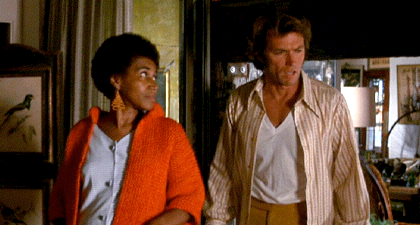
Keep your eyes peeled for an unbilled Clint Eastwood in a bit part behind the oxygen mask as the leader of a squadron of Air Force fighter jets. Eastwood would also have a funny bit part earlier the same year in John Agar’s first sci-fi fright flick, Revenge of the Creature (1955). Eastwood not only gets the opportunity here to upstage John Agar’s Tarantula heroics, for he would also have a much higher profile role 28 years later when Tarantula’s leading lady joined him for her own bit part in Sudden Impact (1983). There Mara Corday plays the waitress who pours way too much sugar into the coffee she serves Eastwood’s Dirty Harry.

People have always wondered why the disease of acromegaly is referred to as “acromegalia” in Tarantula. Beats me. However, the seeming inconsistency of Prof. Deemer’s synthetic nutrient causing infant animals to quickly mature and become giants while the humans that use the nutrient become deformed by acromegaly-type symptoms has usually been written off as a gimmick to include some additional monstrous characters into the story. I think that the writers may have realized that acromegaly is a form a gigantism only enlarging select portions of the body, and that it is an affliction that strikes adults, whereas gigantism that causes enlargement of the entire body begins in childhood. Therefore, it makes sense that the synthetic nutrient causes acromegaly deformities in adult humans while it turns infant animals into giants.
There! Your favorite anal-retentive genius has finally justified that apparent scientific contradiction in this fine film. However, I am still stumped as to why our hero Dr. Matt Hastings literally taste tests a pool of what turns out to be giant tarantula venom. Yuck!