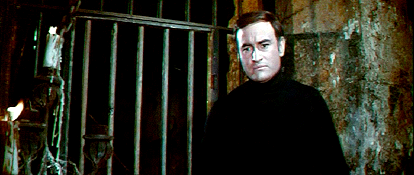
Director: León Klimovsky
Writer: Jacinto Molina (Paul Naschy)
Producer: Salvadore Romero
Cast: Paul Naschy, Gaby Fuchs, Barbara Capell, Patty Shepard (as Paty Shepard), Andrés Resino, Yelena Samarina, José Marco, Barta Barri, Julio Peña, Betsabé Ruiz, Luis Gaspar, María Luisa Tovar, Ruperto Ares, Eduardo Chappa (uncredited), Carlos Aured (uncredited)
Elvira (Gaby Fuchs) and Genevieve (Barbara Capell) are two college students traveling in Northern France doing research for their thesis. They are looking for the tomb of Countess Wandesa Dárvula de Nadasdy (Patty Shepard), a notorious 11th-century Hungarian rumored to be a witch and a vampire that drank the blood of the virgins she killed. The two students happen to meet reclusive writer Waldemar Daninsky (Paul Naschy). He agrees to help them find Countess Wandesa’s tomb while they stay at his country house. Daninsky is suffering from a werewolf curse and believes that finding the tomb can help him end his affliction. When the remains of Wandesa are discovered, the vampire countess is accidentally revived just before Walpurgis Night when her master Satan’s power will be at its peak.
The Flashback Fanatic movie review
Paul Naschy’s werewolf character, Waldemar Daninsky, had already appeared in four previous films. After the character’s successful debut in Frankenstein’s Bloody Terror (1968), aka The Mark of the Wolfman, the next three films suffered many production difficulties and muddled results. In fact, the second Daninsky movie, Nights of the Wolfman (1968), was supposedly never completed and is considered a lost film.

The Daninsky-Werewolf films were not a series in the normal sense. Many of the films often introduced the character with a new origin for his lycanthropy affliction and the stories could take place in different settings and eras. Many consider Walpurgis Night a sequel to The Fury of the Wolfman (1970/released 1972?). However, that previously made film was released at least a year later and only shares a couple details with Walpurgis Night, which was released in the US as The Werewolf vs. the Vampire Woman. As in other Waldemar Daninsky films, there is no specific movie series continuity adhered to in this story. We are introduced to the Daninsky character as a corpse lying in a morgue with two silver bullets in his chest. Although Daninsky had been killed in earlier films, this story is not necessarily an actual sequel to any of them.

The pentagrams finally all seemed to be in alignment for Walpurgis Night. It was the box-office hit that finally made horror hot in Spanish cinema. It would be the most successful film in actor/screenwriter (and later director) Paul Naschy’s vast filmography.

Here Naschy works for the first time with the reliable and versatile director León Klimovsky. Following the suggestions in Naschy’s script, Klimovsky shot slow motion sequences for the vampires that add a dreamy, mystical atmosphere to the film. It has been suggested that this may very well have influenced director Amando de Ossorio’s similar technique for the blood-drinking specters in his famous Tombs of the Blind Dead (1972) and its sequels. The Blind Dead series’ creatures also look quite similar to the zombie monk seen in Walpurgis Night.

What is always of interest to this Paul Naschy fan is the recurrence of Naschy’s particular tropes in his stories. Naschy’s scripts often have the character he plays getting it on with at least one beauty he meets in the story. That’s always a nice perk for a screenwriter starring in his own films. As is also usually the case, here the attraction is almost immediate and declarations of love and sex soon follow.


This film also includes the Naschy trope of the violent rural dweller (Luis Gaspar) accosting Naschy’s hero. It seems practically every time one of Naschy’s characters gets away from the hustle and bustle of the city, he ends up being assailed by at least one dangerous country ruffian that just happens to drop in for no good reason. I wonder if that reflects some deep-seated resentment of what Naschy may have considered a rustic Spanish mindset that might have impeded the acceptance of the horror films that Naschy wanted to make. At that time Spain’s Francisco Franco regime decreed that Spanish films should be devoted to portraying traditional Spanish culture and values in a positive light. This stifled a lot of genre films, especially horror, from being made in Spain, unless the stories were set in other countries.
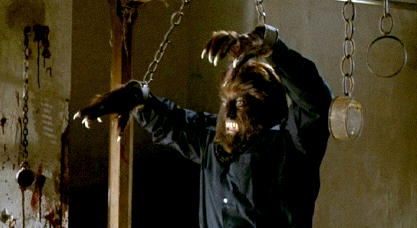
In a nod to the monster mash inspirations from the Universal Pictures of his youth, Naschy provides that favorite trope of multiple menaces in his horror films. Here in Walpurgis Night, we not only have a werewolf and a vampire to deal with; we also get that vampire’s ancient monk ally (Eduardo Chappa) rising from the dead, a victim of the vampire becoming another vampire, a dangerously unhinged handyman (José Marco), a vengeful, knife-wielding, country widower, and Waldemar Daninsky’s deranged, breast-fixated sister Elizabeth (Yelena Samarina) attacking his nubile guests.

All of these offbeat characters enliven a simple story with one-dimensional characters. That simplicity enhances the often-dreamlike feel of the film, but there are no characters of much dramatic interest here. This film is chiefly an exercise in supernatural situations and atmosphere.

Of course, Naschy once again effectively vents his werewolf animosity. That is in great contrast to the subdued and controlled manner of his human side. It is only in close ups of Naschy that we see subtle flickers of emotion register on his stoic features. As Waldemar Daninsky, he conveys certain resignation to his plight as one who is cursed and seeking the release of a permanent death.

Gaby Fuchs is stuck with the film’s second-most thankless role. As Elvira, her character never displays much personality or motivation. She is supposed to be the plot’s major protagonist as a researcher looking for the grave of the vampire Countess Wandesa. She is also the lady that falls for the tragic Waldemar. However, this doomed love angle is never as poignant as it should be due to the thin characterizations of both Elvira and Waldemar. Although it is often difficult to judge the effectiveness of an actor in a dubbed performance, despite being the lead character along with Naschy’s Waldemar, Fuch’s role of Elvira seems to be little more than a plot device.

Elvira’s classmate and friend, Genevieve (Barbara Capell), is a character of no greater depth, but she has a bit of vivacious charm and humor. She also has the interest advantage by indulging in vampire shenanigans after the Countess puts the bite on her.

Patty Shepard had appeared as a different character in an earlier Daninsky film Assignment Terror (1970), aka The Monsters of Terror. In Walpurgis Night her Countess Wandesa would be another of those proponents for lesbian vampirism becoming all the rage in 1970s horror films. According to Paul Naschy, Shepard regretted taking the part, but it is probably the one she is most remembered for. Patty Shepard really looks great in her very limited role. With her enigmatic, pale beauty draped in wispy, black veils, her character has a great spectral presence. Her vertical rise from her tomb late in the story is probably my favorite shot in the entire film. There is something about that simple feat that seems truly supernatural.

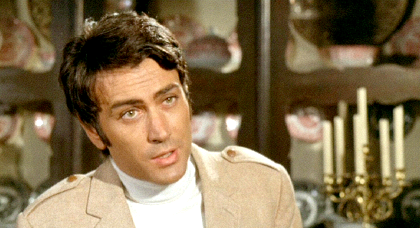
If you are still wondering who has this film’s most thankless role, you are to be congratulated for hanging on my every word. Of course, since Elvira is the second-most thankless role here, it stands to reason that Andrés Resino, as her boyfriend, Inspector Marcel, would take top prize for the most thankless role in Walpurgis Night. He is not only ineffectual, he also gets passed over by his girlfriend for a werewolf with a death wish who lets his loony sister run about unsupervised to grope her. In fact, Marcel is the plot device that enables Elvira’s character (who is barely more than a plot device herself) to have someone to relay the exposition to regarding the Countess Wandessa history for the benefit of the audience. Resino looks like he is actually delivering his lines with some conviction; despite the sometimes-awkward English dialogue dubbing he receives.
Regardless of any nits to pick, Euro-horror buffs and Paul Naschy fans will find Walpurgis Night to be essential viewing. Paul Naschy himself was initially underwhelmed with his first viewing of the film, as he considered director Klimovsky more of a craftsman than an artist. But Naschy did appreciate the film’s most effective sequences and later took pride in Walpurgis Night energizing Spanish horror film production in the 1970s.

I have to believe that part of this film’s record-setting box office performance in Spain was due to some happy accident of timing. Spanish filmmakers had been dabbling in horror for most of the 1960s, yet those productions seemed to find greater success in other countries. In 1971 it seemed that many Spanish moviegoers were finally ready to succumb to the lurid allure of homegrown horror. Paul Naschy was just the right guy to feed their fright flick fever.