Showing posts with label Peter Cushing. Show all posts

Friday, December 13, 2024

TALES FROM THE CRYPT (1972)

Director: Freddie Francis

Writers: Milton Subotsky adapting EC Comics stories by Al Feldstein, Johnny Craig, and Bill Gaines published in Tales from the Crypt and The Vault of Horror

Producers: Milton Subotsky, Max Rosenberg

Cast: Ralph Richardson, Joan Collins, Peter Cushing, Ian Hendry, Richard Greene, Barbara Murray, Robin Phillips, Nigel Patrick, Patrick Magee, Roy Dotrice, Chloe Franks, Martin Boddey, Oliver MacGreevy, Susan Denney, Angela Grant, David Markham, Frank Forsyth, Geoffrey Bayldon, Robert Hutton, Peter Fraser, Manning Wilson, Irene Gawne, Stafford Medhurst, Clifford Earl, Edward Evans, Hedger Wallace, George Herbert, Harry Locke, Jane Sofiano, Peter Thomas, Tony Wall, John Barrard, Robert Rietti (uncredited radio voice)

Five strangers on a tour of a graveyard’s catacombs become separated from the rest of the group and are trapped in a weird stone chamber. They meet a grim, old man (Ralph Richardson) garbed in a hooded robe who shows his apprehensive guests their awful fates.

The Flashback Fanatic movie review

During the 1960s and 1970s, Amicus Productions were the leading contender for British horror movie supremacy against Hammer Film Productions. Amicus seemed to have the most success with their portmanteau format. Amicus produced seven such horror films that each contained multiple stories united by a wraparound narrative.

Of all the Amicus anthology films, Tales from the Crypt is probably the most famous and perhaps the most effective. Each yarn in this film is adapted from a surefire source for this type of material: the infamous, American, 1950s EC Comics series Tales from the Crypt and The Vault of Horror. Each issue of those publications had a similar format of multiple short stories narrated to the reader by ghoulish hosts.


Tales from the Crypt’s fearsome fables are off to a festive start with “And All Through the House.” The drop-dead gorgeous Joan Collins plays Joanne Clayton, a murderous wife caught up in the holiday hustle and bustle of tidying up her Christmas Eve crime scene at the same time a lunatic (Oliver MacGreevy) wearing a Santa Claus costume is trying to break in. There is a perversely cozy, yuletide atmosphere throughout this segment as traditional Christmas carols play on the living room radio while Collins’ cold-blooded beauty takes the time to open the gift from her husband she has just killed before she gets to work staging things to look like an accident. More carols play as she is forced to multi-task between corpse-clean up and locking out the psychotic St. Nick. It is even more perverse in that the murderess is shown to be a loving mother.


The next story has me empathizing a bit with the bad guy. In “Reflection of Death,” Ian Hendry plays family man Carl Maitland who is running away for a new life with his mistress (Angela Grant). There is not a lot of time to flesh out his character, but, in just a few scenes, we see that there is emotional pain and guilt suffered by Hendry’s adulterer abandoning his wife and children. This, more than any other story, makes us realize what a badass fate can be.

Tales from the Crypt does holiday double-duty with “Poetic Justice.” Robin Phillips plays James Elliot, perhaps the most despicable character in the film. He is a young, upper-crust snob obsessing about Arthur Grimsdyke, the kindly, elderly man living across the street. James thinks that the frugal, old rubbish collector and his modest home drive down the property values in the neighborhood. So, James enjoys conducting a secret campaign of harassment meant to drive old Grimsdyke away. Things take a really nasty on Valentine’s Day. Peter Cushing is simply heartbreaking as poor, put-upon Grimsdyke. This is one of my favorite performances by this great actor.


“Wish You Were Here” begins with ruthless businessman Ralph Jason (Richard Greene) and his beautiful wife, Enid (Barbara Murray), facing financial ruin. The Jason couple is contemplating which of their expensive possessions to start selling when they notice the inscription on their old, Chinese statuette. It says that the relic can grant its owner three wishes. Despite Ralph’s reservations, since this situation is eerily similar to that in the classic horror story “The Monkey’s Paw,” Enid makes a wish. That’s when the troubles for the Jason couple really begin.

The final fate that Ralph Richardson’s baleful Crypt Keeper relates is called “Blind Alleys.” It concerns Retired Army Maj. William Rogers (Nigel Patrick) taking over the directorship of a retirement home for blind men. The selfish Rogers spends lavishly on himself from the meager budget allowed the rest home, while the residents have to make due with bad food, poor heating, and not enough blankets. In the role of the blind George Carter, Patrick Magee is the spokesman for his fellow, neglected residents. Magee was a frequent performer in many British genre films. He could be quite unsettling, as he is here. This time, in particular, he has every right to be.

Director Freddie Francis already had plenty of expertise directing fright flicks for Amicus and Hammer. Although Francis did not want to be stuck in the horror rut as a director, he certainly had the knack for this nasty niche. In Tales from the Crypt, he is at his absolute best. Each simple story is just long enough to establish the characters and their situations while never seeming rushed. I suppose that the original comic book stories were almost a storyboard for this film, but Francis knows just how to stage and shoot things effectively. Many creepy sequences play out in purely visual terms with just the right succession of shots effectively building to horrific and ironic climaxes.

Much of the credit for these tight narratives should be given to the original EC Comics stories. The fact that producers Milton Subotsky and Max Rosenberg were Americans probably explains why a British film would be based on the 1950s American horror comics, which were being rediscovered and appreciated in the ’70s.

As has been noted by many others, despite the transgressive acts depicted in horror stories, such narratives often express a very strong morality. That was certainly the case of the once unfairly maligned EC Comics. Those tales were both nasty and satisfying with their ironic justice dealt to evildoers. It is just that kind of cold comfort that makes this film such a satisfying concoction for those who enjoy the morbid mixed with their mirth.

One aspect of this film I appreciate is how it allows its flawed main characters to show little touches of humanity. Each of the five tourists trapped in the crypt become the unethical protagonist of a separate story that The Crypt Keeper tells them. Yet despite the short time allotted to each tale, the film makes us relate to each protagonist as a human being rather than just a hissable villain. Okay, so maybe the vindictive, young snob James Elliot has us hating his guts, but it is hinted that he does have some sense of guilt. Even the selfish and inhumane Maj. Rogers loves his dog. Details like these drive home the moral point that real people can do awful things, so maybe we should examine some of our own choices and motives. All of the regrets and sentiments in people still do not excuse their cruelty.

Sunday, January 28, 2024

THE CREEPING FLESH (1973)

Director: Freddie Francis

Writers: Peter Spenceley, Jonathan Rumbold

Producer: Michael P. Redbourn

Cast: Peter Cushing, Christopher Lee, Lorna Heilbron, George Benson, Kenneth J. Warren, Jenny Runacre, Duncan Lamont, Robert Swann, Harry Locke, Hedger Wallace, Catherine Finn, David Bailie, Michael Ripper, Maurice Bush, Tony Wright, Marianne Stone, Alexandra Dane, Dan Meaden, Larry Taylor, Martin Carroll, (and uncredited cast) Sue Bond, Josie Grant, Lewis Alexander, Reg Thomason, Fred Wood 

In 1894, Professor Emmanuel Hildern (Peter Cushing) returns from his New Guinea expedition to his London, England estate. Hildern has brought back a giant, humanoid skeleton he has excavated that is much older and more advanced than any previously discovered remains of primitive man. As Hildern uses water to start cleaning his find, he notices that flesh begins to grow on one of the skeleton’s fingers. It is Hildern’s belief that the folklore of the New Guinea people describes a day in the future when the skeletons of these ancient beings would be unearthed by natural soil erosion and that their flesh would be regenerated by rain. He also speculates that these beings were the living source of the world’s evil and that a vaccine can be derived from the creeping flesh to inoculate mankind against evil itself. 

The Flashback Fanatic movie review 

Tigon British Films Productions was the company that produced some quirky horror films to compete against the popular product from Britain’s venerable Hammer Films. At first glance, Tigon’s The Creeping Flesh appears to be creeping through the same Gothic horror territory that was Hammer’s usual domain. It is not only set in late 19th-century London, it has past Hammer director Freddie Francis, it stars Hammer legends Peter Cushing and Christopher Lee along with a bit part for Hammer’s ubiquitous character actor Michael Ripper, and it even employs Hammer’s renowned makeup artist Roy Ashton. 

Tigon’s distinction from the Hammer standard was their attitude. Their films seemed to be channeling some of the modern pessimism that was becoming the norm in horror films. While Hammer films would typically end with evil defeated and order being restored, Tigon’s horror stories would often finish up by annihilating the main characters or leaving them probably permanently traumatized. Tigon’s terrors usually did not end with a note of triumph and relief but with a sense of ongoing dread and despair. That is certainly the case with The Creeping Flesh, which also concludes ambiguously to leave us pondering two interpretations of the eerie tale that we have been told. 

One reason I enjoy some Victorian era horror films so much is that they demonstrate the seamy side of the human condition despite the repressive mores of those times. While the lower class is shown to be rife with illicit behavior, we often see the affluent slumming among them to indulge in their own vices. Members of the refined upper crust are often hypocritical, selfish, and unethical. Their status and ambitions may be more important than honesty and humanity. 


No one can better portray the opposing sides of that British, upper class dynamic than Peter Cushing and Christopher Lee. Their characters are dealing with madness in different ways. Cushing’s Emmanuel Hildern is an altruistic scientist trying to expand man’s knowledge and, as a result of his latest find, trying to cure the human race of evil. Lee’s cold-blooded James Hildern is trying to research and treat insanity using the inmates of his asylum as human guinea pigs. 


Their characters’ flaws are responsible for the rash actions that trigger a potential pandemic of evil and insanity. As half-brothers, Cushing’s Prof. Emmanuel Hildern and Lee’s Dr. James Hildern have a very strained relationship. James has always resented the status Emmanuel had and the kudos he has received for his research. Now, James has established his own more stable success as an asylum director and seeks to further show up his older sibling by claiming an award for his own line of research. Emmanuel is not only stressed by the financial strain of his estate having been neglected during his expeditions, he also has been concealing the shame of his unfaithful wife (Jenny Runacre) going mad and being committed to his half-brother’s asylum. It is James’ jealous, amoral ambition and Emmanuel’s emotional trauma that drive each man to act rashly, which causes horrific consequences. 

While unscrupulous James Hildern’s only concern is his selfish ego, kindly Emmanuel Hildern has his dutiful daughter Penelope (Lorna Heilbron) to worry about. He fears that there is a chance that his recently deceased wife’s madness could be hereditary. This spurs the good Professor on to administer his anti-evil vaccine too hastily and only results in more madness and violence. Fright flick fans should consider this a happy accident. It gives us a chance to hang out for a while in an East End pub full of buxom wenches ready for fun upstairs when the price is right. This really turns out to be a bloody good time. 

The creepy catalyst for all of the threat in the film is Emmanuel Hildern’s discovery of the remains of a strange being that predates man. As others have pointed out, this is a somewhat Lovecraftian concept that is quite humbling; something else was running the show here on Earth before humans started civilization. Those ancient beings may be restless and awaiting their chance to return and take over again. They may also have played a role in the development of the human species. 


Director Freddie Francis manages to make things appropriately uncanny. He imbues the inhuman skeleton with an actual presence that makes us wary of it. That apprehension is fulfilled as the story builds to another “happy accident” late in the film. Then we are treated to a skull’s-eye-view shot reminiscent of Francis’ work back in 1965 with the Amicus Productions film The Skull. Throughout The Creeping Flesh, Francis uses unusual shot choices, lighting, and film processing effects to portray madness and approaching menace. 

Composer Paul Ferris contributes an unusual score that is perfect for the awe, dread, despair, and madness running rampant in this story. He had also done a very fine score for perhaps Tigon’s most celebrated horror film, Witchfinder General (1968). 

The Creeping Flesh challenges us about whom we should invest with our trust and sympathy. The evil that threatens to infect all of mankind is madness, and that is shown to manifest itself in many different ways in many different characters. We are left to wonder if the madness threatening to destroy mankind is of inhuman origin or has always been living within all of us. Ultimately, we are also left with the unsettling notion that the truly inspired and benevolent minds may just be coping with their own obsessions and, as a result, may not offer us any real solutions. Unfortunately, it also seems that mankind is usually not ready for solutions if they can keep getting short-term gains by making the same mistakes. That seems to be a madness without any cure.

Sunday, January 15, 2023

THE SKULL (1965)

Director: Freddie Francis

Writers: Milton Subotsky, based on Robert Bloch’s story “The Skull of the Marquis de Sade”

Producers: Max J. Rosenberg, Milton Subotsky

Cast: Peter Cushing, Christopher Lee, Patrick Wymark, Peter Woodthorpe, Jill Bennett, April Olrich, Maurice Good, Nigel Green, Patrick Magee, Michael Gough, George Coulouris, Frank Forsyth, Anna Palk, Paul Stockman, George Hilsdon, Jack Silk 

In London, England, author Christopher Maitland (Peter Cushing) collects strange artifacts used for research in his writings about the occult. Anthony Marco (Peter Wymark), the rather shady procurer of many of Maitland’s curios, presents the writer with the opportunity to own something really special: the skull of the notorious 19th century French author and nobleman the Marquis de Sade. Maitland soon falls under the skull’s frightening influence. 

The Flashback Fanatic movie review

The Skull is not only a change of pace from the anthology horror films that Britain’s Amicus Productions are best known for, it remains a unique tale of possession. The story is simple and the main cast is small. A lot of time is spent in the head game that the skull is playing with Peter Cushing’s character Christopher Maitland. This results in many dialogue-free stretches of surreal and eerie events that confuse and terrify Maitland as he is being brought under the skull’s evil control.

This was the first of the Amicus Productions fright flicks based on the writings of Robert Bloch. Of course, Bloch will always be best known as the writer of the novel Psycho that was adapted into Alfred Hitchcock’s classic 1960 film. Bloch would adapt many of his short horror stories for the scripts of three later Amicus anthology films. This time around, one of his tales is the basis for an entire film. Oddly, he did not write the script himself. 

Perhaps the lack of Robert Bloch’s further involvement resulted in a rather troubled production. It seems that the original short story‘s adaptation did not provide enough incidents for a feature-length film. Director Freddie Francis is supposed to have reworked co-producer Milton Subotsky’s script. Then there had been a lot of rearranging of scenes in the editing room as Subotsky was second-guessing just how to put the final narrative together. 

Fortunately, the final product resulted in a stylized descent into possession told almost entirely from the perspective of Christopher Maitland. This is almost a one-man show with the great Peter Cushing. Although he may have an ethical lapse ignoring Marco’s means of providing occult artifacts, Cushing’s Maitland appears to be a decent person, so his fate seems undeservedly tragic and that makes the skull all the more diabolical. 

Joining Cushing is Christopher Lee in a featured role as fellow artifact collector Sir Matthew Phillips. He tries to warn Maitland about the evil threat the skull of the Marquis de Sade poses. The often aloof and commanding Lee seems rather vulnerable here and earns our sympathy while always appearing dignified. 


The Skull is a casting delight for fans of British horror films. Beyond the teaming of Cushing and Lee, there are many other familiar faces from the genre such as Michael Gough, Nigel Green, Patrick Magee, Patrick Wymark, and George Coulouris. Of special notice is Peter Woodthorpe as the seedy landlord Bert Travers. Besides Peter Cushing, he is my favorite performer in the film. He is immediately unlikable and seems almost as disreputable as his sleazy hypnotist Zoltan in The Evil of Frankenstein (1964), another Freddie Francis-directed/Peter Cushing-starring production. 


Director Freddie Francis dealt with horror quite a bit for both Amicus and their rival Hammer Films. He brings a lot of inventive visual style to the intimate terror experienced by Cushing’s character. Francis manages to make the skull as much of a personality as the characters portrayed by the flesh-and-blood actors.

As in “The Man Who Collected Poe,” another of Robert Bloch’s stories featured in the later Amicus anthology film Torture Garden (1967), the message here seems to be a warning about the dangers of collecting mania. Although I am a devil-may-care chap, I am certain that my film fetishism is perfectly harmless. I only acquire evermore movies and memorabilia to rouse my cinema enthusiasm and share it with others. Now, what’s the harm in that? However, I will admit that I would kill to get a print of The Man Who Could Cheat Death (1959) with the long-missing topless Hazel Court footage.

Thursday, December 22, 2022

CASH ON DEMAND (1961)

Director: Quentin Lawrence

Writers: David T. Chantler, Lewis Griefer, adapted from Jacques Gillies’ teleplay The Gold Inside

Producers: Michael Carreras, Anthony Nelson-Keys

Cast: Peter Cushing, André Morell, Richard Vernon, Norman Bird, Kevin Stoney, Barry Lowe, Lois Daine, Edith Sharpe, Alan Haywood, (and uncredited cast members) Charles Morgan, Jimmy Cains, Vera Cook, Paddy Smith, Fred Stone, Gareth Tandy, Graham Tonbridge

Harry Fordyce (Peter Cushing) is the fastidious, unsentimental manager of the Haversham, England branch of the City & Colonial Bank. As the bank opens on December 23rd, Colonel Gore Hepburn (André Morell) arrives from the bank’s insurance company to inspect security. Once alone with Fordyce, Hepburn reveals that he is actually there to coerce Fordyce into helping him rob the bank or Hepburn’s accomplices will kill Fordyce’s wife and son.

The Flashback Fanatic movie review

Cash on Demand is Hammer Films’ 1961 variant on Charles Dickens’ classic A Christmas Carol. It is rather fitting that the British studio that had just begun making a name for itself by revamping classic horror with their versions of Frankenstein and Dracula would dabble in an update on the classic Christmas comeuppance tale.

Cash on Demand is not a true modern remake of Dickens’ story, but it certainly shares the same sentiments while exchanging the supernatural for a criminal threat. Harry Fordyce is another office tyrant that receives his dose of holiday terror not from spectral visitations but from a cunning fiend that threatens everything he holds dear. Fordyce’s cold and efficient facade is cracked by the danger to his wife and child that forces him to assist Hepburn in the bank robbery.

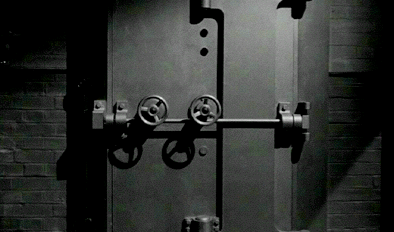
The film opens with a leisurely series of panning shots throughout the empty interior of the bank just before it opens for the day’s business. This unusual and uneventful introduction manages to raise our anticipation. We are made to pay attention to the mundane setting that normally would just be a place where business is conducted attracting no interest at all. The uneasy music score that accompanies this while the credits are shown is far more effective than a rapid-fire series of quick cuts and CGI graphics meant to pass the time until the action begins, which is how so many films must present non-plot moments beginning a film these days. We are given time to get a feel for the environment where this entire story will occur.

There is nothing exotic to see in this bank branch setting. However, it’s reality and our intimacy with it is vital to increasing our sense of immediacy about the situation, the characters, and the stakes involved. One hardly expects anything other than the sedate business of a small town bank to occur here. That makes the contrast of the sudden introduction of the sinister all the more riveting. The fact that most of the film takes place in real time during the first hour that the bank opens for business further stresses the immediacy of everything that happens.

One could refer to all of the above business about this film’s stage setting as a less-is-more approach. That is certainly not the case when it comes to the performances of the two leads. Peter Cushing and André Morell are terrific. Cushing and Morell had starred opposite each other two years earlier as Sherlock Holmes and Dr. Watson, respectively, in Hammer Films’ The Hound of the Baskervilles (1959). The dynamic between these two actors is much different this time around.

Peter Cushing, of course, was a mainstay of Hammer’s many Gothic horror films by this time. Here he is neither villain nor hero. As bank branch manager Harry Fordyce, he is the Ebenezer Scrooge stand-in that first earns our amused contempt and then becomes pathetic and sympathetic as the unwilling accomplice in a criminal’s cruel robbery plot.

André Morell is a sinister joy to watch as Colonel Gore Hepburn. He dispenses amiable charm and wit while reveling in the power he wields over the stuffy Fordyce. He takes sadistic satisfaction in making Fordyce squirm. Hepburn not only makes Fordyce aid him in the robbery of the bank Fordyce takes so much professional pride in, he also tweaks Fordyce’s coldness and lack of Christmas spirit. Hepburn is a fiend, yet he does have more social graces than his bullied victim.


Hammer Films' bread-and-butter was not only their Gothic horror films, but also their adaptations of radio and television productions. A 1960 teleplay, The Gold Inside, was the basis for this film. That production also starred André Morell with Richard Vernon also in the role of the head bank clerk Pearson. The teleplay’s director, Quentin Lawrence, is carried over here, too. He had helmed another of my all-time favorite British thrillers that he also originated on television: the sci-fi horror flick The Trollenberg Terror (1958), re-titled The Crawling Eye in the US.

So, if you have enough neckties, socks, and ugly sweaters, ask for some Cash on Demand this Christmas. Just remember that this much suspense won’t fit in a money holder card. It will take at least four suitcases.

Tuesday, August 24, 2021

HORROR EXPRESS (1972)

Director: Eugenio Martín

Writers: Arnaud d’Usseau, Julian Halevy

Producer: Bernard Gordon

Cast: Christopher Lee, Peter Cushing, Telly Savalas, Alberto de Mendoza, Sylvia Tortosa, Julio Peña, Helga Liné, Alice Reinheart, Ángel del Pozo, George Rigaud, Victor Israel, José Jaspe, Faith Clift, Juan Olaguibel, Barta Barri, Peter Beckman, Hiroshi Kitatawa, Vicente Roca, José Canalejas, Allen Russell, José Marco 

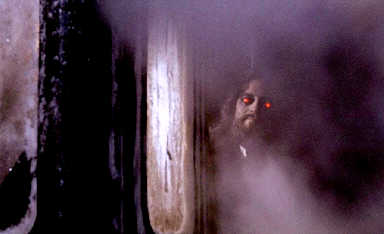
In 1906, British anthropologist Professor Sir Alexander Saxton (Christopher Lee) discovers the frozen remains of a prehistoric ancestor of man in China. He packs his find in a crate and hauls it back to Shanghai. There he loads it aboard the Trans-Siberian Express to return to Europe. However, Saxton’s “fossil” is alive, and its encounters with people leave them dead with blank, white eyes. 

The Flashback Fanatic movie review

Horror Express is a quirky Spanish production that takes you on a strange ride. Just when you think you know where it is going, it veers off in another direction keeping it lively and unpredictable. Its mix of mystery, science fiction, and horror aboard a passenger train traversing the frozen expanse of Siberia provides a unique tale in an interesting and isolated setting.

This film’s story is supposed to be inspired by the classic John W. Campbell 1938 science fiction horror tale “Who Goes There?” That was the source for one of the greatest sci-fi fright flicks of all-time, The Thing from Another World (1951), and John Carpenter’s 1982 remake The Thing. There was even a 2011 prequel to the Carpenter film that was also called The Thing. Although Horror Express shares some basic ideas with the original novella, it also contributes plenty of other novel touches making it a very satisfying and offbeat film. 

The film boasts stars Christopher Lee, Peter Cushing, and Telly Savalas. As Professor Saxton, Lee manages to do that British stiff upper lip, upper class arrogance better than anyone, yet somehow still manages to be heroic. Peter Cushing is Lee’s genial counterpoint as Dr. Wells. He also gets the funniest line of the film. As the ranting and brutal Cossack officer Captain Kazan, Savalas steals every scene he is in. 


Another standout in the cast is Alberto de Mendoza. He plays the monk Father Pujardov. His character demonstrates how easily the spiritually devout can lapse into evil fanaticism. 

There are two beauties in the cast that would both go on to co-star in another Spanish fright flick The Loreley’s Grasp (1973). Silvia Tortosa plays Irina Petrovski, the wife of an elderly Polish count. Apparently with her husband’s blessing, Irina seems to be openly enjoying the chance to flirt and flaunt herself before Professor Saxton, especially to rouse the ire of the Petrovskis’ spiritual advisor Father Pujardov. Frequent Euro-horror siren Helga Liné briefly appears as the stowaway Natasha. I first encountered Liné in this film, which plays no small part in it becoming a favorite Euro-horror of mine. With her graceful figure, auburn hair, and green eyes, her beauty is so striking and her demeanor so smoldering, that I have to believe that anything she appears in is worth watching. Before drool shorts out my keyboard, I had better move on… 


I want to refrain from discussing too many particulars about the menace in this movie and how it functions. The fun in this story is discovering those strange turns along with the characters. It could be argued that in a microscope examination by Professor Saxton and Dr. Wells that they all too quickly find exactly the needed images to tell them the origin of the threat they are dealing with. In the interests of keeping the story moving, it is excusable. We don’t want to watch hours of slide preparations before they arrive at the same conclusion, do we? Of course not, there would be less time for an already too limited amount of Helga Liné footage! Oops! Got to wipe off my keyboard again… 

John Cacavas provides a nice score that is melancholy and haunting, but can provide some horror stings when needed. An interesting idea is that the main theme of the movie is also a tune whistled by the baggage man (Victor Israel) that is learned and repeated by the movie’s menace. 

Director Eugenio Martín provides some eerie images throughout the film, and he makes fine use of the train car set and miniatures from his earlier film Pancho Villa (1972) that also starred Telly Savalas. I wish Martín had directed many more horror films. He did return to the genre the following year with A Candle for the Devil, aka It Happened at Nightmare Inn (1973). 

For the well-traveled horror buff, speeding through the frigid wastes of Siberia aboard Horror Express is a trip that can’t be missed. Horror heroes Christopher Lee and Peter Cushing sharing a compartment with Helga Liné in her slinky green dress is such fine company that being menaced by an unpredictable monster seems to be a perfectly reasonable risk. Need I say it again? Helga Liné! My keyboard can’t take much more…

STANLEY (1972)

Director: William Grefé Writers: Gary Crutcher, William Grefé Producer: William Grefé Cast: Chris Robinson, Alex Rocco, Steve Alaimo, Ma...