Showing posts with label thriller. Show all posts

Sunday, March 29, 2026

THIRTEEN WOMEN (1932)

Director: George Archainbaud

Writers: Bartlett Cormack, Samuel Orniz adapting the 1932 novel by Tiffany Thayer

Producer: David O. Selznick

Cast: Irene Dunne, Myrna Loy, Ricardo Cortez, Jill Esmond, Peg Entwistle, Mary Duncan, C. Henry Gordon, Kay Johnson, Florence Eldridge, Harriet Hagman, Edward Pawley, Wally Albright, Blanche Friderici, Lloyd Ingraham (uncredited), Phyllis Fraser (cut scenes), Betty Furness (cut scenes)

Ursula Georgi (Myrna Loy) is a Eurasian beauty with the mystic ability to force her will on others. She has controlled an astrologer, the Swami Yogadachi (C. Henry Gordon). He had made horoscopes for twelve sorority sisters who were Ursula Georgi’s American finishing school classmates. Georgi forges new horoscopes from the swami and sends them to each of the sorority sisters. Each of the mailed horoscopes now predicts doom and seems to compel each of the women receiving them to perform self-destructive acts.

The Flashback Fanatic movie review

Myrna Loy probably found her greatest film fame as half of the crime-solving couple of Nick (William Powell) and Nora Charles in The Thin Man (1934) and its five sequels. Prior to that, she had been fighting typecasting as exotic, non-American vamps. Her most notorious role was as the depraved daughter of Boris Karloff’s diabolical criminal genius Dr. Fu Manchu in The Mask of Fu Manchu (1932). Just one month before that film’s release, Loy appeared as the sensuous and sinister Eurasian Ursula Georgi in Thirteen Women.

Loy’s performance is restrained, yet she commands every scene she is in; you just can’t take your eyes off her. Her lovely features are suitably enhanced with exotic eye makeup that suggests her mysticism and hypnotic power. During the film’s climax when she is venting about her backstory and grievance that provide her murderous motive, Loy’s performance still maintains enough dignity that we can empathize a bit with her.

At first glance, it may seem that this is just another foreign stereotype of Asian villainy being set up as a film baddie. But this movie eventually reveals how the casual cruelty of American attitudes about class and race cause this foreigner to strike back. That oh so American virtue of pulling oneself up by their bootstraps did not spare the Ursula Georgi character from being ostracized due to the desperate circumstances of her impoverished background and “half breed” status.

That final vendetta reveal, as well as the victims-picked-off-one-by-one storyline, is why Thirteen Women has been cited as a precursor to the slasher film. Many vengeance-seeking slasher villains are revealed to have suffered a trauma dealt to them at a young age or in a school setting. But Loy’s Ursula Georgi doesn’t need to bloody her pretty hands when the weapon she wields is the power of suggestion.


The application of that deadly control is rather vague. It seems that the sorority sisters who are targets for Ursula Georgi’s rage are all susceptible to suggestion by the horoscopes of the Swami Yogadachi predicting their fates. Yogadachi’s horoscopes originally foretold happiness for the sorority sisters. As the swami’s secretary, Georgi writes new horoscopes foretelling doom that she sends in his name to her hated former classmates. Due to their faith in the swami’s horoscopes, these women are compelled to behave in ways that assure their downfall. The Swami Yogadachi is one mystic foreigner who, in turn, is under the sway of another, the hypnotically alluring Ursula Georgi. Her mysticism is weaponizing his. We soon meet another man (Edward Pawley) who is practically Georgi’s henchman because he is also similarly smitten with her. Georgi can also command people to instantly fall asleep. Originally, this film tested poorly with audiences and later had 14 minutes cut from it. Perhaps the missing footage explained more about how all this occultism works. It is just as likely that the filmmakers did not bother. American filmgoers would accept mysterious foreigners from exotic places having strange abilities Westerners just can’t understand. However, all this inexplicable mysticism does enable a fitting irony and ambiguity for the film’s climax.

Irene Dunne distinguished herself in screwball comedies and had been nominated for an Oscar five times without winning. She earned her first nomination in her second film, the 1931 Western Cimmaron. The following year Dunne is starring in Thirteen Women as wealthy single mother Laura Stanhope. Of all the victims of Ursula Georgi’s wrath, Laura earns the most of our sympathy as Georgi targets her young son (Wally Albright) for death. Despite this stress, Dunne’s Laura Stanhope seems the most levelheaded of all the potential horoscope victims.

Ricardo Cortez plays the detective investigating the strange series of deaths inflicted by Ursula Georgi. As Police Sergeant Barry Clive, he meets Dunne’s Laura Stanhope, and something tells me he likes what he sees. Cortez had co-starred with Dunne earlier the same year in the drama Symphony of Six Million (1932). He already had an extensive filmography and had played detective Sam Spade in 1931’s The Maltese Falcon, the first film adaptation of Dashiell Hammett’s novel.

This strange thriller’s acts of self-destruction were tragically prescient for an actress portraying one of the doomed sorority sisters. In Thirteen Women, stage performer Peg Entwistle had her only film credit playing the small role of Hazel Clay Cousins. Unfortunately, just one month before the film's premiere, Peg Entwistle would achieve her greatest fame by committing suicide leaping off the top of the famous Hollywoodland sign. Her motive for this tragic act is left unclear by her cryptic suicide note. Such a sad fate for an actress whose stage performance had inspired none other than the great Bette Davis to pursue acting.

If one attributes any significance to karma or superstition, it may come as no surprise that Thirteen Women was unlucky at the box office. In retrospect, this weird film is appreciated as another pre-Code curiosity that was edgy, unconventional, perhaps eventually influential, and now seems to have a reputation verging on cult status.

Monday, November 17, 2025

EYE OF THE NEEDLE (1981)

Director: Richard Marquand

Writers: Stanley Mann adapting Ken Follett’s novel

Producer: Stephen J. Friedman

Cast: Donald Sutherland, Kate Nelligan, Christopher Cazenove, Ian Bannen, Philip Martin Brown, Jonathan Haley, Nicholas Haley, Alex McGrindle, Faith Brook, George Belbin, Barbara Graley, Rupert Frazer, Stephen MacKenna, Arthur Lovegrove, Barbara Ewing, Patrick Connor, John Bennett, David Hayman, Sam Kydd, John Paul, Bill Nighy, Allan Surtees, Rik Mayall

During World War II, England-based Nazi spy Henry Faber (Donald Sutherland) is trying to deliver film to his German handlers. Faber’s information could jeopardize the allies’ D-Day invasion of Normandy. Fleeing the British authorities, Faber steals a boat, gets caught in a terrible storm, and is shipwrecked on Storm Island, off the coast of Scotland. He finds shelter with the family of David and Lucy Rose (Christopher Cazenove and Kate Nelligan) and their young son, Jo (played by twins Jonathan and Nicholas Haley). David is embittered by the loss of his legs in an automobile accident. Ever since, David has been romantically distant from Lucy. The only other inhabitant on Storm Island is Tom, the lighthouse keeper. The lonely Lucy is drawn by the interest that Henry Faber shows in her, and they begin an affair. While cold-blooded spy Faber begins to reveal some humanity to Lucy, he is still intent on his rendezvous with a German U-boat.

The Flashback Fanatic movie review

Based on the bestselling novel by Ken Follett, Eye of the Needle is a terrific thriller that succeeds by becoming more intimate, and therefore more suspensefully intense, as it progresses. The fate of the Free World could be decided by just the chance meeting of two people on opposing sides of World War II who have a spontaneous affair. The story builds believably with plenty of intrigue and drama. One never gets the impression that any characters are doing “movie stuff.” The stakes are high enough without any heroic or villainous posing and outrageous stunts or pyrotechnics. Best of all, the engaging lead performances remind us that emotional needs can cause anyone to take risks.

Donald Sutherland was such an unconventional presence that he could play sympathetic leads, eccentrics, and villains. As Nazi spy Henry Faber, Sutherland affects a relaxed and pleasant facade while mingling with his British co-workers and neighbors. He will revert to his heartless efficiency to kill anyone who endangers his mission. Henry Faber’s codename of “The Needle” is earned by his weapon of choice, a switchblade stiletto. When Faber meets Lucy, we suspect that his initial decency is all just a part of his act. Yet, as Lucy has her first private conversation with him, we see Faber begin to express some genuine feeling. At this point, we realize Faber is starting to bond with someone as he may never have done before.

Kate Nelligan’s Lucy Rose is such a sympathetic and decent person that we don’t resent her having a sexual tryst with a charming stranger behind her bitter husband’s back. She has tried to create intimacy with David Rose, yet he is unable to accept his disability in their relationship. After four years on the remote Storm Island in this hopeless marriage, her unreciprocated need for romantic love seems an understandable provocation for her infidelity. Nelligan’s tender beauty could convince me of anything, yet it is her understated sensitivity in her performance that has us rooting for her every second. She is both sympathetic and genuine.


The suspense in this thriller is both mortal and emotional. Beyond the concerns of whether the German spy Henry Faber can accomplish his mission, we have the intrigue of his affair with Lucy Rose that seems to be exactly what these two people need. However, Faber is concealing his true background from the woman he has very quickly become involved with. As the affair continues, the dynamic keeps changing because of Faber’s mission-related actions. This makes for some uncomfortable and harrowing moments for Lucy in their affair. Despite the gravity of Eye of the Needle’s espionage plot, Stanley Mann’s script and Richard Marquand’s direction zero in on the emotions of Henry Faber and Lucy Rose that drive the story to a conclusion that could decide the outcome of World War II.

Few movies have benefitted as much from a shooting location as this one. The Storm Island setting that the last two-thirds of the film centers on is really striking. It has a raw, pristine beauty with its expanses of green grass bordered by the magnificent cliffs above the restless ocean. It would seem to be a truly idyllic location for romance, but its isolation is also made very apparent and raises the risk for our heroine. This location was actually the Isle of Mull, an island of the Inner Hebrides off the west coast of mainland Scotland. The island was not as desolate as the selective camera angles would have us believe.


Director Richard Marquand also directed the horror film The Legacy (1978) and the thriller Jagged Edge (1985). George Lucas was so impressed with Marquand’s work in Eye of the Needle that he hired him to direct the third produced Star Wars film, Return of the Jedi (1983). Richard Marquand died much too young at the age of 49.

Eye of the Needle is a war film for people who don’t like war films. It has romance, intrigue, danger, and suspense that never strains credulity and challenges us emotionally.

Thursday, March 27, 2025

BERSERK (1967), aka BERSERK!

Director: Jim O’Connolly

Writers: Herman Cohen, Aben Kandel

Producer: Herman Cohen

Cast: Joan Crawford, Ty Hardin, Judy Geeson, Diana Dors, Michael Gough, Robert Hardy, Geoffrey Keen, George Claydon, Philip Madoc, Sydney Taffler, Ambrosine Philpotts, Thomas Cimarro, Milton Reid, Ted Lune, Golda Casimir, Peter Burton, Marianne Stone, Miki Iveria, Howard Goorney, Reginald Marsh, Bryan Pringle

During a performance at The Great Rivers Circus in England, tightrope walker Gaspar the Great (Thomas Cimarro) is killed in a gruesome accident. As a result, circus attendance soars. The steel-willed co-owner and ringmistress of the circus, Monica Rivers (Joan Crawford), appreciates the increase in revenue that the morbid publicity generates. But as more deaths to circus personnel occur, suspicion and fear spread among the circus performers.

The Flashback Fanatic movie review

Once again the team of producer Herman Cohen and his writing partner, Aben Kandel, provide more thrills and chills in 1967’s Berserk. During the 1960s, American filmmaker Cohen’s productions had settled in England, but they were still punching the audience’s panic buttons. The horror Cohen is pitching this time around has a circus setting. Many circus acts serve to pad out the film’s running time and add a lot of production value to make this B-film seem quite lavish. It is the Billy Smart Circus that provides many of the acts we see performed under the big top. Two other British-backed movies were also filmed in this famous venue: Circus of Horrors (1960) and Circus of Fear (1967).

Cohen’s Berserk provides even more spectacle with his chosen star: Joan Crawford. The Oscar-winning actress was entering the twilight of her career, but during the 1960s she had already appeared in a few successful shockers. In 1962’s What Ever Happened to Baby Jane?, Crawford co-starred with another aging Hollywood legend, Bette Davis. That hit film led to the “psycho-biddy” trend of thrillers starring older, established actresses usually playing against type. For horror-meister William Castle, Crawford starred in Straight-Jacket (1964) and I Saw What You Did (1965).

Supposedly, Joan Crawford’s clout prompted a title change for this film. Originally, it was called Circus of Blood, but Crawford suggested Berserk. That was certainly a memorable title that I’ll bet Crawford thought sounded a bit less exploitational. Her title would also keep this film from being confused with the previously made circus-based thrillers. What remains unknown is did Crawford suggest the title with or without an exclamation mark? The onscreen title has no punctuation, yet the posters for the film usually add an exclamation mark. Which is it?! It’s enough to drive this anal-retentive film fanatic berserk!

It seems that no matter what stage her career was at, or the intent of the material she was performing in, Joan Crawford always gave it her all. She did not think that headlining a lurid thriller made her any less of a star. In fact, Crawford quite rightly must have felt that her name was lending these productions a lot of prestige. She also thought that her fans must always perceive her as a star. Therefore, she had to give them a performance worthy of a star. In addition to her ballyhoo as the ringmistress announcing the acts and her take-charge demeanor with circus employees, Crawford deftly delivers a few saucy one-liners and subtle expressions that display her character’s worldly confidence.

Joan Crawford seems simpatico with her role in Berserk. Crawford was determined and relentless in achieving and maintaining her stardom. She channels that same resolve into her performance as the head of the circus that is the story’s setting. Her Monica Rivers is rather opportunistic about the bizarre death of her tightrope performer that has resulted in very profitable notoriety for her circus. Monica also demands that the show must go on, and it seems that her commanding presence is all that keeps the circus folk in line despite their paranoia. There are not a lot of shadings to her character or any others in this film, yet there is some ambiguity about them, which is appropriate in a mystery yarn.

For this horror fan, and a devotee of producer Herman Cohen’s flicks in particular, another name in this cast that gets my attention is Michael Gough. With Joan Crawford’s star power taking center stage, Gough is left with a supporting role instead of the villainous main attraction he had provided to distinguish Cohen’s previous Horrors of the Black Museum (1959), Konga (1961), and Black Zoo (1963). I find it quite interesting that Gough’s usual dominant and heartless role in a movie relationship is reversed in Berserk. Here his Albert Dorando is the subordinate and lovelorn business partner to Crawford’s Monica Rivers. Actor Gough performs an amusing about-face having the decency to criticize Crawford’s character for being cold-blooded about the tragedy that took the life of a circus performer. But fear not, Gough fans! The great Michael Gough’s vile villainy would be redeemed in the next Joan Crawford-starring Herman Cohen fright flick, Trog (1970).

Ty Hardin had starred as the hero on the ABC television network Western series Bronco (1959-62). Here Hardin plays hot-tempered Frank Hawkins, the handsome replacement for the deceased Gaspar the Great. Hawkins is suspect for not only conveniently showing up to replace the just-killed high-wire artist, he also is pretty deliberate about putting the moves on Monica Rivers. His proposition to become her business partner in the circus makes him appear up front about his ambitions, yet he still seems rather suspicious. While Hawkins acts frustrated with Monica’s reserve in their potential romance, we wonder if his urges are driven more by profit than passion.

The sexy standout in Berserk is Diana Dors. Once groomed to be the British alternative to Marilyn Monroe, Dors provides plenty of sparks to justify her blonde bombshell status. As Matilda, the assistant to the magician Lazlo (Philip Madoc), she is the circus sexpot and troublemaker. Whether she is trying to seduce the Magnificent Hawkins, badmouthing the magician she lives with, spreading malicious gossip, or getting into catfights, Matilda is probably my favorite character in Berserk. Any bodacious babe who drops by with notions of nookie in her noggin and brings her own booze is still a class act in my book.


Judy Geeson shows up as Angela Rivers, Monica’s just-booted-from-boarding school daughter. Angela’s reunion with her mother serves to soften the edges of the Monica Rivers character, making the hard-nosed circus owner a bit more sympathetic. This also seems to be following the Herman Cohen formula for having youthful characters prominent in his horror films.


Like many giallo films, or the slasher films that they would inspire, Berserk has us playing the whodunit guessing game. The oh so dapper Detective Supt. Brooks makes sure that we are mulling over the various suspects. As was often the case in Cohen’s films and horror movies in general, the officers of the law are diligent but largely ineffectual. Nevertheless, I enjoy Robert Hardy’s smooth assurance as Brooks. He convinces us that having him tag along with the Rivers Circus should reveal the killer. In the meantime, Brooks displays the smoothest fast draw I’ve ever seen when lighting Monica’s cigarettes. Although some may regard the police procedural antics as just padding, I appreciate that the authorities dealing with fright flick atrocities are often out of their depth. This lends a lasting sense of chaos and unease to the proceedings.


Ultimately, Berserk is simply a showcase for Joan Crawford that kills time with circus acts and squabbles between the murders. Fully enjoying the film requires one to appreciate being part of that circus lifestyle for an hour and a half. I am all too happy to settle for this vicarious video experience. Although my immaturity means that I am never too old to consider running away to join the circus, unless I could land a sideshow gig as the Great Couch Potato, I would probably end up pounding tent stakes and shoveling up elephant droppings.


Monday, January 6, 2025

THANK YOU, MR. MOTO (1937)

Director: Norman Foster

Writers: Willis (later Wyllis) Cooper, Norman Foster adapting John P. Marquand’s novel

Producer: Sol M. Wurtzel

Cast: Peter Lorre, Thomas Beck, Jayne Regan, Sidney Blackmer, Pauline Frederick, Philip Ahn, John Carradine, Sig Rumann, Nedda Harrigan, John Bleifer, Wilhelm von Brincken 

Japanese detective and international importer Mr. Moto (Peter Lorre) has recovered one of a set of seven ancient Chinese silk scrolls. The complete set of scrolls would reveal the location of the tomb and treasure of the 13th-century Mongol emperor Genghis Kahn. Moto contacts Prince Chung (Philip Ahn) and his mother Madame Chung (Pauline Frederick) in Peiping, China. The Chung family has long been entrusted to safeguard the scrolls and keep the treasure’s location a secret. While Moto tries to encourage them to let him use their scrolls, there are others who will use any means to acquire all of the scrolls and take the Genghis Kahn treasure. 

The Flashback Fanatic movie review 

Peter Lorre will probably always be associated with unsavory characters ever since he achieved international fame playing a serial murderer of little girls in the German film M (1931). His small stature, unusual features, and soft Hungarian accent make him seem both harmless and distinctive. That impression abetted Lorre as a film menace. This is the kind of guy who would not seem threatening to most, yet the viewer finds him odd enough to be interesting and unsettling. That quality also made Peter Lorre a great choice for the devious and dangerous Mr. Moto. 

Think Fast, Mr. Moto (1937) had been a big B-film hit for 20th Century Fox, which led to the series that the studio surely hoped for. The adaptation of novelist John P. Marquand’s popular Japanese secret agent maintained the character’s mystique and the popular formula of danger and mystery in exotic places. The main changes to the Mr. Moto film character made him a more central player in the story and his vocation became more international than strictly Japan-directed. 

Thank You, Mr. Moto was the second film released in the eight-film series. Once again Lorre’s Mr. Moto is the soft-spoken and enigmatic character that we join in the midst of an adventure, and we have to try to keep up with him for a good stretch of the picture before we know just what he is after. As in the first film, Mr. Moto seems vaguely sinister. For those who had not seen that first Moto movie, they may not be sure that he is supposed to be the good guy. He continues to nonchalantly dispose of people and, while they certainly seem to deserve it, we are not immediately sure of just how noble Moto’s objectives are. 

Also returning are Thomas Beck and Sig Rumann as different characters fulfilling more or less the same purpose as they did in the first film. Beck plays Tom Nelson, the male half of the young couple caught up in the danger. As Colonel Tchernov, Rumann is another baddie, though in a much smaller part this time around. 


In her first starring role, Jayne Regan plays Eleanor Joyce, the love interest of Tom Nelson. She would be cast as a different character in the very next Moto film to be released, Mr. Moto’s Gamble (1938). 

Genre film favorite John Carradine appears as the shady antiquities dealer Periera. As was the habit in this film series, Carradine was another actor who would play a different character in a later entry. He shows up for a larger role in Mr. Moto’s Last Warning (1938). 

The main heavy is Herr Koerger, a real bastard that is so intent on getting his greasy mitts on treasure that he’ll even resort to punching out an old woman. If Herr Koerger seems familiar, that’s because Sidney Blackmer plays him. Blackmer had been a prolific character actor appearing in films since 1914. He would also make many guest appearances in various television series. Blackmer memorably starred as another villain in “The Hundred Days of the Dragon,” the second episode of the classic science fiction television series The Outer Limits (1963-65). He is probably most remembered as half of the elderly, eccentric Castevet couple who room next door to Rosemary and Guy Woodhouse in Rosemary’s Baby (1968). 

While the Mr. Moto movies were always fun, this adventure is probably the grimmest in the series. As the film approaches its climax, Moto makes a vow of vengeance to a dying man and the film ends on an unusually somber note.

Monday, December 4, 2023

PLAY MISTY FOR ME (1971)

Director: Clint Eastwood

Writers: Jo Heims, Dean Riesner

Producer: Robert Daley

Cast: Clint Eastwood, Jessica Walter, Donna Mills, John Larch, James McEachin, Don Siegel (as Donald Siegel), Clarice Taylor, Jack Ging, Irene Hervey, Britt Lind (as Brit Lind), Duke Everts, Jack Kosslyn, George Fargo, Tim Frawley, Otis Kadani, Mervin W. Frates, Paul E. Lippman, Ginna Patterson, Malcolm Moran, (and jazz musicians as themselves) Cannonball Adderley and Johnny Otis 

Dave Garver (Clint Eastwood) is the evening disc jockey at KRML, a jazz radio station in Carmel, California. One of his frequent callers is a woman who always requests that Garver play the song “Misty.” After his shift one night, Garver stops at his favorite local bar and meets a woman named Evelyn Draper (Jessica Walter). Garver takes Evelyn home and she reveals that she went to the bar hoping to meet Garver since he had mentioned on his program that he hung out there. Garver realizes that Evelyn is the listener who always requests “Misty.” The two spend the night together. What Garver thought would be just a casual fling leads to Evelyn obsessing over him and disrupting his life. Garver soon reunites with Tobie Williams (Donna Mills), a past lover that he feels serious about. This drives Evelyn to increasingly erratic and dangerous behavior. 

The Flashback Fanatic movie review 

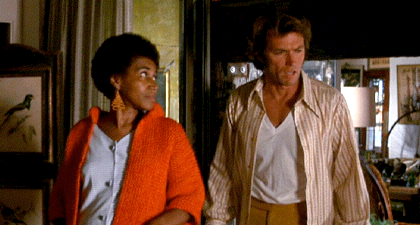
Clint Eastwood’s directorial debut is one of this Eastwood fan’s favorites. In Play Misty for Me, we see Eastwood’s typical manner applied to a character and situation much different than the crime thrillers and Westerns he is most associated with. This movie delivers a different kind of tension due to Eastwood’s character not being accustomed to a life of violence. 

During a 17-year acting career, Clint Eastwood had learned a few things behind the camera and knew how to relate to actors. Eastwood formed Malpaso Productions in 1968 and had begun starring in his own film projects. Everything really seemed to come together for his directorial debut, Play Misty for Me. Eastwood had been in the business long enough to have established some industry relationships for the talents he needed to collaborate with, he had made a marketable international name for himself as an actor, and Universal Pictures had already distributed three of his Malpaso Productions’ films. Therefore, Eastwood was able to secure a deal with Universal Pictures to distribute his first film with him as director. 

Play Misty for Me is far more than just a vanity project. Eastwood really delivers with an intimate and leisurely paced film that continues ratcheting up the complications and suspense to make for an intense and entertaining movie. 

This story’s role for Clint Eastwood gives him a chance to be a guy with an ideal lifestyle. He seems a bit more carefree at the start of the film than most of his other film characters, yet we are still treated to some of Eastwood’s typically terse wit. It is fun to see Eastwood play someone who is not an action hero get ensnared in an increasingly dangerous situation. His Dave Garver character is just a promiscuous disc jockey that has one too many one-night stands. You can’t blame the guy for being tempted by so much opportunity. With his looks, a classic Jaguar, and a real swingin’ bachelor pad, the Carmel-by-the-sea jazz DJ is bound to land plenty of ladies who are begging to be on his playlist. 

Casual sex quickly turns into crazy stalking from Dave Garver’s number one fan, Evelyn Draper. As the groupie from hell, Jessica Walter gives one helluva performance. She displays sentimentality and devotion that is so desperate it ultimately makes her seem rather pathetic. Initially, Evelyn seems sweet and naive, but she manages to manipulate confident stud Dave Garver. At first, Garver thinks that he is the one in control, but hooking up with Evelyn was just what she intended and she reels him in with her seemingly casual attitude about having sex immediately. There is always the risk of emotional entanglements when physical intimacy is involved. When Garver’s latest catch does not want to be released, she goes off the deep end and tries to capsize his entire life. Before long Garver feels “smothered.” 

Donna Mills plays Tobie Williams, the lady with whom Dave Garver had a recent relationship that he wants to renew. She is reserved, levelheaded, and a bit reluctant to start up again with the randy disc jockey, but Garver is persistent, has a way with words, and looks like Clint Eastwood, so he just can’t miss. Unfortunately, Garver had started taking more requests than just playing records from Evelyn Draper… 


This film’s main cast is pretty small, but there are other characters that help to dilute the tension before it starts to build again. Their humorous interaction with Eastwood’s Dave Garver not only entertains; it also helps to expand the audience perception of Eastwood as more than just a badass movie hero. Frequent Eastwood director Don Siegel takes the role of Murphy, the bartender at Dave Garver’s favorite hangout. James McEachin is full of witty banter, on-air and off, as Sweet Al Monte, Garver’s fellow disc jockey. Garver gets more teasing from Clarice Taylor as his cleaning lady, Birdie. Police officer Sgt. McCallum, played by John Larch, is the authority figure that has to help deal with Garver’s stalker problem and reminds us that Eastwood’s character is just another citizen in trouble. 


This film takes its time to establish the picturesque Carmel, California setting, Dave Garver’s lifestyle, and the gradual renewal of love between Garver and Tobie. Director Eastwood indulges in what amounts to a musical intermission with Roberta Flack’s song “The First Time Ever I Saw Your Face“ playing during a lengthy montage of Dave Garver and Tobie Williams strolling and making love in the solitude of nature. This is followed up with attendance at the Monterey Jazz Festival. Some probably thought that first-time director Eastwood was just being self-indulgent, but this musical recess brings us down from an outbreak of insanity and makes us happy that Eastwood’s character has started to find some new joy in his life. We are given time to relax and become comfortable and hopeful that things are going Garver’s way after the conflicts he has had with Evelyn, which were becoming evermore alarming. 

Play Misty for Me spins us a twisted love triangle that has a little added bite in the midst of the sexual revolution era. At that time, people became more upfront about indulging their lust and openly skipped the responsibility of attachment before getting it on. Once some of them had been making it with the right person, they may have sought something more meaningful and lasting. The ongoing problem is that not all sexual partners evaluate feelings the same way or have the same motives. Play Misty for Me deals with the free love scene’s worst-case scenario: Hell hath no fury like a groupie scorned.

STANLEY (1972)

Director: William Grefé Writers: Gary Crutcher, William Grefé Producer: William Grefé Cast: Chris Robinson, Alex Rocco, Steve Alaimo, Ma...