

Director: Fred F. Sears
Writers: Samuel Newman, Paul Gangelin
Producer: Sam Katzman
Cast: Jeff Morrow, Mara Corday, Morris Ankrum, Robert Shayne, Edgar Barrier, Louis D. Merrill, Frank Griffin (as Ruell Shayne), Morgan Jones, Clark Howat, (and uncredited cast) George Cisar, Robert B. Williams, Fred F. Sears, Sol Murgi, Benjie Bancroft, Brad Brown, Al Cantor, Dabbs Greer, Bud Cokes, Leonard P. Geer
Electronics engineer Mitch MacAfee (Jeff Morrow) is helping to calibrate early warning radar stations for the U.S. military near the North Pole. While piloting a plane during the tests, MacAfee reports a UFO moving too fast to be seen clearly, but he describes it as being as “big as a battleship.” When jet interceptors are scrambled, the unidentified flying object is not located and one of the planes does not return. MacAfee’s account is doubted until more aircraft in other parts of the world are also reported missing. Eventually, the UFO is identified as an enormous birdlike creature that is invisible to radar, impervious to weapons, and attacks to feed on anything that moves, especially humans.
The Flashback Fanatic movie review
Taking potshots at that infamous terror turkey, The Giant Claw, has long been a popular sport for sci-fi film fans. It would be an absolutely generic example of the 1950s sci-fi monster movie if not for its sub-par special effects, extravagant science, and earnest performances coping with some loopy lines of dialogue. Despite all of its deficiencies, I still find it as rewatchable as its monstrous cousins of a far finer pedigree like The Beast from 20,000 Fathoms (1953) and Tarantula (1955).

This is a movie that seems like its script is really trying to impress with an original variation on the giant monster movie. A giant bird is certainly a change of pace from giant bugs and dinosaurs. To further distinguish it, The Giant Claw’s airborne atrocity is plumed with more sci-fi claptrap than a fleet of flying saucers.
It is not only the scientific speculation and theories bandied about that put the screenwriters’ typewriter keys through contortions. Their characters’ lines in many scenes are as circular as the monster bird’s flight pattern. The roundabout dialogue seems to be hell-bent on trying to be clever. Once writers Samuel Newman and Paul Gangelin coin a quip or metaphor, they just gotta keep it in circulation. That “big as a battleship” reference to the creature’s size is repeated so often that you would think it is a standard unit of measurement used by the National Audubon Society.

The writers’ characters often engage in banter that lobs idioms back and forth in an attempt at witty and colorful conversation that often falls flat. The most strained and almost successful attempt at this is when Jeff Morrow’s Mitch MacAfee is putting the moves on Mara Corday’s Sally Caldwell. They engage in an elaborate verbal bout of likening the routine of seduction to the game of baseball. Morrow and Corday are good enough actors to make this contrived dialogue amusing. But then Morrow’s hero caps it off with a clumsy attempt at romantic poetic wit before they start necking on a plane full of other passengers. I would have proposed this far more apt bit of verse:
My poem’s direct sincerity avoids the utter irrelevance of the first line in the Mitch MacAfee composition. However, it probably would have resulted in our amorous hero getting slapped in the kisser, but that would have been more entertaining. It’s not enough to just bitch about a movie’s flaws unless you know damned well how to fix them.

Of course what most fright flick fans think needs fixing in this film is that not-so fine feathered flying freak from outer space. (You know I was just dying to drop an F-bomb to lengthen that line of alliteration.) Actually, a different creature design would be a mistake. It is this outrageous monster that is solely responsible for this movie’s enduring reputation, bad as that rep tends to be. I am rather fond of this big bird’s bug-eyed, badass expression. The damned thing even has twitching nostrils on its beak! It looks goofy and vindictive at the same time. I can’t think of any other giant movie monster’s puss that has more personality than this big, baleful buzzard.

Our leads had headlined their share of classic 1950s sci-fi before they went on this turkey shoot. Jeff Morrow had starred in This Island Earth (1955), The Creature Walks Among Us (1956), and Kronos (1957). Former showgirl, pinup model, and October 1958 Playboy Playmate Mara Corday had already starred alongside perennial sci-fi horror hero John Agar in 1955’s Tarantula. She would also soon join another genre stalwart, Richard Denning, in The Black Scorpion (1957).
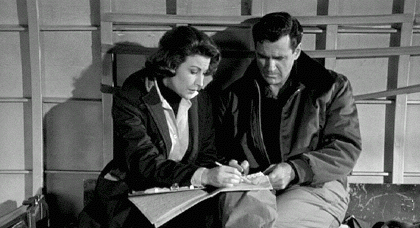
These two are pretty game performers that maintain our interest in their characters without engaging in any actual character development. As electronics genius Mitch MacAfee, Morrow is that oh-so American ideal of the heroic professional who “makes his own rules.” At least his ability is based on intelligence and technical know-how tempered by a bit of humility. None of that modern-day movie snark and swagger or one-man-army bullshit is to be found here. Mara Corday’s mathematician Sally Caldwell is capable and not around just to be menaced and saved. Yet, unlike many of today’s movie heroines, she is not trying to prove that she can play with the boys by acting like Rambo in a skirt. She is just doing her job. She is also not trying to assert her independence by contriving some animosity against the leading man who we just know will win her over anyway. They begin by teasing each other a bit before they actually become an item. This relationship is never made into a Screenwriting 101 character arc; it just happens and the movie is better for it.

Both Morrow’s Mitch MacAfee and Corday’s Sally Caldwell come across as simple, appealing characters. Despite some of the script’s trying-too-hard, clunky dialogue, there are also times when these two get to deliver some funny lines. Their performances were probably helped by the fact that Morrow and Corday had no idea what the monster would look like, since a south-of-the-border, cut-rate effects shop made the bird creature puppet and its scenes were shot separately.

Another pair of genre reliables provides the U.S. Air Force authorities that have to deal with the winged menace. Robert Shayne, as Gen. Van Buskirk, and Morris Ankrum, as Lt. Gen. Edward Considine, play the military brass that recruit MacAfee and Caldwell to help them destroy the seemingly invulnerable flying monster. Ankrum had played another military general role in director Sears’ Earth vs. the Flying Saucers (1956).
Director Fred F. Sears was the B film specialist who had helmed the great 1956 sci-fi double feature Earth vs. the Flying Saucers and The Werewolf. His sci-fi sophomore effort the following year was The Giant Claw paired with The Night the World Exploded. Both later films deal with some far-out science fiction concepts that are let down by their filmed execution.
I can’t speak personally on the latter film’s shortcomings, but budget is probably the major factor in the much-maligned special effects of The Giant Claw. Even though notoriously cheap producer Sam Katzman was in charge of 1955’s It Came from Beneath the Sea and 1956’s Earth vs. the Flying Saucers, those two films displayed some fine effects work due to the stop-motion animation expertise of Ray Harryhausen. Producer Katzman probably wasn’t inclined to allow the time or money for anymore of Harryhausen’s meticulous efforts, so we end up with the special effects audacity on display in The Giant Claw.

In all fairness, the monster does commit a satisfying amount of carnage (even if a few shots of chaos and destruction are swiped from earlier productions such as Earth vs. the Flying Saucers). Aside from the sometimes too-obviously miniature props it plucks at and its visible puppeteering wires, the monster’s movements are sometimes nicely done. I just love the scene of it swooping in to gobble up people dangling helplessly from parachutes. Every monster kid remembers that bit of bad bird behavior.

I really appreciate that in the can-do 1950s sci-fi films, there was usually effective collaboration between the government, military, and scientists to cope with unprecedented, catastrophic threats. Unfortunately, such efficient cooperation seems unlikely these days in our troubled world. After consultation with the military and scientist Dr. Karol Noymann (Edgar Barrier), Mitch MacAfee’s highfalutin physics come in handy devising a weapon to try combating the creature.

Dr. Noymann’s character is the guy that really lets this movie’s sci-fi logic genie out of its bottle. He explains that the monster can generate an antimatter shield making it indestructible and undetectable by radar, and more speculation determines that it came from an outer space, antimatter universe. However, despite all of this scientific gobbledygook regarding the intergalactic gobbler, we are never told how it traveled through outer space to arrive on Earth. Flapping wings don’t propel without an atmosphere. As Gen. Buskirk grumbles: “It’s just a bird!”
I guess the titanic turkey’s ability to reach our planet is left to my all-too fertile imagination. Hmmm… since the aerodynamic principles of winged locomotion don’t work in the airless void of outer space, I theorize that the monster generated antimatter flatulence to propel it through the galaxy. Eureka! Now, after all of that brilliant brainwork, I’m hungry. Where is my beautiful mathematician to serve me my well-deserved helping of coffee and sandwiches?


