Showing posts with label Vincent Price. Show all posts

Friday, October 27, 2023

THE COMEDY OF TERRORS (1963)

Director: Jacques Tourneur

Writer: Richard Matheson

Producers: James H. Nicholson, Samuel Z. Arkoff

Cast: Vincent Price, Peter Lorre, Boris Karloff, Basil Rathbone, Joyce Jameson, Rhubarb (the cat Cleopatra), Beverly Powers (as Beverly Hills), Linda Rogers, Joe E. Brown, Luree Holmes, Alan DeWitt, Buddy Mason, Douglas Williams, (and uncredited cast) Paul Barselou, Harvey Parry, Charles Soldani 

In 19th century New England, underhanded undertakers Waldo Trumbull (Vincent Price) and Felix Gillie (Peter Lorre) are so destitute that they have used a single coffin for the last thirteen years. Once the mourners leave the graveside after each funeral service, Trumbull and Gillie dump the corpse into the hole and bury it to keep reusing the same casket. In spite of such economizing, their rent is a year overdue. Trumbull decides that they must resort to murder to generate more business. 

The Flashback Fanatic movie review 

During American International Pictures’ heyday of Edgar Allan Poe story adaptations, they followed up their Poe-inspired horror-comedy The Raven (1963) with The Comedy of Terrors. The latter film is not a Poe-based project and, surprisingly, not even contrived to be marketed as one. After all, AIP was the studio that tried passing off an adaptation of H.P. Lovecraft’s novel The Case of Charles Dexter Ward as a Poe adaptation by calling it The Haunted Palace (1963), merely using the title of one of Poe’s poems. Despite The Comedy of Terrors taking place in the Poe-appropriate setting of 19th century New England and dealing with that Poe-story peril of premature interment, AIP were content to just deliver another comedy dealing with period piece horror situations without a Poe reference. They probably thought that, between the gothic horrors of Britain’s Hammer Films and their own Poe adaptations, the popularity of classic horror was now firmly established and would contrast enough with humor for The Comedy of Terrors to create an interest all its own. 

The Comedy of Terrors has the talent to make it an absolute joy for the classic horror fan. Genre film stalwarts Vincent Price, Peter Lorre, Boris Karloff, and Basil Rathbone are given the chance to play comedy to the hilt. It is clear that they are enjoying themselves bringing to life the morbid slapstick, crass behavior, and bumbling antics in Richard Matheson’s fun script.

Another surprise is that Roger Corman was not this film’s director. Corman had directed all of the previous Matheson-scripted Poe films. That team seemed to be a safe bet at the box office for AIP’s period piece horror films, including the recent horror-comedy The Raven. Matheson had suggested that Jacques Tourneur direct. Best known as the director for several of producer Val Lewton’s atmospheric and thoughtful horror classics of the 1940s, one of the greatest film noirs with Out of the Past (1947), and the intense British supernatural thriller Night of the Demon (1957), Tourneur may seem like an odd choice to direct a comedy, even if it has macabre aspects. Matheson had been impressed with Tourneur’s thorough preparation and efficiency when directing the Matheson-scripted episode “Night Call” of The Twilight Zone television series (1959-1964). Matheson’s instincts paid off. Tourneur’s direction must have agreed with the entire cast who give spirited performances that result in plenty of laughs. 

Vincent Price is every bit as accomplished in his comedy here as he had been with the horror that is a large part of his cinematic reputation. He is hilariously despicable as the unprincipled, sarcastic, and ill-tempered drunkard Waldo Trumbull. My favorite aspect to this comedy is the oh-so-refined manner that Price’s Trumbull knowingly affects that contrasts with the true crassness of his character. One of the funniest line deliveries I have ever heard is when Price says, “Remove the carcass.” 

As Felix Gillie, Waldo Trumbull’s oppressed and bumbling lackey, Peter Lorre has our sympathy while still earning laughs. Gillie’s lack of ability is apparent at all times. Whether trying to build a coffin, breaking into a house, or even correctly pronouncing Trumbull’s name, Gillie never manages to accomplish much more than irritating his employer. Trumbull keeps Gillie under his thumb because he knows of Gillie’s criminal past and thinks that Gillie has no choice but to remain as Trumbull’s unscrupulous, undertaking assistant. 

Boris Karloff makes a seemingly thankless role as a doddering and ineffectual old man into another comedy highlight. As Amos Hinchley, he is the senior partner of the Hinchley & Trumbull Funeral Parlor. Being hard of hearing, tired, and senile, Hinchley is oblivious to the treachery of his partner. Trumbull’s favorite drunken game is trying to offer the old man “medicine” from a clearly labeled bottle of poison. When Hinchley’s daughter, Trumbull’s neglected wife Amaryllis, keeps preventing her father from being poisoned, Hinchley whines that nobody cares whether or not he lives or dies since he can’t take his “medicine.” 

Making the despicable Waldo Trumbull even more unreasonable is his disdain for his voluptuous wife. The beautiful blonde Amaryllis tries to be faithful to her habitually drunk husband despite his insults and ill temper. Apparently, Amaryllis is stuck in this marriage to her father’s amoral business partner. It must be said that her ear-splittingly awful attempts at operatic singing would test anyone’s patience except her nearly deaf father and the love-struck Felix Gillie. As Amaryllis, Joyce Jameson adds to the silliness with her character’s total lack of self-awareness regarding her terrible singing voice and her ambition to be an opera singer. 

It is interesting to consider that in the 1962 AIP film Tales of Terror, during the segment adapting Poe’s “The Black Cat,” the acting trio of Price, Lorre, and Jameson also played out the situation of the destitute inebriate not appreciating his luscious wife who is charmed by an associate. Price and Lorre are actually almost playing reversed roles in The Comedy of Terrors. Peter Lorre’s role in “The Black Cat” was that of the crude, drunken lout neglecting Joyce Jameson as his wife who falls for the refined and appreciative wine taster played by Vincent Price. Lorre and Price were in fine, if more subdued, comic form there, as well. 

Another cast member from Tales of Terror is Basil Rathbone. Here his John F. Black is the landlord threatening Waldo Trumbull with eviction, which inspires the unsavory undertaker to commit murder to get paying customers in a hurry. Rathbone’s Black is a devotee of Shakespeare and indulges himself acting out with hammy excess scenes from the Bard’s plays. In Poe fashion, Black is afflicted with frequent deathlike spells from catalepsy that keep the audience and the shifty undertakers wondering if he is ever really going to die. 

I can’t recall ever seeing a film where it was more evident that everyone involved must have been having a great time making it. The Comedy of Terrors is a farce that should also give every fan of classic horror a great time watching it.

Sunday, November 14, 2021

THE TINGLER (1959)

Director: William Castle

Writer: Robb White

Producer: William Castle

Cast: Vincent Price, Philip Coolidge, Judith Evelyn, Patricia Cutts, Daryl Hickman, Pamela Lincoln, William Castle (as himself), (and the following uncredited actors) Bob Gunderson, Dal McKennon, Gail Bonney, Pat Colby, Amy Fields, Leon Alton, George DeNormand, Clarence Straight, Richard Barthelmess (in silent movie footage), Ernest Torrence (in silent movie footage) 

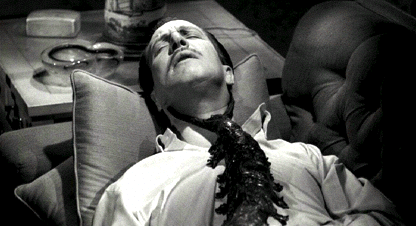
The effects of intense fear on the human body fascinate pathologist Dr. Warren Chapin (Vincent Price). During some autopsies, Chapin has found shattered vertebrae that he thinks are the result of an organism that is dormant inside the human spine until intense fear stimulates its growth. Chapin dubs this theoretical creature “the tingler” in reference to the tingling sensation one feels in their spine when frightened. A series of Chapin’s experiments try to detect this strange parasite. Once he is presented with just the right kind of corpse, Chapin is able to extract the living and dangerous proof of his theories. 

The Flashback Fanatic movie review

The Tingler is fun and creepy with one of the most outrageous and imaginative concepts in any horror film. It predates the “body horror” series of sci-fi features from the Canadian director David Cronenberg by sixteen years. This in no way diminishes the grand and gruesome accomplishments of Cronenberg’s thought-provoking horror film canon. However, it must be noted that this 1959 William Castle film, while striving to be nothing more than a crowd-pleasing fright flick, is distinguished by its very original menace.


This story also has an offbeat vibe due to its small cast of three very different couples: the odd, middle-aged couple of Oliver Higgins (Philip Coolidge) and his germ phobic, deaf mute wife Martha (Judith Evelyn) who own the movie house showing silent films; the contentious couple of Dr. Warren Chapin and his sexy, wealthy, cheating wife Isabel (Patricia Cutts); and the happy, young couple of Dr. Chapin’s lab assistant Dave Morris (Darryl Hickman) and Isabel’s younger sister Lucy Stevens (Pamela Lincoln). All of the other characters in the film are bit parts, and most of them have no dialogue. 

The more I watch this film the more I appreciate Vincent Price’s performance. As mercurial as some of his behavior seems in this story, it is always justified by the situations and his objective. This adds of bit of audience uncertainty as we are unsure of whether to categorize his Dr. Chapin as a “good guy” or a “bad guy" for a good portion of the film. Price is portraying a character with a wacky theory he is trying to prove that has him treading dangerously close to mad scientist territory. We wonder just how far his ethics go. He comes across as the nicest guy around, yet he can toss off wicked and well-deserved quips at his unfaithful wife. Their scenes are my favorites in the film. At one point Price is wielding a pistol with a baleful glare that would do Dr. Phibes proud.

The Tingler boasts not only an innovation in the monster department, but is also the major motion picture debut of LSD. Price’s performance is undeservedly often only remembered for his freak out scene under the drug’s influence. His Dr. Chapin character shoots himself up to induce the fear reaction he needs to feel to help him understand the ultimate terror needed to rouse the tingler.

The story by Robb White is one contrivance after another to keep us guessing just where the hell it is all going. The film provides a series of set pieces and gimmicks that cumulatively result in an atmosphere of irrational terror that both the tingler and the horror crowd thrive on. 

Director-producer William Castle was in the midst of his series of horror films that included an added element of gimmicky showmanship in the movie houses where they were shown. The gimmick he used for The Tingler was called Percepto. It was accomplished by having buzzers attached to random seats in the theater. At the most frightening moments in the film, the buzzers would be activated to vibrate the seats beneath viewers giving them an added “tingle.” No doubt, this would produce some of the loudest screams in the audience. One has to wonder if the Percepto gimmick was first conceived and then the film story concocted to fit with it. 


The Tingler pulls out all the stops to throttle its audience with break-the-fourth-wall gimmicks. The film itself features some addresses directly to the audience. William Castle himself opens the film with an introduction that sets up the later Percepto gimmick. He states that The Tingler will innovate by making more sensitive members in the audience experience the physical reactions that the film’s characters do. Those “sensitive” people had the misfortune to park their asses in Percepto-prepped seats. No doubt during the planned Percepto assault, the film’s story involves the tingler getting loose in a movie theater. At that point in the film, the screen goes black and Vincent Price is heard telling the movie house audiences in both the movie world and the real world to scream for their lives, as screaming is the tingler’s kryptonite. 

Perhaps the best stunt in the film is during its scariest sequence. There is an isolated bit of color appearing during this black-and-white film that makes everyone take notice. 

With its dysfunctional relationships, oddball characters, panic attacks, plot twists, an outrageous monster, and broken boundaries between its medium and its audience, The Tingler ends appropriately with an unsettling, open-ended climax. In his crass enthusiasm to thrill and chill, William Castle leaves us with an exercise in hysterical and irrational fear.

Sunday, October 31, 2021

THE OBLONG BOX (1969)

Director: Gordon Hessler

Writers: Lawrence Huntington, Christopher Wicking, Michael Reeves (uncredited), Edgar Allan Poe (claiming to be based on the Poe short story, though using only its title)

Producer: Gordon Hessler

Cast: Vincent Price, Alister Willamson, Peter Arne, Christopher Lee, Hilary Dwyer, Carl Rigg, Harry Baird, Godfrey James, Maxwell Shaw, Uta Levka, Sally Geeson, Rupert Davies, Michael Balfour, Danny Daniels, James Mellor, John Barrie, Ivor Dean, John Wentworth, Hira Talfrey, Betty Woolfe, Martin Terry, Anne Clune, Jackie Noble, Jan Rossini, Ann Barrass, Tara Fernando, Zeph Gladstone, Tony Thawnton, Colin Jeavons, Richard Cornish, Anthony Bailey, Martin Wyldeck, Hedger Wallace, Barbara Kellerman, Andreas Malandrinos, the Oh! Ogunde Dancers 

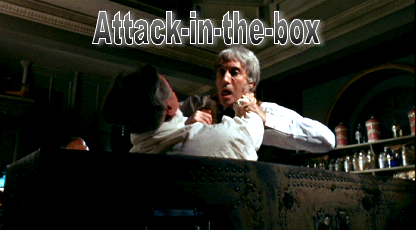
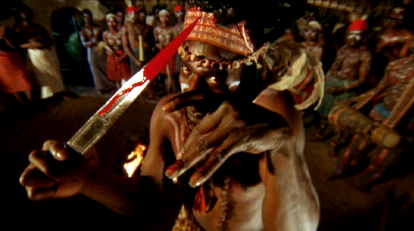
On a nineteenth-century African plantation, Englishman Sir Edward Markham (Alister Wiliamson) is subjected to an occult African ritual that has disfigured him and unhinged his mind. His plantation co-owner and brother Sir Julian Markham (Vincent Price) returns him to the family manor in England and keeps him chained in an upstairs room. The mad Sir Edward plots to escape and seek revenge.

The Flashback Fanatic movie review

Throughout the '60s, American International Pictures specialized in fright flicks based upon the works of Edgar Allan Poe. Although director Roger Corman decided to stop making Poe-based pictures, AIP was not ready to abandon this lucrative horror film subgenre. They retitled their fine and economically produced British film Witchfinder General (1968) as The Conqueror Worm to suggest a Poe connection. The Oblong Box would be their next hardly-Poe-based production.

This was to be the up-and-coming British director Michael Reeves’ follow-up to Witchfinder General. Along with writer Christopher Wicking, Reeves did a lot of reworking on Lawrence Huntington’s original script. However, director Reeves was suffering from drug and mental issues and was replaced early on by Gordon Hessler, who also produced the film. Many lament that not only was young Reeves  soon to die from an overdose, but that he did not get the chance to direct The Oblong Box. I think that the project was turned over to a very capable director, as Gordon Hessler gives us a very bleak and unsettling film. Its success convinced AIP to sign Hessler to a three-picture deal to direct more horror films for them.

While having nothing to do with the Edgar Allan Poe short story its title is taken from, The Oblong Box film still manages a Poe-like feel with its nineteenth-century era and its themes of madness, murder, revenge, family sin, and premature burial. It is a convoluted tale of skulduggery that exposes the often-unjust foundations beneath family fortune and reputation. It also reveals the corruption and lack of ethics behind those of the upper crust. Both the aristocracy and the professional class resort to illegal means and exploit the lower class to achieve their ends. All of this scheming and treachery creates conflicts and complications in the lives of the well-to-do that leads to their ruin. Sir Julian Markham suggests that the fate of his brother Edward is retribution. There is plenty of retribution to go around in The Oblong Box.

As in most of the AIP Poe-based films, The Oblong Box stars Vincent Price. His Sir Julian Markham is not an obsessive neurotic like many of his earlier Poe characters, yet he has his share of emotional baggage and ethical lapses. He presents a very dignified and genial front while being able to manipulate and coerce his dishonest lawyer to commit a crime. Two of Markham’s servants are also privy to his scheme. Despite the risks, this is apparently acceptable to those involved, as it will maintain the dignity of the Markham family image. 

Price’s beautiful co-star from Witchfinder General, Hilary Dwyer, has a much more wholesome relationship with Price’s character this time around as his betrothed Lady Elizabeth. She helps to make Julian Markham a more sympathetic character rather than just a guilty and entitled aristocrat. 

Peter Arne is fine as Samuel Trench, the unethical Markham family lawyer. Trench is instrumental in many of the underhanded shenanigans that result in so many deadly complications. He is also part of the film’s mannered British wit when being offered a drink or ordering tea at the end of scenes involving criminal schemes. He has one of the best moments in the film that typifies director Hessler’s intense and subjective approach to horror. From the mad Sir Edward’s viewpoint, we see a close up of Trench being throttled. Peter Arne’s eyes actually get increasingly bloodshot during this uninterrupted take. 


Many horror buffs are stunned that in a film starring those two terror titans Vincent Price and Christopher Lee, the only scene they share is so brief that Lee barely gets out a single word. That nit to pick aside, Lee has terse and amusing scenes with nearly everyone. His Dr. Neuhartt is another unethical professional that unwittingly contributes to the horror to come. 

Alister Williamson is both scary and sympathetic as the menace of Sir Edward. Williamson spends most of the film with his ruined face off camera or hidden beneath a crimson hood. Perhaps much of the credit for his performance belongs to the vocal performance of another actor that it is rumored to have dubbed his lines. That voice is rich and distinctive while suggesting the pain and madness that drive his character. 


The Oblong Box is one of those films that I appreciate much more after repeat viewings. The intricate and unforeseen consequences of the Markham family crimes and the attempts to maintain class conscious dignity while a madman threatens to destroy it all is very satisfying to this humble and hardworking flashback fanatic. This film also has one of the best finishes that any fright flick could hope for. The direction, dialogue, performances, editing, and music all mesh perfectly to deliver that great last-minute chill. 

Saturday, July 31, 2021

WITCHFINDER GENERAL (1968), aka THE CONQUEROR WORM

Director: Michael Reeves

Writers: Tom Baker, Michael Reeves, (additional scenes) Louis M. Heyward, based on the novel by Ronald Bassett

Producers: Louis M. Heyward, Arnold Miller, Phillip Waddilove, Tony Tenser

Cast: Vincent Price, Ian Ogilvy, Hilary Dwyer, Robert Russell, Rupert Davies, Nicky Henson, Tony Selby, Michael Beint, Bernard Kay, Godfrey James, John Trenaman, Paul Ferris, Bill Maxwell, Hira Talfrey, Maggie Kimberly, Peter Haigh, Peter Thomas, Edward Palmer, Ann Tirard, Alf Joint, David Webb, Lee Peters, David Lyell, Martin Terry, Beaufoy Milton, Michael Segal, Dennis Thorne, Jack Lynn, Toby Lenon, Patrick Wymark, Gillian Aldam, Wilfrid Brambell, Margaret Nolan, Donna Reading, Sally Douglas, Philip Waddilove, Susi Field, Derek Ware, John Kidd 

During the English Civil War in 1645, lawyer Matthew Hopkins (Vincent Price) and his assistant John Stearne (Robert Russell) travel the land as witchfinders. They are paid to apprehend and force confessions from those accused of witchcraft before executing them. When they accost Sara Lowes (Hilary Dwyer) and condemn her uncle (Rupert Davies) as a witch, Sara’s lover Richard Marshall (Ian Ogilvy), a Roundhead soldier in Cromwell’s army, vows vengeance.

The Flashback Fanatic movie review

Young director Michael Reeves’ third and final film, Witchfinder General, is always remembered for the promise of an important body of Reeves films that should have followed. An overdose of drugs and alcohol cut short his life and career.

This film is also notable for the conflict between the young director and star Vincent Price. Reeves wanted Donald Pleasence in the role of Matthew Hopkins, but American distributor AIP preferred the star power of their Poe films mainstay Vincent Price. Price seemed to be immediately a bit contemptuous of such a young man as director, or perhaps he had heard that Reeves was contemptuous of Price being imposed upon him. Reeves certainly did not want a repeat of the Price characterizations from his other recent films. He repeatedly interrupted Price during his takes to force the actor to underplay with a cold reserve. This resulted in one of Price’s best performances and his most despicable villain. Once Price saw his own performance, he appreciated just what Reeves had helped him achieve and had the class to tell Reeves so. 


The rest of the cast is very fine. Robert Russell, as Matthew Hopkins’ henchman John Stearne, is a real bastard. He openly enjoys the brutality he inflicts, which contrasts to Hopkins’ cold reserve and makes us wonder if Matthew Hopkins actually believes in his cause. Ian Ogilvy plays the likable and stalwart hero that we expect to save the day, and Hilary Dwyer, in her film debut, is his beautiful fiancée. Ogilvy would become Roger Moore’s television successor portraying Simon Templar in the series Return of the Saint a decade later. Hilary Dwyer would soon co-star again with Vincent Price in The Oblong Box (1969) and Cry of the Banshee (1970). 

Michael Reeves crafted a tale that dealt with the historic horror enabled by lawlessness and ignorance which mercenary posers took full advantage of. This film channels the same nihilism as Night of the Living Dead (1968). The horror films of the late '60s began venting the anxieties wrought from shattered optimism. Simply dropping out and turning on would not generate enough peace and love to stop war, end civil unrest, and eliminate the threat of nuclear annihilation. Despite this story taking place three centuries ago, 1968’s Witchfinder General dealt with a theme that is just as relevant today: Society being exploited by those hiding behind professed values and titles to gain personal profit and power. 

The greatest horror of the film is that once accusations are made, the accused are condemned with no hope. Their innocence is never a consideration. Much time and effort is wasted going through the process of forcing confessions from those accused of witchcraft to justify executing them. Those doing “God’s work” to get paid and laid perpetuate this barbarity. Although the film is an adaptation of the novel by Ronald Bassett, the title character of Matthew Hopkins actually existed. 

When AIP distributed the film they tried to pass it off in the US as another of their films based on Edgar Allan Poe stories. They changed the title to The Conqueror Worm and added a voiceover by Vincent Price concluding the film with a quote from the Poe poem. AIP also used this trick back in 1963 to try passing off The Haunted Palace film as a Poe adaptation, though it was actually based on the H.P. Lovecraft novel The Case of Charles Dexter Ward.


"Oh, stop your gabbling," I can hear Matthew Hopkins scolding. Let me conclude by saying that horror fans wanting to see an uncompromising slice of historic barbarity and hypocrisy starring one of the genre’s legends need to see Witchfinder General. Definitely not for the kiddies, even if they like baked potatoes.

Friday, June 25, 2021

SCREAM AND SCREAM AGAIN (1970)

Director: Gordon Hessler

Writers: Christopher Wicking, based on the novel The Disorientated Man by Peter Saxon (pen name)

Producers: Milton Subotsky, Max J. Rosenberg

Cast: Vincent Price, Christopher Lee, Peter Cushing, Alfred Marks, Michael Gothard, Marshall Jones, Uta Levka, Christopher Matthews, Judi Bloom, Judy Huxtable, Anthony Newlands, Yutte Stensgaard, Clifford Earl, Peter Sallis, Kenneth Benda, Julia Holloway, Nigel Lambert, Amen Corner (the band as themselves)

A jogger collapses in London and awakens in a hospital bed to find one of his legs has been removed with no explanation from his cold and silent nurse. There is also a series of brutal murders of young women being committed by someone draining the victims’ blood. Meanwhile in a fascist country, a cold-blooded member of its military rule is killing to ascend to a higher position of power. All three of these scenarios eventually prove to be related. 

The Flashback Fanatic movie review

I don’t like to reveal spoilers when reviewing films. In this case, I hate to discuss too many story developments, because the wild and crazy ride this film takes you on is all the more satisfying for seeing how three seemingly unrelated plots connect. This eccentric approach to the story has drawn a lot of criticism or indifference over the years. The same people that can’t appreciate it are probably thinking Quentin Tarantino was a genius for doing the same thing twenty-five years later in Pulp Fiction (1994). I am not suggesting Tarantino ripped off this film in any sense. I will say that the tying together of different parallel events and characters in a screenplay was much more unusual back in 1970. I will also say that this can create a sense of unease and dislocation in the viewer that enhances the paranoid feeling that Scream and Scream Again strives for.


Scream and Scream Again is a very unique film with a mix of genres that keeps it constantly moving and unpredictable. It is first and foremost a horror film with science fiction, sociopolitical, and police procedural elements. The ultimate concerns the story raises are that we may not know who the hell is really in charge and we may not be able to do anything about it.

Most horror fans are drawn to this flick because of the three heavy-hitters of horror in the cast: Vincent Price, Christopher Lee, and Peter Cushing. Some of those same fans are soured because all three actors are not featured more prominently. Cushing’s role is really just a cameo and he only interacts with one other main cast member, but not with Price or Lee. Price gets the most screen time, but only shares a single scene with Lee. However, the absolutely cold and brutal Marshall Jones as Konratz interacts with all three. This character is one truly despicable badass. His idea of a chicken dinner isn’t fingerlickin’ good.


Other cast members of note are Alfred Marks as detective superintendent Bellaver and Michael Gothard as “the vampire killer.” Marks is just great as the acerbic and weary member of law enforcement trying to catch the serial murderer. I am not familiar with Marks’ other work, but his main forte is comedy, which explains how good he is with his offhand humor in his role. Gothard is just plain mean once he stops being mod and charming. He provides plenty of surprises for the cops and the audience.

Gordon Hessler’s direction keeps things edgy and energetic. The film has a pretty cold and brutal tone throughout. Hessler kept pretty busy around this time on horror assignments. This film, as well as his work on The Oblong Box (1969), should have been much more appreciated in their day. Fortunately, both films were quite successful and are becoming more appreciated in recent years. Some consider Scream and Scream Again a cult film, though almost any offbeat and fondly remembered old movie seems to earn cult status these days. The famous German director Fritz Lang was supposed to be crazy about it.

Christopher Wicking’s script is also largely responsible for the unique qualities of this movie, yet it is surprisingly faithful to the novel it is based upon, The Disorientated Man by Peter Saxon (pen name). The film’s omission of an extraterrestrial basis for the plot is an improvement. This makes the origins of the menace more vague and disturbing. It doesn’t let man off the hook as being his own worst enemy when science is used to achieve power. 

STANLEY (1972)

Director: William Grefé Writers: Gary Crutcher, William Grefé Producer: William Grefé Cast: Chris Robinson, Alex Rocco, Steve Alaimo, Ma...