Showing posts with label eco-horror. Show all posts

Thursday, July 25, 2024

PROPHECY (1979)

Director: John Frankenheimer

Writer: David Seltzer

Producer: Robert L. Rosen

Cast: Robert Foxworth, Talia Shire, Armand Assante, Richard Dysart, Victoria Racimo, George Clutesi, Tom McFadden, Kevin Peter Hall (uncredited), Charles H. Gray, Everett Creach, Burke Byrnes, Johnny Timko, Mia Bendixsen, Graham Jarvis, Evan Evans, Lyvingston Holms, James H. Burk, Lon Katzman, Bob Terhune

Washington, D.C. Government Health Inspector Dr. Robert Verne (Robert Foxworth) brings his pregnant wife, Maggie (Talia Shire), along with him into the woods of Maine to assess the environmental impact of the Pitney Lumber Company paper mill. It is hoped that this assessment can help settle the conflict between the paper mill and members of the local Native American tribe who feel that their ancestral forests are being despoiled. The lumber company is blaming the tribe for recent disappearances of loggers in the forest. An elder of the tribe believes that Katahdin, a legendary forest spirit, has risen to protect his people and the environment.

The Flashback Fanatic movie review

The filmmaker who delivered the classic, dark-humored, political thriller The Manchurian Candidate (1963) might seem like the last guy in the world who was itching to make a monster movie. Apparently, director John Frankenheimer and his writer had some things to say, whether there was a receptive audience or not. The screenplay was by none other than David Seltzer, who had written the huge horror hit The Omen (1976).
Chasing the 1970s pack of animals-attack flicks, Prophecy is the eco-horror alternative to the radiation-spawned-monster movies of the 1950s. It has often been derided over the years, yet I have always liked it. Much of the negativity about this film is because it is loaded with issues. I suppose some people want to take offense at anything that raises concerns they are apathetic to or in denial about. There are also many moviegoers who don’t want anything too heavy when all they are looking for are thrills and chills. Others may argue that this film is being heavy-handed in the way it addresses its concerns.

There is no denying that there is a lot to ponder here beyond how to survive the big, bad monster. In addition to the main issue of industrial pollution that can poison people and the environment, there are also the conflicts of industry with Native American culture, concerns about overpopulation, business corruption, inadequate urban housing, and abortion. For many viewers this movie may have just seemed like a checklist of contemporary issues striving for some sort of relevance.

I never seek out a film or judge it worthy because it is trying to be relevant. I am hoping to be involved and entertained. In the case of Prophecy, I don’t have an issue with its issues-heavy approach. Who says horror can’t be thoughtful? I think the pollution angle is a good one providing a topical basis for the menace here. It also provides the basis for most of the cultural and character conflict in the film.

The four main characters articulate all of this film’s issues. Health Inspector Dr. Robert Verne is concerned about the pollutants the paper mill may be discharging into the environment. Maggie Verne is reluctant to tell her parenting-averse husband about her pregnancy. Paper mill supervisor Bethel Isely (Richard Dyshart) contends that his mill is ecologically safe and simply meeting society’s demand for paper. Native American John Hawks (Armand Assante) defends his tribe’s concerns for their land being ruined by the paper mill.


Despite these oppressive themes, Robert Foxworth and Talia Shire give nice performances as the Verne couple. Although he is idealistic, EPA-appointed investigator Dr. Robert Verne does not immediately take a side in the local dispute. Maggie Verne is looking for the right moment to tell Robert that she is pregnant knowing that he does not want to bring a child into a troubled and overcrowded world. We get to share one quiet moment of romantic relief with them in their rustic cabin on the lake deep in the idyllic Maine forest just before the film’s main concern literally shows up on their doorstep.

Perhaps the weight of all these issues would have been easier for the film to carry if there were a bit of humor to be found with some of these characters. They are all delivering exposition or debating. I am not about to suggest we need a comic relief sidekick bumbling about or that characters should be delivering sitcom-styled wisecracks, but despite most of this film taking place in the great outdoors, emotionally we could use a breath of fresh air. It may have alleviated Prophecy’s preachy atmosphere.


Prophecy gets off to a great start with an opening scene that does what the best horror films do. It establishes a sense of dread and intrigue; we wonder just what the hell the nasty thing is that makes mincemeat out of the first characters we meet. That immediately catches this horror hound’s interest and keeps me eagerly sniffing along the trail this story leads me on.


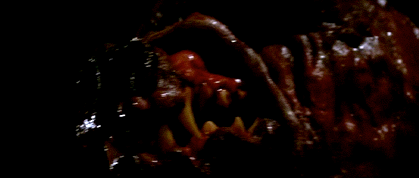
Many don’t like the monster. I do. It’s big, brutal, and ugly. While no one in the film gives us an exact definition of the beast, it is generally understood to be a mutant bear. This creature seems like a reasonable extrapolation based on the environmental pollution hazard that is this movie’s main concern. We are shown other forms of life in the area that have also been altered in size or temperament. As a supporter of exposition in films when it is needed to get our heads around challenging concepts, I appreciate the effort made to explain an industrial waste’s monster-making potential. I am sure some self-styled scientists out there won’t accept that such a mutation could occur. I say that toxic waste is just as believable a justification for a monster as radiation was back in the good old ’50s. In more recent decades, it seemed that all any filmmaker needed to do was throw around the term “genetic engineering” to get the audience to accept the creation of any monster or superhero.

There are also special effects nitpickers wanting to find fault with the monster that I have never really understood. Prophecy is using many techniques of the time to realize its menace and to tell its story. I think that it accomplishes this, even if we think we know many of the tricks that were used. Nowadays, people will accept any absurdity presented with CGI and yet are so jaded that they are not impressed. About the only notice now given to CGI is when it is poorly done. While some back in 1979 were obviously not making a practical effects-to-CGI comparison, they seemed to be unwilling to engage with this issues-heavy film. Hence, they criticized everything from its characters, to its plot, to its issues, to its special effects.

With Prophecy this horror junkie gets a little extra kick beyond the high I will usually settle for. This is a horror movie with a thoughtful consideration of the environmental factors that justify its menace. We also have characters strongly motivated and impacted by those factors beyond just the most imminent threat of the bloodthirsty monster. Perhaps best of all, we get the innovative sleeping bag kill. Eat your heart out, Jason Voorhees.

Sunday, April 30, 2023

KINGDOM OF THE SPIDERS (1977)


Director: John “Bud” Cardos

Writers: Stephen Lodge, Jeffrey M. Sneller, Alan Caillou, Richard Robinson

Producer: Igo Kantor, Jeffrey M. Sneller

Cast: William Shatner, Tiffany Bolling, Lieux Dressler, Woody Strode, Altovise Davis, David McLean, Marcy Lafferty, Natasha Ryan, Joe Ross, Adele Malis-Morey, Roy Engel, Hoke Howell, Whitey Hughes, Bill Coontz (as Bill Foster), Jay Lawrence, Bettie Bolling, Anita Merritt (as Juanita Merritt), Nadia Caillou, Valla Rae McDade, Jon-Jon, Spec O’Donnell 

In Verde Valley, Arizona, spiders are killing cattle and pets with their venomous bites. The local veterinarian Robert “Rack” Hansen (William Shatner) and entomologist Diane Ashley (Tiffany Bolling) are trying to discover the reason for these attacks and to advise the local authorities. Before long humans also become victims, and soon the whole town of Camp Verde is threatened by the evermore-aggressive multitude of deadly spiders. 

The Flashback Fanatic movie review 

In the nature-attacks film wave of the 1970s, spiders were a natural choice of threat as most people are not very fond of the eight-legged critters. They were members in a multi-species, man-killing army of the Florida bayou in Frogs (1972) and came from outer space to menace North Central Wisconsin in The Giant Spider Invasion (1975). When Stephen Lodge and Jeffrey M. Sneller, the writers of the original story for Kingdom of the Spiders, decided to base a horror film on what they were both afraid of, spiders were their mutual choice.

This film falls squarely into the eco-horror category. It is suggested that man’s pesticides have killed off much of the spiders’ natural prey. Therefore, the spiders have adapted to become more venomous and attack larger animals, including man.

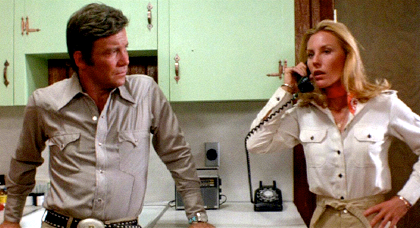
William Shatner tops the cast in his best role since Captain James T. Kirk of the Star Trek TV series (1966-69). As veterinarian “Rack” Hansen, Shatner is down-to-earth, heroic, funny, and likable. His performance really distinguishes what could otherwise have seemed like just one more killer critter flick for the drive-ins. Of course, Shatner brings some star power to the production, but he also keeps things interesting between all of the horror stuff.

Shatner’s character and performance take the edge off of the boy-meets-girl movie cliché of the heroine playing hard to get. It is immediately established that there is a bit of a class and culture clash between Shatner’s desert town, pickup truck driving vet “Rack” Hansen and the liberated, Mercedes driving, university entomologist Diane Ashley (Tiffany Bolling). It makes some sense that, initially, there would be a bit of friction between the two characters. Hansen’s teasing of Ashley is amusing as are her rebuffs of his early advances. We learn to like these two characters and welcome their eventual comfort with each other. 

This film demonstrates just how labor-intensive it must have been to make such a movie in those pre-CGI days. The filmmakers had to get thousands of live tarantulas onto the shooting locations, let them loose just before the cameras would start rolling, then round the spiders up again after each shot and put them into separate plastic cups so that they would not cannibalize each other.

Just as impressive is an airplane stunt that seems to occur quite close to our stars William Shatner and Tiffany Bolling. This all had to take place physically in front of the camera and must have required a lot of planning and precise timing to pull off safely. 

Kingdom of the Spiders is a ’70s spin on that 1955 sci-fi horror classic Tarantula. Of course, in ’55, we also had a spider as the beastie, a desert setting, and the handsome local doctor hooking up with the beautiful visiting science academic. The science that got out of hand to cause the arachnid menace was also concerned with providing man’s food. In the atomic age of the ’50s, it was a scientist using radiation to develop a nutrient that caused a spider escaping from the lab to become a giant, man-eating monster. In Kingdom of the Spiders, the man-made cause of the horror is once again intended to aid in food production: pesticides. This results in not just one monster. Instead, it forces thousands of tarantulas to start feeding on man to replace the spiders’ natural prey that the pesticides have eliminated. The cause of the threat in Kingdom of the Spiders is far more pervasive than a single scientist’s screw-up, which accounts for the later film’s much more bleak attitude.

That attitude is this film’s lasting distinction. The story takes the time to make us bond with some of the characters and there is a fair amount of humor from roles large and small. As a result, there is certainly a sense of tragedy felt about some of the fatalities that occur. With none other than William Shatner as our hero, we expect things to work out when he takes charge. However, as the menace keeps mounting, the situation seems to keep getting more and more hopeless. While Kingdom of the Spiders does not strive to be deep or clever, it does not stroke its audience with comforting clichés, either.

Wednesday, September 15, 2021

DAY OF THE ANIMALS (1977)

Director: William Girdler

Writers: William W. Norton, Eleanor E. Norton, Edward L. Montoro

Producers: Edward L. Montoro, David Sheldon (uncredited)

Cast: Christopher George, Lynda Day George, Leslie Nielsen, Michael Ansara, Paul Mantee, John Cedar, Susan Backlinie, Richard Jaeckel, Ruth Roman, Bobby Porter, Andrew Stevens, Kathleen Bracken, Walter Barnes, Michelle Stacy, Michael Andreas, Gil Lamb, Jan Andrew Scott, Gertrude Lee, Garrison True, Walt Gorney (uncredited), Mike Clifford (uncredited) 

Depletion of Earth’s ozone layer is allowing unfiltered ultraviolet radiation to affect the behavior of animals and turning them aggressive. The radiation levels have the most extreme effects at higher altitudes. The many beasts in the California mountains menace a group of hikers trying to get back to civilization. 

The Flashback Fanatic movie review

1954’s film The Naked Jungle climaxed with Charlton Heston’s South American plantation owner character trying to defend his property against an approaching wave of army ants. Then Alfred Hitchcock’s 1963 classic The Birds probably set the standard for the nature attacks movies. It was not until the ecology conscious '70s that the animal vs. man theme became the impetus for many a fright flick. Aside from the individual animal freaks of Jaws (1975) and Grizzly (1976), there were the animal armies united to wipe out humans in films such as Frogs (1972) and Piranha (1978). Director William Girdler dealt with both forms of this horror sub-genre; first in the aforementioned Grizzly, and then the following year in Day of the Animals.

Some of the animals-attack-man movies had no specific reason for the beasts’ homicidal behavior. Others had a man use his animals as murder weapons. More, however, had the animals become a menace due to the unforeseen consequences of man’s environmental contamination. Day of the Animals is dealing with this latter situation. 


The film opens with another '70s habit of the grim expositional text appearing on screen to lend a bit of gravitas and truth to the subject matter of the story. This film does not pretend to be based on a true story, but wants us to believe it is possible in the near future due to the very real and contemporary concern about depletion of Earth’s ozone layer by man-made fluorocarbons used in so many aerosol products. Like the radiation fears of the '50s justifying the mutated menaces of so many movie monsters in that era, ozone layer depletion is the unlikely culprit that drives animals crazy. Once again, a very real worldwide threat is used to justify the creation of a movie menace to thrill and chill the audience. For horror junkies, like myself, that’s making the best of a bad situation. 

This film also seems to be a variation on that other '70s film genre: the disaster film. We have here a diverse cast of characters stuck in a dangerous situation. Most of them are given just enough of a back-story to maintain their individuality. In the course of the ongoing dangers they face, conflicts arise between them. 


Heading up this cast of unfortunate characters are two of the stars from William Girdler’s previous film Grizzly: Christopher George and Richard Jaeckel. George’s wife and frequent co-star Lynda Day George joins him. Susan Backlinie, the shapely first victim in Jaws, is on the receiving end of more animal aggression here. Behind the scenes, Backlinie also assisted her husband wrangling some of the animals used in this film. John Cedar plays her character’s nearly estranged husband. Ruth Roman, from Alfred Hitchcock’s Strangers on a Train (1951), plays the nagging single mother of her young son (Bobby Porter). Andrew Stevens appears here in an early role with Kathleen Bracken as his girlfriend. Two familiar faces from television, Michael Ansara and Paul Mantee, are also in this group of hikers. 


Speaking of familiar faces from television, in the '70s Leslie Nielsen frequently appeared as the guest star heavy in network crime dramas. No matter how despicable he may have been in those roles, they were only warm-up acts for his awesome assholism in Day of the Animals. With him around, hiking is never boring. As advertising executive Paul Jenson, Nielsen is the perfect example of the character you love to hate. He is arrogant, insensitive, opinionated, snide, and hilarious. That’s all before his character takes a turn for the worst and he devolves into a caveman. When burly Leslie Nielsen grabs a small boy by the collar and roars into his face calling him a “little cockroach,” a new pedestal in the Movie Villains Hall of Fame has to be furnished for him. 

Aside from the animal menace to the hikers, the conflict between Christopher George’s hiking guide Steve Bruckner and Leslie Nielsen’s Paul Jenson is the other main point of interest in this film. Despite the fact that Jenson is a jerk, he does not seem completely unreasonable when he displays increasing criticism of Bruckner’s leadership. Of course, all of this seems a bit suspect because Jenson is a conceited blowhard that is completely out of his element in the great outdoors. His ego is driving his attempt to take command. Yet there is the very real concern that Bruckner’s hiking plan seems to keep running into unforeseen disasters. This results in a division in the hiking group between those still being led by Bruckner and those choosing a different direction to be led by Jenson. To find out which leader is most capable you’ll have to watch the film, but Leslie Nielsen’s Paul Jenson led march is certainly the most entertaining.

Sunday, August 15, 2021

DEADLY EYES (1982), aka NIGHT EYES

Director: Robert Clouse

Writers: Lonon Smith, Charles Eglee, adapted from the novel The Rats by James Herbert

Producers: Paul Kahnert, Andre Morgan, Charles Eglee

Cast: Sam Groom, Sara Botsford, Scatman Crothers, Cec Linder, Lisa Langlois, Lesleh Donaldson, Joseph Kelly, Lee-Max Walton, James B. Douglas, Jon Wise, Kevin Foxx, Wendy Bushell, Dora Dainton, Michael Fawkes, George Merner, Charles Jolliffe, Michael Mark McManus, Roger Dunn, Jaime Hyland, Michael Hogan, Jack Van Evera, Bridget O’Sullivan, David Cardoza, Bunty Webb, Guy Sanvido, Paul MacCallum, Til Hanson, David Hughes, Steven Fearnley, Tod Woodcraft, John Stephen Hill, Sandy Grant, Lorraine Housego, Suzanne Housego, Mary Anne Ziewkiewicz, Bruce O.R. Marshall, Brian P. Morrison, Kevin Sheard, George Hollo (uncredited) 

Toronto city health inspector Kelly Leonard (Sara Botsford) orders a shipment of contaminated corn to be burned. The feed is infested with rats and has been treated with an illegal steroid. That steroid has mutated the rats to become huge and vicious. The rats flee the burning feed to infest the city and begin feeding on humans. 

The Flashback Fanatic movie review

Deadly Eyes is a holdover of the nature attacks movies of the '70s. It is supposed to be based on the 1974 debut novel, The Rats, by the prolific, British horror author James Herbert. Aside from the idea of a plague of large, man-eating rats, this film has almost nothing to do with its prose source.

Initially, I had a rather lukewarm reception to this film. There were not any real pressing character conflicts to be resolved or to complicate the situation. You are left with the gimmick of big rats infesting a big city and attacking people. That can only generate so much interest and variety before it can become a bit monotonous. Like many monster movies, the interest lies in how will the menace be identified and then dealt with. 

After further years of contemplation and spiritual growth, I have discerned the divine value contained in the film Deadly Eyes: Sara Botsford! As health inspector Kelly Leonard, she’s smart, beautiful, cool under pressure, has a good sense of humor and initiative. If she likes what she sees, she grabs that phone to make a mating call. 

Our other hero, divorced high school teacher and basketball coach Paul Harris (Sam Groom), is the lucky stiff (and that’s one expression you don’t have to pardon) that accidentally bumps into our ravishing redhead twice in a couple of days. Then Kelly looks up Harris’ name in the phone book (things were so much simpler then) and calls the guy up for a date. Before the evening is over, we see that Harris can score with more than his jump shot. 

Kelly Leonard is so cool under pressure that, even when menaced by man-eating rats, she never screams. Even when being reprimanded by her sexist boss (James B. Douglas), she does not lose her composure. She even takes it all in stride when she stops by Harris’ pad the day after their first date to see a cute teenager (Lisa Langlois) exit the bedroom with Harris, who is wearing only his bath towel. Harris says he can explain, but Kelly shrugs it off and drives away with Harris’ five-year-old son (Lee-Max Walton) while Harris is getting dressed. Okay, I guess Kelly Leonard may be cool under pressure, but she can also scare the living shit out of someone. 

Some people may complain that this relationship stuff is filler. I like it. Many movies do this, and it was a staple of the '50s sci-fi flicks. I find the relationship beginning between Kelly Leonard and Paul Harris to be pleasant enough without trying to be a big dramatic subplot. These are two likable and believable characters, and that should make us care whether or not they survive. Also, Paul Harris’ incredible good luck hooking up with Kelly Leonard has me green with envy. Dancing the horizontal tango with her looks like a helluva lot more fun than writing movie reviews. 

Deadly Eyes has developed a bad movie reputation almost solely due to its rather ingenious special effects solution for creating its giant rats. It just sounds so cute and outlandish that once a person knows how it was done, they may not be able to think past it. In all fairness, I think the rat creatures are well done. CGI techniques of today would probably multiply the amount of rats and have them performing absurdly extravagant antics, instead of just being a scurrying pack of beasts jumping on people and chewing them up. That is probably about all that man-eating rats would actually do. 

By the way, did I mention that this movie also has Sara Botsford in it? Well, it does, so this flick makes the grade with me. 

Director Robert Clouse is at his best, and the film is at its nastiest, during the kid in the high chair scene. Clouse had made an earlier animals-attack-man movie called The Pack (1977). He specialized in the action film genre and is best known for directing the most famous Bruce Lee film, Enter the Dragon (1973). He also directed Lee’s final film, Game of Death (1978), which was completed and released after Lee’s sudden death. That is the film showing at a movie theater during one of the more memorable scenes in Deadly Eyes. 

Like Day of the Animals (1977), Kingdom of the Spiders (1977), and Prophecy (1979), man is responsible for the creatures in Deadly Eyes becoming a menace. Atomic radiation was being replaced by man-made environmental contaminants as the handy story springboard that could launch all sorts of beasties to pounce on mankind. Unlike the can-do '50s sci-fi flicks, these more recent films assert that if man’s folly got us into this mess, then even his ingenuity may not get us out of it. That is a lesson many of us still do not heed.

TARANTULA (1955)

Director: Jack Arnold Writers: Robert M. Fresco, Martin Merkeley, Jack Arnold, adapting Robert M. Fresco’s “No Food for Thought” script us...