Showing posts with label Dick Miller. Show all posts

Monday, May 6, 2024

THE HOWLING (1981)

Director: Joe Dante

Writers: John Sayles, Terence H. Winkless, adapting the novel by Gary Brandner

Producers: Michael Finnell, Jack Conrad

Cast: Dee Wallace, Christopher Stone, Patrick Macnee, Belinda Balaski, Dennis Dugan, Elisabeth Brooks, Robert Picardo, Kevin McCarthy, Dick Miller, Slim Pickens, Margie Impert, James Murtaugh, John Carradine, Don McLeod, Kenneth Tobey, Jim McKrell, Noble Willingham, Herb Braha, Steve Nevil, Joe Bratcher, Bill Sorrells, Mesach Taylor, Ivan Saric, Wendell Wright, Michael O’Dwyer, Sarina Grant, Chico Martinez, Daniel Nunez, (and uncredited cast) John Sayles, Forrest J. Ackerman, Roger Corman, Michael Chapman, Mick Garris, Robert A. Burns, Robert Hammond, John Jensen, Jonathan Kaplan, Kelli Thompson 

Eddie ‘the Mangler’ Quist (Robert Picardo) is a serial killer that has been using Los Angeles as his hunting ground. He has a fixation on television news anchorwoman Karen White (Dee Wallace). In cooperation with the police, Karen agrees to meet with Eddie in the hopes that this will result in the killer’s capture. The dangerous encounter results in Eddie being shot to death and Karen being traumatized. To help recuperate from this disturbing experience, Karen and her husband, Bill Neill (Christopher Stone), take a vacation at The Colony, a country retreat for group psychological therapy. Karen finds more stress with some of the odd characters staying at The Colony, and the howling that she hears from the woods around her cabin frightens her. 

The Flashback Fanatic movie review 

Director Joe Dante’s previous fright flick, Piranha (1978), was his sci-fi variation on Jaws (1975). His horror follow up here is a modern spin on werewolves that reveals they are as susceptible to incompatibility with modern society as anyone else. In their case, those concerns are not just to achieve happiness but also to ensure their survival. 

Although this film is adapted from the original novel by Gary Brandner, director Dante was unsatisfied with earlier scripts that were more faithful to the source material. So, John Sayles was brought in to write an entirely new story using just a few elements from Brandner’s novel. Sayles once again concocts a fine mix of horror, humor, and quirky characters as he did for Joe Dante’s Piranha. Sayles also plays an uncredited role as the morgue attendant. 

Another of the talents from Piranha, special make-up effects artist Rob Bottin, created a lot of The Howling’s attention-getting buzz with a fantastic transformation sequence. His efforts result in the scene that set the creature effects standard for decades to come. Bottin’s expertise was noticed and he became a much-in-demand talent. He would continue to distinguish himself with his work in a succession of thrilling genre films, such as The Thing (1981), RoboCop (1987), Total Recall (1990), Basic Instinct (1992), and many more. 

The Howling is a film that looks and sounds great. Cinematographer John Hora’s lighting enhances the mood of just about every interior scene and his views of the foggy forest have a nightmarish beauty. Pino Donnagio’s fine music score boosts the creep factor even higher. 

Ably assisted by these great talents, director Joe Dante once again expertly mounts a horror gem of many facets. The Howling flaunts humor that is never at the expense of the horror, which is a pretty tricky balancing act. Much of that humor is used to expose the pretense and crassness of media that caters to a cynical and apathetic audience. The film’s characters are not explored at any great depth, but they are all well realized with good performances. 

Anyone who can’t fall in love with Dee Wallace during this movie is heartless. As our heroine, traumatized newscaster Karen White, Wallace gives a great performance with her simply drawn character. Her sensitivity and vulnerability keep us loyally on her side every minute. Wallace had appeared in horror specialist Wes Craven’s classic The Hills Have Eyes (1977). She would soon star in the Steven Spielberg sci-fi blockbuster E.T. the Extra-Terrestrial (1982). When Wallace got top billing in the Stephen King novel adaptation Cujo (1983), she was joined in the small cast by The Howling’s Christopher Stone. 

Dee Wallace’s soon-to-be husband, Christopher Stone, appears in The Howling as her character’s spouse, Bill Neill. He provides a nice, solid support to the traumatized sensitivity of Karen White. Bill seems like a stable and caring sort of guy and is responsible for prompting Karen to follow through on visiting the retreat to help with her emotional trauma. Unfortunately, Bill eventually becomes unreliable and creates even further stress for our troubled heroine. 

Belinda Balaski, who was so likable in Piranha, continues to win me over as Karen White’s best friend and co-worker, Terri Fisher. She is featured in two of this movie’s scariest scenes. 

The third beauty to grace the main cast is Elisabeth Brooks. She is unforgettable as Marsha, the most exotic resident of The Colony. Whether decked out in her provocative leather dress or much less, she manages to be both sexy and unsettling. 

Certainly the film’s most unsettling character is Eddie ‘the Mangler’ Quist. Robert Picardo plays Karen White’s fiendish fanboy to perverse perfection. His rendezvous with his favorite anchorwoman in the movie booth of a porn shop is the first of many creepy scenes in The Howling. We are introduced to Eddie as only a shadowy presence that neither Karen White nor the audience is allowed to get a good look at. Picardo’s soft-spoken dialogue is dripping with lust and menace that makes the audience squirm as much as poor Karen. 

One of director Dante’s favorite actors and cult film favorite, Dick Miller, plays yet another of his characters named Walter Paisley. This time around he is the proprietor of an occult bookstore. Miller’s character is this film’s brusque, modern answer to the Professor Van Helsing-type of folklore authority found in many traditional horror films. Miller has said that this was his favorite role and he really shines during his brief time in it.


The cast is rounded out with a lot of other great actors for fans of genre films and television. Patrick Macnee, John Carradine, Kenneth Tobey, Slim Pickens, and Dennis Dugan join Piranha’s Kevin McCarthy. Even Famous Monsters of Filmland magazine editor Forrest J. Ackerman makes an appearance. 

With such casting, it is apparent that director Joe Dante was indulging himself and other horror film fans. In addition to The Wolf Man (1941) playing on television, many of this film’s characters are named after directors of werewolf films. Despite this sense of fun, the film never lapses into meta-film contrivances that take us out of the movie. Dante still keeps us invested in the characters’ situations and concerns. 

“Repression is the father of neurosis,” states Patrick Macnee as trendy psychotherapist celebrity Dr. George Waggner. The effects of repression on individual behavior and society are evident throughout The Howling. We see the denizens of the sleazy side of town called “flotsam and jetsam” by Kenneth Tobey’s veteran cop, yet many of them are there just to partake of the disreputable delights of prostitutes and pornography. Repression by society does not quell those longings; it merely makes their indulgence more dangerous. 

While repression has been responsible for so many people throughout the ages being guilted into their hang-ups, society also recognizes that an individual’s amoral freedom can pose dangers to others. The Howling explores the sociopathy of hedonism. Releasing the most basic inhibitions may be a lot of fun, but lycanthropy demonstrates the worst-case scenario for such behavior. The abandonment of empathy and conscience results in a loss of humanity. It is this total disregard for others and ultimately the resulting destruction of a stable society that is the danger posed by everyone giving in to all of their innermost, selfish desires. 

The Howling also makes the sensual aspect of werewolves more overt than prior films. Lycanthropy is not treated as a curse but as a turn-on. However, turning into a werewolf is risky behavior. Civilization has a long and often shameful history of persecuting those not conforming to prevailing social norms, but stopping monsters that enjoy killing people seems to be a wisely accepted standard. The main concern here for those afflicted with lycanthropy is not being cured but to figure out how to keep getting away with it. As if that’s not deep enough for you, The Howling also answers the burning question: Do werewolves do it doggy style? 

1981 was a golden age for horror films. As a regular reader of the new Fangoria magazine, I had been really jazzed to see The Howling, and it did not disappoint. Its perfect blend of horror, humor, sex, and satire serves up a fun fright flick that is thrilling, touching, and just a bit thought provoking. The Howling was one of the best times this horror hound has ever had at a movie theater.

Tuesday, January 31, 2023

NOT OF THIS EARTH (1957)

Director: Roger Corman

Writers: Charles B. Griffith, Mark Hanna

Producer: Roger Corman

Cast: Beverly Garland, Paul Birch, Jonathan Haze, Morgan Jones, William Roerick, Anna Lee Carroll, Dick Miller, Roy Engel, Gail Ganley, Ralph Reed, Harold Fong, Tamar Cooper, Pat Flynn, Barbara Bohrer, Lyle Latell, (and uncredited cast members) Jan Boleslavsky, Tom Graeff, John Clark, Hank Mann, Charles B. Griffith 

Nadine Storey (Beverly Garland) accepts a position as a live-in nurse at the Los Angeles, California home of the stoic and impersonal Mr. Johnson (Paul Birch). Nadine is to administer blood transfusions to Johnson who claims that he is dying from a rare blood disease. Johnson is actually an agent from the planet Davanna and is responsible for a series of murders. The blood that he drains from his victims is sent back to his home planet for analysis. Should the earthling blood prove beneficial to Johnson’s dying race, Davanna will invade Earth and enslave mankind to be cattle for the aliens to feed upon. 

The Flashback Fanatic movie review 

Not of This Earth is another stellar example of how the right mix of script, pace, performance, and wit make for a very entertaining film, regardless of its low budget and short shooting schedule. I think it is with this film that director Roger Corman really began to hit his stride. While production efficiency and economy were always foremost in Corman’s mind when directing his films, it is no accident that this and many other Corman productions turned out to be fresh and satisfying. Some very savvy preproduction planning allowed him to get things done quickly and properly. Corman also has the taste to be sure that a script has the offbeat elements to distinguish a story while delivering the gimmicks to meet the genre’s audience expectations. 

Scriptwriter Charles B. Griffith was one of director Corman’s greatest assets. From a brief story suggestion or genre gimmick, Griffith could develop an interesting story full of snappy dialogue with as much humor as the project required. Griffith, along with co-writer Mark Hanna, provide Not of This Earth with the novel science fiction concepts, wit, and surprises that make all the difference. 

Truly using a less-is-more approach, the story employs an interesting sci-fi variation on vampires. This gives us a humanoid menace that is easier to achieve for the filmmakers and more interesting for the audience. Just a pair of milky white eyes capable of frying one’s brain is every bit as startling and probably more effective than the menace of some sort of inhuman monster prop. 

This space vampire is also an interesting personality. Always dressed in a business suit and tie, wearing dark glasses to conceal his blank alien eyes, and speaking in a stilted and formal manner, actor Paul Birch still manages to make us believe in his Mr. Johnson as an actual alien being rather than just a stiff caricature. As Mr. Johnson, Paul Birch is both menacing and amusing. However, his character is never played for campy humor. This feels a lot smarter than the in-our-face attempts at postmodern hipness many later films would strive for to compensate for the lack of any originality. Birch’s character is funny when a bit off in his interactions with the “Earth subhumans” and almost earns our sympathy when confounded by traffic laws or a pushy door-to-door salesman. It is light touches like these that make a simple film lively and involving while validating a strange character. 


A frequent star in Corman’s ’50s films, Beverly Garland is the heroine. As nurse Nadine Storey, she may end up as a damsel in distress, yet she is intelligent and confident. She provides the film a bit of sex appeal while never being the least bit intimidated by the initial sexual harassment of Mr. Johnson’s ex-con chauffeur Jeremy Perrin (Jonathan Haze). 


Jeremy is another example of the cleverness in the screenplay’s character development. At first we assume that he will be just an obnoxious thug deserving punishment. Despite his introductory lechery of Nadine, he actually becomes something of a confidant of hers as they compare notes about their mysterious employer. This is probably Jonathan Haze’s best role. He plays someone that we actually learn to like who also keeps things lively and amusing. Of course, Haze is best known as the dim-witted protagonist Seymour Krelboin of the Corman-directed/Griffith-written 1960 cult comedy The Little Shop of Horrors. 

Dick Miller’s brief appearance is always fondly remembered. In one of the film’s best scenes, Miller portrays the persistent door-to-door vacuum cleaner salesman offering a free demonstration of his product. Ironically, Mr. Johnson decides to demonstrate his blood suction device instead. 

There are other quirky bits of business in the film that make it truly distinctive: teleportation instead of spaceships used to travel through space, telepathy, a floating umbrella-shaped monster assassin, and rabies-infected blood. 

The grimmest aspect in the film is the Nazi-like attitude about the aliens’ plans. No doubt considering themselves a master race, they refer to earthlings as subhumans as if to justify their intent of turning mankind into an enslaved food source. In another unpleasant reminder of World War II atrocities, Mr. Johnson uses his large basement furnace as a body-disposing oven. That all of this takes place in a mundane suburban setting makes the situation relatable while also creating a bizarre and unsettling contrast. 

For many years Not of This Earth was the Roger Corman film that I had most anticipated. When I finally got the chance to see it, I found it well worth the wait. Like many of my film favorites, it does not just pacify me; it amuses, surprises, and involves me. That is why this Earth subhuman can’t stop looking at it.

Tuesday, August 30, 2022

PIRANHA (1978)

Director: Joe Dante

Writers: John Sayles, Richard Robinson

Producer: Jon Davison

Cast: Bradford Dillman, Heather Menzies, Kevin McCarthy, Paul Bartel, Belinda Balaski, Melody Thomas Scott, Shannon Collins, Barbara Steele, Dick Miller, Keenan Wynn, Bruce Gordon, Barry Brown, Shawn Nelson, Richard Deacon, Janie Squire, Roger Richman, John Sayles (uncredited), Guich Koock, Bill Smillie, Eric Henshaw, Jack Pauleson, Virginia Dunnam, Diamond Farnsworth, Robyn Ray, Robert Vinson, Mike Sullivan, Bruce Paul Barbour, Jack Cardwell (Brandy the dog)

Skip tracer Maggie McKeown (Heather Menzies) is sent to Texas to find a young couple. Her search leads her to a remote area where she meets an unemployed, hard-drinking recluse named Paul Grogan (Bradford Dillman). She convinces him to be her guide and together they explore the nearby, seemingly abandoned US Army facility where a pool and lab were kept to use for bioweapon research. Finding some clothing and hiking gear that belonged to the missing couple, Maggie drains the pool to see if their bodies are at the bottom. Unfortunately, this has released a school of voracious mutant piranha into the local river that head downstream towards a summer camp and the newly opened Lost River water park.

The Flashback Fanatic movie review

Piranha is the best of all the nature-attacks flicks that followed in the bloody wake of Jaws (1975). Although it is another man-eating fish horror film, it is hardly just a rip-off. It deals with other themes and uses a sci-fi angle to create its menace. This makes the film fresh while still delivering more of the summertime, waterlogged terror its audience expected.

John Sayles’ and Richard Robinson’s script goes a long way to distinguish this film from its Jaws inspiration. It has a lot of humor that never goes so far as to diminish the horror or our involvement in the situations and the main characters. The story raises concerns about the direction that military research can still go in peacetime. As one character states: There will always be wars. There also will always be cover-ups and greed that can jeopardize public safety.

After co-directing Hollywood Boulevard (1976), which included horror elements, Joe Dante’s first solo directed film Piranha established him as someone who knows how to deliver multi-faceted exploitation that should satisfy any fright flick fan. The film has nice images, suspenseful build-ups to the bloody climaxes, race-against-time pacing, and good performances from its simply drawn characters.

Heading up the cast are Heather Menzies and Bradford Dillman. As our skip tracer heroine Maggie McKeown, Menzies is the impulsive and confident counterpoint to Dillman’s surly recluse Paul Grogan. Dillman often played unlikable characters, so it is fun to see him here eventually shift into hero mode. They make an appealing pair of protagonists because they are not presented as infallible icons ready to kick ass and save the day. They have their faults and quirks that make them interesting and that’s why we are rooting for them. Their initial friction with each other and then their teamwork provides humor that enlivens their ongoing efforts to stop the piranha threat.

Kevin McCarthy, as the hermit scientist Dr. Robert Hoak, provides another hysterical warning about a sci-fi menace as he did back in Invasion of the Body Snatchers (1956). This time around, he is responsible for developing the menace that is unknowingly unleashed by our heroine Maggie McKeown. Hoak provides the necessary and interesting exposition about his research that helps to establish the film’s cynicism regarding government and the military.

That '60s Italian horror film icon Barbara Steele is a presence as unsettling as the piranha. Her character of government scientist Dr. Mengers had collaborated with Hoak on the development of the new piranha species. Unlike Hoak, she is not conflicted about the deadly consequences of the experiment getting out of control. Her assurances to the public are more about public relations than public safety.


Paul Bartel, as the priggish summer camp director Dumont, and Dick Miller, as Lost River Aquarena entrepreneur Buck Gardner, provide plenty of humor. They also contribute to the terror and tragedy as they refuse to believe the warnings of danger about the escaped piranha.

Two years before summer camps became the preferred stomping grounds for murdering maniacs, Piranha racks up a bloody body count that includes a lot of preteens among its victims. This lends an extra nasty edge to the flick that reminds us just how high the stakes are if this menace is not stopped.

Since the script, direction, and performances engage us in different ways with horror, humor, science fiction, and suspicion of authority, this movie has just enough complexity to make this escapist fun very satisfying. Piranha is a perennial summertime film favorite of mine, so in those lazy, hazy, crazy days of summer, I invite you to take a trip down Lost River. If you like blood with your bikinis, you can’t go wrong.

Sunday, August 1, 2021

A BUCKET OF BLOOD (1959)

Director: Roger Corman

Writer: Charles B. Griffith

Producer: Roger Corman

Cast: Dick Miller, Barboura Morris, Julian Burton, Antony Carbone, John Shaner, John Brinkley, Ed Nelson, Bert Convy, Myrtle Damerel, Judy Bamber, Jhean Burton, Bruno VeSota, Lynn Storey, Alex Hassilev (singer-guitarist uncredited), Paul Horn (saxophone player uncredited) 

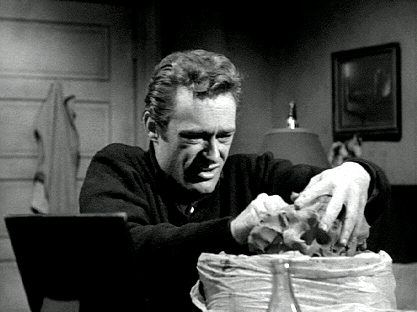
Walter Paisley (Dick Miller) is the lonely and slow-witted busboy at The Yellow Door, a beatnik coffeehouse. Walter wants to be accepted by the artsy bohemian crowd at the coffeehouse and to win the affections of pretty artist Carla (Barboura Morris). Inspired by the resident beatnik poet Maxwell’s (Julian Burton) recitations proclaiming the virtues of art and creativity, Walter strives to be a sculptor. He compensates for his lack of talent by molding clay over the bodies of his murder victims. 

The Flashback Fanatic movie review

Hey, get hip to this hepcat horror mini-masterpiece! A Bucket of Blood is one of my all-time favorites. This film is a horror-comedy just as unique and quirky, yet more touching and thought provoking, than the more famous Corman directed/Griffith written follow-up The Little Shop of Horrors (1960). A Bucket of Blood is a little gem of many facets. Like the best films, especially in the horror genre, A Bucket of Blood settles us intimately into its environment and characters. The storyline is simple and so are the characters, but those people are all distinctive and interesting. That all of this is achieved in just over an hour while delivering so much humor, pathos, and satire along with its horror is admirable.


The film begins with a series of long and mobile shots that immediately immerse us in this beatnik culture. As the film’s title and credits are displayed, the camera moves from the close-up of poet Maxwell reciting his latest verse to roam all around the coffeehouse and its hip patrons while Walter is performing his busboy duties. It is a very efficient and impressive sequence that must have required a lot of planning and some pretty damned reliable actors to pull it off. Corman was always of the hurry-up-and-get-it-done mode of filmmaking, so this seems to be pretty ambitious, as such long sustained takes with so many people and camera moves during an ongoing recitation of poetry could go wrong so many ways. 

The main characters are quickly introduced and their personalities and conflicts established. We are immediately on the side of poor misfit Walter Paisley. He wants to fit in with a beatnik group that most of society ignores or looks down on, but even being accepted by these voluntary outcasts is beyond him. Inspired by poet Maxwell’s artist-adoring rants, Walter figures he can get acceptance by making art. His hopeless naïveté trying to fashion a lump of clay into the likeness of the photo of Carla, the girl he is in love with, is both funny and sad. In just a minute Walter realizes his total lack of talent. When Walter breaks down sobbing his loneliness and squalor really register on the viewer.

Dick Miller stars as Walter Paisley. It is unique in his long series of roles. Miller usually plays cynical and street-wise types. Here he is meek and simple minded. He manages to be funny, pathetic, and have us rooting for him, even though he is this movie’s menace. This atypical role is the most dominant one he ever had in a film. As a sort of in-joke, many characters Miller played in later films were also named Walter Paisley. 

While the story is poking fun at the beatnik culture it is portraying, it also seems that the characters are enjoying their affectations and pretensions. They are grooving on attitudes and language the way an accomplished jazz musician can enjoy improvising solo or as an interaction with others. The beatnik duo of Oscar (John Shaner) and Will (John Brinkley) is the finest example of this loose and self-indulgent art. Every time these two cats make the scene it’s hilarious.

The pomposity of poet Maxwell H. Brock is also terrific. Charles B. Griffith must have had a ball writing his poems, which are quite clever as they play nonsensical word games to laud creativity with a grave earnestness. Julian Burton, as Maxwell, convinces us how he became the star beatnik at The Yellow Door with his spirited delivery. 

An integral element to Roger Corman’s great early films is the writing of Charles B. Griffith. He uses snappy dialogue, interesting characters, and humor to enliven the strange tales that Corman directs. He also provides motivations for his characters that not only propel the plot, but also make us think. In this film we are left to ponder: What is art and what is affectation? Can the motives behind the creation of art corrupt it? Is the reaction an artist seeks from his audience all that is needed to create something worthwhile? Where does sincere expression end and self-indulgent egotism begin? If I knew the answer to that I’d probably stop writing these damned reviews. 

A Bucket of Blood is yet another great example of low budget maestro Roger Corman proving that talent and wit can outclass any over-produced, big-budgeted, hyperactive vanity project that tries to pass itself off as a movie over half a century later. Crazy, man, crazy.

STANLEY (1972)

Director: William Grefé Writers: Gary Crutcher, William Grefé Producer: William Grefé Cast: Chris Robinson, Alex Rocco, Steve Alaimo, Ma...