Showing posts with label Michael Reeves. Show all posts

Sunday, October 31, 2021

THE OBLONG BOX (1969)

Director: Gordon Hessler

Writers: Lawrence Huntington, Christopher Wicking, Michael Reeves (uncredited), Edgar Allan Poe (claiming to be based on the Poe short story, though using only its title)

Producer: Gordon Hessler

Cast: Vincent Price, Alister Willamson, Peter Arne, Christopher Lee, Hilary Dwyer, Carl Rigg, Harry Baird, Godfrey James, Maxwell Shaw, Uta Levka, Sally Geeson, Rupert Davies, Michael Balfour, Danny Daniels, James Mellor, John Barrie, Ivor Dean, John Wentworth, Hira Talfrey, Betty Woolfe, Martin Terry, Anne Clune, Jackie Noble, Jan Rossini, Ann Barrass, Tara Fernando, Zeph Gladstone, Tony Thawnton, Colin Jeavons, Richard Cornish, Anthony Bailey, Martin Wyldeck, Hedger Wallace, Barbara Kellerman, Andreas Malandrinos, the Oh! Ogunde Dancers 

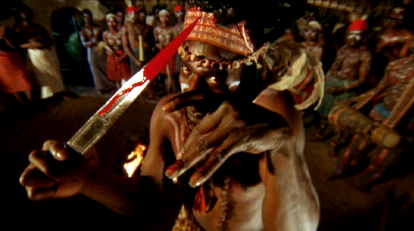
On a nineteenth-century African plantation, Englishman Sir Edward Markham (Alister Wiliamson) is subjected to an occult African ritual that has disfigured him and unhinged his mind. His plantation co-owner and brother Sir Julian Markham (Vincent Price) returns him to the family manor in England and keeps him chained in an upstairs room. The mad Sir Edward plots to escape and seek revenge.

The Flashback Fanatic movie review
Throughout the '60s, American International Pictures specialized in fright flicks based upon the works of Edgar Allan Poe. Although director Roger Corman decided to stop making Poe-based pictures, AIP was not ready to abandon this lucrative horror film subgenre. They retitled their fine and economically produced British film Witchfinder General (1968) as The Conqueror Worm to suggest a Poe connection. The Oblong Box would be their next hardly-Poe-based production.

This was to be the up-and-coming British director Michael Reeves’ follow-up to Witchfinder General. Along with writer Christopher Wicking, Reeves did a lot of reworking on Lawrence Huntington’s original script. However, director Reeves was suffering from drug and mental issues and was replaced early on by Gordon Hessler, who also produced the film. Many lament that not only was young Reeves  soon to die from an overdose, but that he did not get the chance to direct The Oblong Box. I think that the project was turned over to a very capable director, as Gordon Hessler gives us a very bleak and unsettling film. Its success convinced AIP to sign Hessler to a three-picture deal to direct more horror films for them.
While having nothing to do with the Edgar Allan Poe short story its title is taken from, The Oblong Box film still manages a Poe-like feel with its nineteenth-century era and its themes of madness, murder, revenge, family sin, and premature burial. It is a convoluted tale of skulduggery that exposes the often-unjust foundations beneath family fortune and reputation. It also reveals the corruption and lack of ethics behind those of the upper crust. Both the aristocracy and the professional class resort to illegal means and exploit the lower class to achieve their ends. All of this scheming and treachery creates conflicts and complications in the lives of the well-to-do that leads to their ruin. Sir Julian Markham suggests that the fate of his brother Edward is retribution. There is plenty of retribution to go around in The Oblong Box.

As in most of the AIP Poe-based films, The Oblong Box stars Vincent Price. His Sir Julian Markham is not an obsessive neurotic like many of his earlier Poe characters, yet he has his share of emotional baggage and ethical lapses. He presents a very dignified and genial front while being able to manipulate and coerce his dishonest lawyer to commit a crime. Two of Markham’s servants are also privy to his scheme. Despite the risks, this is apparently acceptable to those involved, as it will maintain the dignity of the Markham family image. 

Price’s beautiful co-star from Witchfinder General, Hilary Dwyer, has a much more wholesome relationship with Price’s character this time around as his betrothed Lady Elizabeth. She helps to make Julian Markham a more sympathetic character rather than just a guilty and entitled aristocrat. 

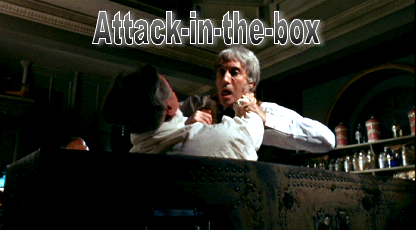
Peter Arne is fine as Samuel Trench, the unethical Markham family lawyer. Trench is instrumental in many of the underhanded shenanigans that result in so many deadly complications. He is also part of the film’s mannered British wit when being offered a drink or ordering tea at the end of scenes involving criminal schemes. He has one of the best moments in the film that typifies director Hessler’s intense and subjective approach to horror. From the mad Sir Edward’s viewpoint, we see a close up of Trench being throttled. Peter Arne’s eyes actually get increasingly bloodshot during this uninterrupted take. 


Many horror buffs are stunned that in a film starring those two terror titans Vincent Price and Christopher Lee, the only scene they share is so brief that Lee barely gets out a single word. That nit to pick aside, Lee has terse and amusing scenes with nearly everyone. His Dr. Neuhartt is another unethical professional that unwittingly contributes to the horror to come. 

Alister Williamson is both scary and sympathetic as the menace of Sir Edward. Williamson spends most of the film with his ruined face off camera or hidden beneath a crimson hood. Perhaps much of the credit for his performance belongs to the vocal performance of another actor that it is rumored to have dubbed his lines. That voice is rich and distinctive while suggesting the pain and madness that drive his character. 


The Oblong Box is one of those films that I appreciate much more after repeat viewings. The intricate and unforeseen consequences of the Markham family crimes and the attempts to maintain class conscious dignity while a madman threatens to destroy it all is very satisfying to this humble and hardworking flashback fanatic. This film also has one of the best finishes that any fright flick could hope for. The direction, dialogue, performances, editing, and music all mesh perfectly to deliver that great last-minute chill. 

Saturday, July 31, 2021

WITCHFINDER GENERAL (1968), aka THE CONQUEROR WORM

Director: Michael Reeves

Writers: Tom Baker, Michael Reeves, (additional scenes) Louis M. Heyward, based on the novel by Ronald Bassett

Producers: Louis M. Heyward, Arnold Miller, Phillip Waddilove, Tony Tenser

Cast: Vincent Price, Ian Ogilvy, Hilary Dwyer, Robert Russell, Rupert Davies, Nicky Henson, Tony Selby, Michael Beint, Bernard Kay, Godfrey James, John Trenaman, Paul Ferris, Bill Maxwell, Hira Talfrey, Maggie Kimberly, Peter Haigh, Peter Thomas, Edward Palmer, Ann Tirard, Alf Joint, David Webb, Lee Peters, David Lyell, Martin Terry, Beaufoy Milton, Michael Segal, Dennis Thorne, Jack Lynn, Toby Lenon, Patrick Wymark, Gillian Aldam, Wilfrid Brambell, Margaret Nolan, Donna Reading, Sally Douglas, Philip Waddilove, Susi Field, Derek Ware, John Kidd 

During the English Civil War in 1645, lawyer Matthew Hopkins (Vincent Price) and his assistant John Stearne (Robert Russell) travel the land as witchfinders. They are paid to apprehend and force confessions from those accused of witchcraft before executing them. When they accost Sara Lowes (Hilary Dwyer) and condemn her uncle (Rupert Davies) as a witch, Sara’s lover Richard Marshall (Ian Ogilvy), a Roundhead soldier in Cromwell’s army, vows vengeance.

The Flashback Fanatic movie review

Young director Michael Reeves’ third and final film, Witchfinder General, is always remembered for the promise of an important body of Reeves films that should have followed. An overdose of drugs and alcohol cut short his life and career.

This film is also notable for the conflict between the young director and star Vincent Price. Reeves wanted Donald Pleasence in the role of Matthew Hopkins, but American distributor AIP preferred the star power of their Poe films mainstay Vincent Price. Price seemed to be immediately a bit contemptuous of such a young man as director, or perhaps he had heard that Reeves was contemptuous of Price being imposed upon him. Reeves certainly did not want a repeat of the Price characterizations from his other recent films. He repeatedly interrupted Price during his takes to force the actor to underplay with a cold reserve. This resulted in one of Price’s best performances and his most despicable villain. Once Price saw his own performance, he appreciated just what Reeves had helped him achieve and had the class to tell Reeves so. 


The rest of the cast is very fine. Robert Russell, as Matthew Hopkins’ henchman John Stearne, is a real bastard. He openly enjoys the brutality he inflicts, which contrasts to Hopkins’ cold reserve and makes us wonder if Matthew Hopkins actually believes in his cause. Ian Ogilvy plays the likable and stalwart hero that we expect to save the day, and Hilary Dwyer, in her film debut, is his beautiful fiancée. Ogilvy would become Roger Moore’s television successor portraying Simon Templar in the series Return of the Saint a decade later. Hilary Dwyer would soon co-star again with Vincent Price in The Oblong Box (1969) and Cry of the Banshee (1970). 

Michael Reeves crafted a tale that dealt with the historic horror enabled by lawlessness and ignorance which mercenary posers took full advantage of. This film channels the same nihilism as Night of the Living Dead (1968). The horror films of the late '60s began venting the anxieties wrought from shattered optimism. Simply dropping out and turning on would not generate enough peace and love to stop war, end civil unrest, and eliminate the threat of nuclear annihilation. Despite this story taking place three centuries ago, 1968’s Witchfinder General dealt with a theme that is just as relevant today: Society being exploited by those hiding behind professed values and titles to gain personal profit and power. 

The greatest horror of the film is that once accusations are made, the accused are condemned with no hope. Their innocence is never a consideration. Much time and effort is wasted going through the process of forcing confessions from those accused of witchcraft to justify executing them. Those doing “God’s work” to get paid and laid perpetuate this barbarity. Although the film is an adaptation of the novel by Ronald Bassett, the title character of Matthew Hopkins actually existed. 

When AIP distributed the film they tried to pass it off in the US as another of their films based on Edgar Allan Poe stories. They changed the title to The Conqueror Worm and added a voiceover by Vincent Price concluding the film with a quote from the Poe poem. AIP also used this trick back in 1963 to try passing off The Haunted Palace film as a Poe adaptation, though it was actually based on the H.P. Lovecraft novel The Case of Charles Dexter Ward.


"Oh, stop your gabbling," I can hear Matthew Hopkins scolding. Let me conclude by saying that horror fans wanting to see an uncompromising slice of historic barbarity and hypocrisy starring one of the genre’s legends need to see Witchfinder General. Definitely not for the kiddies, even if they like baked potatoes.

STANLEY (1972)

Director: William Grefé Writers: Gary Crutcher, William Grefé Producer: William Grefé Cast: Chris Robinson, Alex Rocco, Steve Alaimo, Ma...