Showing posts with label mad science. Show all posts

Saturday, May 9, 2026

THE NIGHT STRANGLER (1973)

Director: Dan Curtis

Writer: Richard Matheson (based on characters created in Jeff Rice’s novel The Kolchak Papers)

Producer: Dan Curtis

Cast: Darren McGavin, Jo Ann Pflug, Simon Oakland, Scott Brady, Wally Cox, Margaret Hamilton, John Carradine, Nina Wayne, Al Lewis, Ivor Francis, Richard Anderson, Virginia Peters, Kate Murtagh, Diane Shalet, Anne Randall, Francoise Burnheim, Regina Parton.

Veteran reporter Carl Kolchak (Darren McGavin) relocates in Seattle, Washington looking for work. He runs into the newspaper editor he used to work for in Las Vegas, Tony Vincenzo (Simon Oakland), and gets hired. As Kolchak’s luck would have it, he is soon investigating a series of murders just as strange as those he reported on back in Las Vegas. Women are being strangled by a killer who leaves traces of rotted flesh on their throats and extracts blood from the base of their skulls. Once again, Kolchak runs afoul of the authorities who don’t want to accept the incredible sounding facts he uncovers about the crimes.

The Flashback Fanatic movie review

The Night Strangler is the equally entertaining sequel to the ratings blockbuster telefilm The Night Stalker (1972). Once again, the theme of journalism oppression by the authorities is as prevalent as the horror. Both Dan Curtis and Richard Matheson are involved again. This time producer Curtis also directs. Matheson’s script is an original story using the two characters of newspaper reporter Carl Kolchak and his exasperated editor, Tony Vincenzo, from the previous film that was based on a Jeff Rice novel. Rice, in turn, would write a novelization of this sequel film.

Some may feel that The Night Strangler is something of a rehash of The Night Stalker, but it has an energy all its own. It is loaded with funny and distinctive characters, most of whom Kolchak can’t help rubbing the wrong way. This leads to many bust-out-loud-laughing moments, yet the humor is never at the expense of the horror. We are still fully invested in the setting and situations Carl Kolchak is investigating.

Speaking of setting, that is often as important as character and motivation in a good horror tale. Like the earlier film, The Night Strangler takes place in a city not often dealt with, especially on television back in the ’70s. Seattle provides not only a different locale, but screenwriter Matheson delves into a strange-but-true bit of its history to add another layer of mystery and the bizarre to his story; it is an essential part of the killer’s character.

The main concept for this film’s menace seems to have a strong precedent in the Hammer Films horror movie The Man Who Could Cheat Death (1959), which was a remake of Paramount Pictures’ The Man in Half Moon Street (1945). Matheson’s story brings plenty of other elements into this film to keep it fresh and exciting, and his use of the Seattle Underground is a great idea.

First published in 1950, Richard Matheson was a very innovative and influential writer of fantasy stories. His horror tales often placed a menace in the contemporary settings and times of his readers. This made his stories more relatable and potentially unsettling for his audience. Matheson’s prolific output would also include screenplays for films and television. Many of the best-remembered episodes of TV’s The Twilight Zone (1959–64) were scripted by Matheson. He wrote most of director Roger Corman’s film adaptations of Edgar Allan Poe stories in the 1960s. In the ’70s, Matheson scripted two important movies that helped ensure popularity and respect for the burgeoning made-for-TV film medium: Duel (1971—based on Matheson’s short story and directed by Steven Spielberg in his feature film debut) and the first Carl Kolchak adventure, The Night Stalker.

Producer Dan Curtis admired Richard Matheson’s writing, but he had once offended the writer when offering an option to make a film based on a Matheson story. Matheson had resented such a low-figure bid for his work. That earlier Curtis production never materialized, but when the opportunity for Curtis to produce The Night Stalker arrived, he had a tough time overcoming Matheson’s grudge to get his “favorite writer” to do the screenplay. Once they got past that initial acrimony, Curtis and Matheson became cordial and would collaborate on more ’70s telefilms.

The Night Strangler repeats the narrative hook of the dedicated journalist tracking down another weird serial killer. Both writer Matheson and producer-director Curtis must have felt that more overt humor would keep the sequel from appearing formulaic. Matheson had already proven his merit writing for laughs in the horror comedies The Raven (1963) and The Comedy of Terrors (1963). While the first Kolchak film was laced with cynicism and humor, Matheson’s original screenplay for this sequel has even more amusing characters collaborating or clashing with our newshawk hero. Since all this humor arises from character quirks, egos, and conflicting agendas, it does not diminish the threat and intrigue of the horror being investigated. Dan Curtis’s direction still enhances the creep factor and delivers some fine jump scares.


Jo Ann Pflug co-stars as Carl Kolchak’s belly dancer friend and psychology undergrad, Louise Harper. She is another sexy and appealing lady that our reporter hero manages to hook up with, and she becomes much more involved in Kolchak’s investigations than his last girlfriend. Pflug would also star in the next year’s Curits-Matheson TV terror, Scream of the Wolf (1974).

Scott Brady plays Police Captain Roscoe Schubert, Kolchak’s most immediate obstacle to his latest journalistic crusade. Schubert actually seems quite reasonable if inflexible; however, he is driven to rage by Kolchak’s pushy antics.

Horror movie stalwart John Carradine is Llewellyn Crossbinder, the stuffy and domineering publisher of Kolchak’s newspaper, The Seattle Daily Chronicle.

Wally Cox (TV’s Mr. Peepers—1952–55) is The Chronicle’s meek and forgotten researcher, Titus Berry, and he proves to be a great help to Kolchak’s investigations.

Margaret Hamilton (The Wicked Witch of the West in 1939’s The Wizard of Oz) has a cameo as the cranky Professor Crabwell who gives Kolchak some ideas about the killer’s motivation.

Al Lewis (Grandpa in The Munsters TV series—1964–66) portrays a vagrant living in the Seattle Underground.

Richard Anderson, best known as Oscar Goldman in both The Six Million Dollar Man (1973–78) and The Bionic Woman (1976–78) TV series, brings fanatical intensity and a touch of madness to his brief role of Dr. Richard Malcolm.

Dan Curtis’s frequent music composer, Robert Cobert, returns with a revamped theme from The Night Stalker. Cobert also contributes other jazzy and creepy pieces that perfectly suit this contemporary urban horror story.

This second Carl Kolchak television movie was also quite successful, and plans were made for a third film that was to be called The Night Killers. Richard Matheson collaborated on that script with William F. Nolan, another writer who would also provide creepy scripts for future Dan Curtis productions. That third Kolchak feature film was never made, but on Friday the 13th in September of 1974, Kolchak: The Night Stalker debuted as a twenty-episode television series. Curtis and Matheson were not involved in the weekly show, as they both felt that the Kolchak concept was played out. Darren McGavin would not only star in the ongoing series; he was also the co-producer. The series was a ratings flop in its day, but it was great, spooky fun and has developed a devoted cult following over the years. It influenced Chris Carter when he created the television series The X-Files (1993–2002, 2016–18).

The 1970s were the heyday of made-for-television movies. There were many in the horror genre that deserve to be made available again. Of them all, the Carl Kolchak adventures The Night Stalker and The Night Strangler are the most deserving of classic status. Those two films are all-time favorites of mine and must-see for true horror buffs.

Wednesday, October 8, 2025

FRANKENSTEIN (1931)


Director:
James Whale

Writers: John L. Balderston, Garrett Fort, Francis Edward Faragoh, adapted from Mary Shelley’s 1818 novel Frankenstein; or, The Modern Prometheus and Peggy Webling’s 1927 stage play Frankenstein

Producer: Carl Laemmle, Jr.

Cast: Colin Clive, Boris Karloff, Mae Clarke, Edward Van Sloane, Dwight Frye, John Boles, Frederick Kerr, Lionel Belmore, Marilyn Harris, Michael Mark, Francis Ford (uncredited)

In Europe, obsessed scientist Henry Frankenstein (Colin Clive) wants to create life. He assembles a new being from various stolen human body parts. Frankenstein believes that he can harness a lifeforce from lightning. During a thunderstorm, Frankenstein conducts his experiment. He succeeds in animating his creation (Boris Karloff), who is as ignorant as any newborn. Unfortunately, Frankenstein’s assistant Fritz (Dwight Frye) provided the brain of a criminal for transplanting into the skull of the huge, grotesque creature. Frankenstein’s neglect and Fritz’s abuse prompt the monster to become violent.

The Flashback Fanatic movie review

When Universal Pictures’ 1931 Dracula proved to be a much-needed hit, Frankenstein would seem to be a sure-fire follow-up. Like Dracula, this film would also credit an earlier stage play adaptation of its source novel. Peggy Webling’s 1927 play can probably primarily be credited with proving to Universal Pictures that Frankenstein had commercial potential due to its recent English stage productions. Since John L. Balderston apparently hated Webling’s stage script, one would assume his film story treatment was hardly faithful to it.

An early contender for the director’s chair, Robert Florey, is supposed to have ignored any previous film treatments and wrote an uncredited script that may have shaped what is now a film classic. Florey had gone so far as to direct a 20-minute test film with none other than Dracula’s Bela Lugosi as the monster. There have been many contradictory accounts of how Lugosi’s monster in that test footage was depicted. Some have said his appearance was based on the animated clay being in Paul Wegener’s German film The Golem (1920). Others have suggested that the Lugosi monster makeup already had characteristics that would eventually be used in the final film, and that some of that makeup was based on Robert Florey’s ideas. This horror fan can think of no lost film footage that would be more thrilling to be found and shown one day than Florey’s Frankenstein film test. Ultimately, Florey did not get to direct Frankenstein and Lugosi was denied the monster role. That may have been an awful career move for Lugosi, yet he was not very enthusiastic about playing a mute role buried under extensive makeup. Of course, Lugosi would eventually play the monster in 1943’s Frankenstein Meets the Wolf Man.

One distinction of Webling’s play would be that it is supposed to be the first time that Frankenstein’s monster is called “Frankenstein.” It was probably the Frankenstein film’s posters with the monster prominently featured that helped perpetuate the popular monster misnomer. Apparently by 1933, the name of Frankenstein being used as a euphemism for monstrous ugliness was common. In Mystery of the Wax Museum (1933), actress Glenda Farrell refers to that film’s disfigured menace as someone who “made Frankenstein look like a lily.”

It is interesting to note that the original 1818 novel of Frankenstein; or, The Modern Prometheus by the English author Mary Shelley, while being a world-famous story of Gothic horror, is an early example of science fiction. Frankenstein is a scientist whose pioneering medical research and experimentation birth a being that becomes a menace and turns on its creator. The 1931 movie adaptation has little resemblance to the source novel, yet the film still shares the book’s themes of scientific irresponsibility, parental neglect, and man’s inhumanity to one who is different.

English director James Whale had recently established himself as a respected talent at Universal. His background in theater made him valuable as a director in the era when films were transitioning from silents to talkies. Whale had been involved in three World War I films, the last of which was the successful Waterloo Bridge (1931) for Universal Pictures. When the critically acclaimed, recent arrival at Universal was given his pick of projects for his next film to direct, he chose Frankenstein. World War I veteran James Whale wanted a change of pace from war films and certainly must have relished the stylized visual and dramatic opportunities suited to Gothic horror.

Whale brought not only his filmmaking craft to the project, for he was also instrumental in discovering the talent who would portray his film’s monster and become an icon of horror: Boris Karloff. The fellow Englishman’s unique, angular features must have struck Whale as being the perfect foundation for the strange being that needed to be built into the starring menace of his film.

Jack Pierce, Universal’s head makeup man, was about to become as revered to horror fans as Boris Karloff when he concocted the creature’s look. Mary Shelley’s original novel is vague on the details of the monster’s creation. Therefore, Pierce’s makeup expertise had to devise ways to depict the surgical improvisation and augmentation that Frankenstein used to construct a new being from various corpses that could be brought to life with electricity. He turned Karloff into the most recognizable character in horror history. There has been a multitude of Frankenstein films made all over the world since 1931, but Universal’s pale, scarred giant with the flattop skull and electrodes in its neck is still the world’s most famous movie monster. Pierce’s monster design played a huge role in the picture’s success and solidified Universal Pictures’ reputation as a fear film factory with Pierce as the chief monster maker.

Just as instrumental in the success of the film was Boris Karloff’s performance as the monster. Karloff is not only playing a character with the attention-getting advantage of a monstrous appearance. He is also bringing nuances of emotion to a being without the benefit of dialogue. Karloff’s inarticulate monster can only whimper, moan, and roar. Despite his heavy makeup and costuming, Karloff registers a wide array of expressions with a wonderful mime performance. This was something extraordinary at that time; what other film character was given so much emotional depth without being able to speak or even be considered truly human? Despite the monster receiving a criminal brain, we are left to wonder if it has only become dangerous as a reaction to abuse and neglect. Nearly a century later, Karloff’s performance still can’t be taken for granted. 

I was surprised to learn that, in addition to many years of stage work, the relatively unknown, 43-year-old actor had already appeared in 81 film roles by that time. I knew Karloff had already paid his dues as an actor, but I didn’t realize how often he had already been before movie cameras. All that dedication and experience finally paid off, and films were due for many more great, starring performances from Boris Karloff.

With Frankenstein’s sensational debut of Karloff’s monster, it is easy to forget what a fine performance Colin Clive contributes as Henry Frankenstein. Colin Clive was an English actor who had worked with director Whale before in the English stage production of Journey’s End before appearing in Whale’s 1930 film adaptation. Clive brings both obsessive intensity and sensitivity to the role. His wonderful speaking voice draws us in when he explains his ambition to make scientific discoveries. Clive’s unhinged victory rant of “It’s Alive! It’s Alive!” is a famous film quote and horror movie catchphrase. Horror fans appreciate Clive reprising his role in Bride of Frankenstein (1935) and starring in another ’30s creepy classic, Mad Love (1935). Unfortunately, Colin Clive was as emotionally tormented as his film characters and would soon die at just 37 years of age in 1937.

Two of the supporting cast were lifted from Universal’s pioneering, sound-era, horror classic Dracula: Edward Van Sloan and Dwight Frye. Van Sloane appears as another scientist, Dr. Waldman, who tries to help Frankenstein avoid the disaster his experiment is leading to. Frye plays another unsavory ally to the title character, this time around as hunchbacked lab assistant Fritz.


Mae Clarke plays Henry Frankenstein’s fiancée, Elizabeth. Clarke had drawn fine notices acting in director Whale’s recent Universal hit, Waterloo Bridge. Bette Davis was considered for the role of Elizabeth, but Whale must have preferred working again with Clarke after proving herself in his previous film. Mae Clarke had a very extensive filmography, yet her most famous film moment is probably having James Cagney smash half a grapefruit in her face in The Public Enemy (1931).

Despite its familiarity so many generations later, James Whale’s Frankenstein is still vital and entertaining to the discerning fright flick fan. Its expressionistic interior and stylized exterior sets create a mood ripe for nightmares. Whale’s camera moves establish settings and his shot choices cut abruptly to closeups that ratchet up character conflict or apprehension. In the early days of the sound era, this was very agile filmmaking that defied the “handicap” of coping with new sound recording technology which often hindered mobile camera work and varied perspectives in a scene.

Another trademark of Whale’s horror films is wit. This was not just ham-handed comic relief but touches of irreverence and eccentricity. One could argue that Frederick Kerr’s elderly Baron Frankenstein is a comic-relief character, but he is quite appealing in his blustery ignorance and jovial energy. One of my favorite bits in the film is after Dwight Frye’s Fritz refuses admittance to visitors trying to interrupt Frankenstein’s experiment. Whale’s camera lingers on the hobbling hunchback just long enough for us to see Fritz pause to pull up a droopy sock on his grubby ankle. That action serves no story purpose, but it is such a “non-movie” moment that it feels both real and funny.

Universal Pictures’ Frankenstein established many horror film tropes that would be indulged in by the genre’s filmmakers ever since: the indeterminant time and place of its European setting, graverobbing, the torch-bearing mob of angry villagers, monsters created by mad scientists, and extravagant and arcane mad science gadgetry. Electrician Kenneth Strickfaden’s impressive array of sparking, buzzing, and blazing gizmos used in Henry Frankenstein’s experiment were to be recycled and elaborated on in many more sci-fi scenarios for Universal Pictures over the years. This film defined the state-of-the-art for mad scientist labs.

Frankenstein became another much-needed box-office hit for Universal Pictures. It also drew a lot of criticism for its then-objectionable content. The horror genre was always a lightning rod for moral condemnation, and Frankenstein attracted its share of outrage. For decades after its initial release, prints of the film were trimmed of Henry Frankenstein blaspheming about feeling like God. Another more shocking incident was the monster’s unintentional drowning of the child (Marilyn Harris) that befriends him. Even today, death to children is a touchy subject in horror films. Fortunately, these trims have been restored to this horror classic.

With the 1931 back-to-back box office hits of Dracula and Frankenstein, horror at the sound era cinema was a proven crowd-pleaser. For the next 15 years, Universal Pictures was the predominant purveyor of fright flicks that created scary characters who are now American pop culture icons. They have achieved a legendary status that exemplifies all things spooky for all ages and all time.

Tuesday, February 11, 2025

THE INCREDIBLE 2-HEADED TRANSPLANT (1971)

Director: Anthony M. Lanza

Writers: James Gordon White, John Lawrence, Ross Massbaum (uncredited)

Producers: John Lawrence, Ross Massbaum (uncredited)

Cast: Bruce Dern, Pat Priest, Berry Kroeger, John Bloom, Albert Cole, Casey Kasem, Larry Vincent, Darlene Duralia, Jack Lester, Jerry Patterson, Ray Thorne, Gary Kent (as Donald Brody), Mary Ellen Clawsen, Mike Espe, Janice P. Gelman, Eva Sorensen, Andrew Schneider, Bill Collins, Jack English, Leslie Cole, Robert Miller, Carolyn Gilbert, Laura Lanza, William Bonner (uncredited), Phil Hoover (uncredited)

Dr. Roger Girard (Bruce Dern) has been experimenting in his home lab transplanting second heads onto various animals. The next step is to try human subjects. If a two-headed human transplant is successful, Dr. Girard will be closer to his ultimate goal: replacing the heads of brain-damaged people with the heads of those who are mentally sound but terminally ill. When insane killer Manuel Cass (Albert Cole) abducts Dr. Girard’s wife, Linda (Pat Priest), Girard and his lab assistant, Max (Berry Kroeger), follow in pursuit. During Linda’s rescue the murderous Cass is shot. Now Dr. Girard has a convenient opportunity to attach the dying criminal’s head to the body of Danny (John Bloom), the mentally handicapped giant staying in the Girard household.

The Flashback Fanatic movie review

The title alone guarantees this flick its place in horror history. It also was the attention-getter that would get the drive-in crowd to pay up and pull in. If you were looking for sci-fi horror, The Incredible 2-Headed Transplant says that you need look no further.

The story is quite simple and depends on its Frankenstein variation to generate almost all of the interest. The rest of the interest is supplied by the luscious Pat Priest in an assortment of early ’70s outfits that scream, “I’m half-dressed with nowhere to go!” Priest is best known for replacing Beverley Owen as the beautiful blonde Marilyn in the classic TV sitcom The Munsters (1964-66). Her wholesome beauty is once again contrasted with monstrous characters, but in nastier circumstances this time around.


In retrospect, Bruce Dern’s appearance in this thing certainly elevates its curiosity value. Initially, he must have seemed like an odd choice to play a dedicated and ambitious surgeon. However, his past villainous roles have us braced to see him stoop to unethical behavior. He does give the role a sense of sincerity and never comes across as just a mad scientist. In the aftermath of a mental breakdown, Dern’s Dr. Roger Girard needs to prove his merit as a scientist to the world. That need for approval and redemption, along with the nagging of lab assistant Max, misdirects Girard’s moral compass. Girard is conflicted about what his experiment will do to the huge and innocent Danny, to whom he will be attaching a maniac’s head, but Girard overcomes that concern for what he thinks will eventually be for the good of mankind.

Every wannabe mad scientist worth his scalpel needs an unsavory lab assistant. Berry Kroeger plays Max, Dr. Girard’s scientific accomplice. He wants Girard’s transplant experiments to continue, regardless of any ethical considerations or criminal consequences. Former surgeon Max is frustrated by his damaged hands. Once head transplant surgery is perfected, the elderly Max wants his own head ported over to a new body that will allow him to perform surgery again. Geez, I think the guy really needs a hobby. However, it is Max’s mad science peer pressure that prods Dr. Girard onward to make a monster, so I guess I can cut the creep a little slack. After all, we don’t watch a flick called The Incredible 2-Head Transplant just to see two-headed lab animals munch their meals in cages.

Personally, I think the good Dr. Girard, if not mad, must have at least a few screws loose. How can any sane man spend all his time in the lab neglecting a wife who looks like Pat Priest? All Linda Girard wants is a little attention from her husband who locks himself away in his lab for days on end, yet she could become High Priestess of the Cult of the Bikini and have hordes of worshippers at her beck and call. Consider me for Chief Elder and Ogler in that congregation.

Famous disc jockey Casey Kasem, host of the music countdown show American Top 40 and voice of numerous Hanna-Barbera television cartoon characters, plays the role of Dr. Ken Anderson, a friend and confidant to the Girard couple. Dr. Anderson raises the ethical issue of Dr. Girard’s final goal: When replacing the head of someone who is brain-damaged with another head of a dying person, how is it decided who is truly more worthy of life? Kasem should have gotten stunt pay for managing to walk around beneath the crushing burden of his massive early ’70s collars and the biggest belt buckle this side of the WWE championship belt. I assume that his character’s specialty was not ophthalmology as he, and all those around him, run the risk of being blinded by the incredible tie he wears.


As insane killer Manuel Cass, Albert Cole seems to be having the most fun in this flick. He’s a wild-eyed, gap-toothed, laughing maniac who clearly enjoys his work. Slobbering all over Pat Priest is nice work, if you can get it. Cass may have awful manners, but he’s got great taste.

7’ 4” John Bloom plays the innocent, simple-minded Danny that gets the noggin of a maniac transplanted onto himself. The interaction between Bloom and Cole as two very different minds using one body is quite effective. The dominant head of the evil Cass berating and controlling his giant host is bizarre and amusing. Of course, the sadistic Cass makes the best of this bad situation and uses his huge and powerful new body to commit more murders. This is definitely a case of two heads not being better than one, except for horror fans. Bloom and Cole worked together the same year in a scene of director Al Adamson’s Dracula vs. Frankenstein (1971). There Bloom also played another product of mad science, the Frankenstein monster.

The success of The Incredible 2-Headed Transplant led to the consideration of a sequel. That ultimately became another unrelated two-headed transplant film called The Thing with Two Heads (1972). Over a decade earlier, The Manster (1959) pioneered the two-headed gimmick. However, it is The Incredible 2-Headed Transplant that has the honor of being the finest two-headed monster movie. That is an honor it truly deserves; the other movies don’t have Pat Priest in a bikini.

Thursday, October 31, 2024

RE-ANIMATOR (1985), aka H.P. LOVECRAFT'S RE-ANIMATOR

Director: Stuart Gordon

Writers: Dennis Paoli, William J. Norris, Stuart Gordon, based on H.P. Lovecraft’s serialized story “Herbert West—Reanimator”

Producer: Brian Yuzna

Cast: Jeffrey Combs, Bruce Abbott, Barbara Crampton, David Gale, Robert Sampson, Carolyn Purdy-Gordon, Peter Kent, Ian Patrick Williams, Al Berry, Gerry Black, Craig Reed, Bunny Summers, Barbara Pieters, Velvet Bebois, Lawrence Lowe, Robert Holcombe, Mike Filloon, Jack Draheim, Robert Pitzele, Annyce Holzman, Derek Pendleton, Gene Scherer, James Ellis, James Earl Cathay, (and uncredited cast) Kim Deitch, Greg Robbins, John Forker 

In Arkham, Massachusetts, Miskatonic Medical School student Dan Cain (Bruce Abbott) accepts newly transferred student Herbert West (Jeffrey Combs) as a roommate in his rented house. The intense West is obsessed with his own medical research and believes that the dead can be restored to life. West has developed a serum to reanimate dead tissue and involves Dan in his increasingly dangerous experiments. 

The Flashback Fanatic movie review 

Chicago, Illinois native Stuart Gordon had a background in theatre. First at the University of Wisconsin–Madison, then back in Chicago with the Organic Theater Company that he founded, Gordon directed and produced controversial and confrontational plays. When he decided to make a film, horror was not only the genre most marketable for beginning filmmakers; it was also the genre that would allow director Gordon to keep pushing boundaries. 

Gordon had first considered making his Lovecraft adaptation a production for the stage, then as a series of episodes for television, and finally as a feature film. Gordon found the perfect ally in producer Brian Yuzna, who was also a fan of horror and the writings of H.P. Lovecraft. Yuzna convinced Gordon to shoot the film in Hollywood and arranged the distribution deal. The initial scripts for the television series proposal were pared down into a concise feature film screenplay with more outrageous ideas added. 

Lovecraft’s writings were usually concept-driven and concerned with creating an atmosphere of awe and dread. Many of his tales dealt with the terror of man’s insignificance in a universe full of other beings and forces beyond our power to understand or control. Lovecraft’s stories did not dwell on their characters’ relationships. The protagonists of Lovecraft’s stories were usually driven only by an obsessive goal or an unearthly influence. Like the film adaptations of Edgar Allan Poe’s short stories, movies based on Lovecraft’s work usually needed his plots to be elaborated upon with additional characters, if one believes that movie plots should be character driven. 

While Re-Animator is not much more faithful to the prose it is based on than many other Lovecraft adaptations, it seems to have one of the best reputations of all Lovecraft-based films. Lovecraft’s serialized story, “Herbert West—Reanimator,” was written to be published in six parts, each of which needed to have a climax. It was more frantic than some other Lovecraft works, while having a less cosmic and a more grisly spectacle to it. As such, this lesser known Lovecraft yarn lends itself to the excesses of a mid-eighties fright flick. Stuart Gordon’s film takes the basic premise from Lovecraft’s tale and runs wild with it. 

Re-Animator is that exploitation rarity that gives the horror buffs all they are craving while still being surprisingly well received critically. Along with the gore and sex, there is a demented sense of fun to be found in the performances and the escalating madness of situations getting further and further out of control. The horror and humor are perfectly balanced so that the film never lapses into spoof territory. It keeps delivering the shocks while the performances keep us involved and amused. 

The story works so well because there is always a sense of intimacy to the horror. Aside from a few establishing shots, the action all takes place in a handful of interior locations. We have time to settle into this environment and with the small cast of main characters clashing with each other. Yet things never really seem to slow down and relax. Everything further bonds us with the characters or lays out the goals and values they have which cause most of the conflict. There is never a sense of the story marking time. It also seems like there is no limit to how much further the horror and chaos can go. 

Jeffrey Combs became a horror film immortal with his insolent and probably mad medical student, Herbert West. This character’s wit and sociopathy never fail to make me smile. He strikes me as the 1980s American answer to Peter Cushing’s Victor Frankenstein of the British Gothic horror classics from Hammer Films. West’s single-minded devotion to restoring the life of the dead spurs him on ever further into greater risk-taking and mishaps. Combs’ performance is a joy to watch for any horror fan. 

The hapless hero that we identify with is Bruce Abbott’s Dan Cain. He seems like a decent sort just trying to make it through medical school and get on with his life. Dan provides a measuring stick of normalcy against which to gauge the recklessness of his ruthless roommate, Herbert West. Unfortunately, Dan is just a bit too enamored of West’s medical achievement and gets entangled in the complications created by West’s experiments. 

Another important aspect of Abbott’s performance is that his Dan Cain is traumatized by the horrors he encounters in the story. This was deliberate on director Gordon’s part. He stated that his audience would not be frightened if his characters weren’t. This is an important technique that maintains Re-Animator’s delicate balance between humor and horror. Too many films of many genres forget to honestly depict how normal people would behave in dire situations. 

Like Jeffrey Combs, Barbara Crampton also became a legend in the horror genre for her role in Re-Animator. She would join Combs in more Stuart Gordon-directed horror films. As Gordon has stated, Crampton was a real trooper going above and beyond the call of duty providing this film its sex appeal. It doesn’t hurt that she is also a fine actress going through an entire range of extreme emotions while always remaining likable and relatable. 

With beautiful Barbara Crampton as Dan Cain’s co-ed girlfriend, Megan Halsey, some could envy Dan too much to have sympathy for him. However, we really learn to like both of these simply drawn characters during the few intimate moments we get to spend with them. That means that the rest of the morbid and madcap time, we care about them, which really sets up a touching, ironic, and unsettling payoff. 

I remembered Robert Sampson best for his appearance in “The Mutant,” an episode of the great, sci-fi, television series The Outer Limits (1963-65). Sampson was an experienced actor guest-starring in a multitude of television programs for three decades by the time he was cast as the dean of Miskatonic Medical School, Alan Halsey. Although Sampson had a supporting role in Italian director Lucio Fulci’s typically very moist horror film City of the Living Dead (1980), here he becomes a key player in the gruesome goings-on. At first, his character of Megan’s conservative and dignified father seems like the establishment type just meant to complicate things for our young couple. He really ends up in the wrong place at the wrong time and unwittingly helps the cause of mad science. 

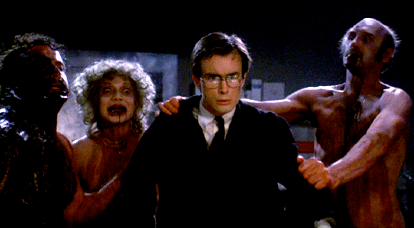
If anyone in this cast seemed custom-made for the horror genre, it was David Gale. With his angular features, deep voice, and piercing gaze, he projects authority, intelligence, and evil effortlessly. His ambitious and underhanded Miskatonic professor, neurosurgeon Dr. Carl Hill, is yet another unprincipled proponent of mad science. Hill’s supercilious pupil, Herbert West, almost has us empathizing with him, but it does not take long before the not-so-good doctor reveals his loathsome nature. Dr. Hill’s shenanigans with Megan Halsey are Re-Animator’s most notorious highlight. 


There you have it: the five characters that push around this gory gurney called Re-Animator. Aside from some bit parts in this film, everyone else is dead, which could mean that they have a lot more to do, courtesy of Herbert West and his hypos of reagent serum. 

Re-Animator was a surprise hit at the Cannes Film festival, winning a Special Prize. When presenting the film for theatrical release in the US, director Gordon thought that getting the R rating was possible, but the MPAA had become less permissive in recent years and would have gutted the barely feature length film. Producer Brian Yuzna and Gordon made the gutsy decision to release the film unrated. This earned Re-Animator a bit of notoriety, while the critics still noticed the craft and wit of a film pushing its genre limits. Cuts were made to the film to get an R rating for another theatrical release the following year. That R-rated version included some previously deleted footage to add to the less gory cut’s runtime. Re-Animator found its greatest success on home videotape releases that usually used the unrated version. Fortunately, producer Yuzna was able to secure the rights again to get Re-Animator restored in all of its unrated, gory glory for 21st-century DVD releases. 

Due to this success of what Stuart Gordon considered a blessed production, he continued to direct and write more films. While he would dabble in other subject matter, Gordon would often return to the genre he is most associated with. If Gordon had never made another film after his first, he would still be a revered horror filmmaker. His Re-Animator is a cult film that has become a classic.

STANLEY (1972)

Director: William Grefé Writers: Gary Crutcher, William Grefé Producer: William Grefé Cast: Chris Robinson, Alex Rocco, Steve Alaimo, Ma...