Showing posts with label dark comedy. Show all posts

Tuesday, June 30, 2026

EATING RAOUL (1982)

Director: Paul Bartel

Writers: Paul Bartel, Richard Blackburn

Producer: Anne Kimmel

Cast: Paul Bartel, Mary Woronov, Robert Beltran, Susan Saiger, Garry Goodrow, Dan Barrows, Ed Begley, Jr., John Shearin, Buck Henry, John Paragon, Don Steele, Edie McClurg, Richard Blackburn, Darcy Pulliam, Ralph Brannan, Hamilton Camp, Billy Curtis, Allan Rich, Anna Mathias, Richard Paul

Paul and Mary Bland (Paul Bartel and Mary Woronov) are a financially strapped, asexual, married couple living in a Los Angeles, California apartment building that is crawling with swingers. When Paul kills one of the sex-crazed partiers (Garry Goodrow) trying to assault Mary, the Blands find a lot of money on the body that they could use toward a down payment on the country kitchen restaurant that they aspire to open. It occurs to them that killing and robbing perverts they think no one will miss could quickly finance their business startup. The Blands place sex fetish performance ads in a local paper to lure more victims to their apartment.

The Flashback Fanatic movie review

Paul Bartel and Mary Woronov both had indie and underground film experience: In the 1960s, Bartel had directed his own experimental short films while Woronov appeared in famous multi-media artist Andy Warhol’s film projects. By the early ’70s, both Bartel and Woronov were working in low-budget feature films. They first worked together in the Bartel-directed Roger Corman production Death Race 2000 (1975). They would continue to collaborate in numerous films, both often playing roles together as an odd couple. Bartel decided that he and Woronov could play a couple that would be the main protagonists of a film. With that goal in mind, Bartel conceived the dark comedy Eating Raoul and gave the cult film audience the ultimate Bartel-Woronov movie.

As Paul and Mary Bland, Bartel and Woronov seem like the most reasonable people in a crass, hedonistic world. They have a lifestyle modeled after the squeaky-clean façade of 1950s media. In their apartment full of retro furniture and bric-a-brac, they sleep fully clothed in separate twin beds and are appalled by the rampant sexuality of the other tenants in their apartment building. Both at home and at work, the Blands are constantly confronted with lowbrow and debauched people.

While they are offended by this world full of crude horndogs, the Blands are just as amoral in their entrepreneurial pursuit. They feel justified killing because decent people like them are struggling, while those no-good swingers always seem to have plenty of money. Their only concern about the murders they commit is finding enough money in two weeks to make a bid on the property they want to buy for their restaurant.

The humor found in the behavior of the Blands is never at the expense of their staid character. They never relish their villainy or truly engage in the spirit of the sexual come-ons that setup their victims. Watching Mary Bland woodenly recite lines as she role plays contrasts hilariously with the rampant antics of her horny johns. Since the Bland couple agreed that Mary would never have to have sex with her clients before her fellow aspiring restauranteur Paul brains them with a frying pan, this is a case of the end justifies the means for the Blands; trickle-down economics be damned.

Soon after the Blands have new locks installed in their apartment, the shady locksmith, Raoul, breaks in at night and discovers the body of one of their recent victims. Rather than report this crime to the police, Raoul partners with the Blands. Raoul figures out more ways to profit from the Blands’ victims than just emptying their wallets.

Robert Beltran is best known for his role as Commander Chakotay on the television series Star Trek: Voyager (1995–2001). As Raoul, he is the handsome and pushy presence that manages to prompt some promiscuity out of the prudish Mary Bland. This adds complications to the Blands’ scheme and relationship.


There are many other small parts played to hilarious, tasteless perfection. Garry Goodrow, John Shearin, Dan Barrows, Ed Begley, Jr., and Don Steele are awesomely obnoxious as swingers. John Paragon is one of my favorite characters as the loudmouth sex shop cashier who always speaks in a raised voice about the sexual aids the embarrassed Paul Bland must purchase for his new, moneymaking enterprise. Paragon also played “Breather,” the sweaty, bad joke-telling creep who frequently made phone calls to Cassandra Peterson’s Elvira during her Elvira’s Movie Macabre (1985–2011) horror-movie-hosting television show. Paragon would collaborate as a writer with Peterson for her Elvira feature films Elvira: Mistress of the Dark (1988) and Elvira’s Haunted Hills (2001).

The comedic edge in Eating Raoul is maintained by not lapsing into the physically surreal. All the humor is derived from the amoral behavior and/or the bad taste excesses of nearly all the characters. The character friction is between the couple with standards and a society that seems to have none. This still allows the film, as light as it is, to satirize the do-it-if-it-feels-good hangover of the sexual revolution, while also demonstrating that sexually uptight people can be even more amoral in their entrepreneurial ambitions.

Eating Raoul was a modest success and critically well received. Bartel and Woronov reprised their Bland characters for a cameo in the 1986 techno-horror film Chopping Mall. In 1989, a sequel to Eating Raoul, called Bland Ambition, was in the works by Bartel and his Eating Raoul co-writer, Richard Blackburn. Unfortunately, the production’s funding was dropped just before filming could begin. That’s a damned shame. I don’t know if Eating Raoul’s comedic special sauce could be reformulated for a sequel, but I was salivating to be served another course à la Bland.

Sunday, September 15, 2024

THE CORPSE GRINDERS (1971)

Director: Ted V. Mikels

Writers: Arch Hall, Joe Cranston

Producer: Ted V. Mikels

Cast: Sean Kenney, Monika Kelley, Sanford Mitchell, J. Byron Foster, Warren Ball, Ann Noble, Zena Foster, Harry Lovejoy, Vincent Barbi, Ray Dannis, Earl Burnham, Drucilla Hoy, Charles ‘Foxy’ Fox, Stephen Lester, William Kirschner, Andy Collings, Curt Matson, Sherri Vernon, Mary Ellen Burke, George Bowden, Don Ellis, Mike Garrison, Richard Gilden 

Domestic cats are attacking their human owners. The ferocious felines are consumers of Lotus Cat Food. The secret ingredient in that brand of cat chow is human flesh, which turns pets into man-eaters. The corner-cutting managers of the Lotus Cat Food Company acquire their illegal additives from a local cemetery, a funeral home, and hired thugs who abduct street derelicts. The harvested bodies are fed into a corpse-grinding machine that mixes them with grain to produce that special feline delicacy. 

The Flashback Fanatic movie review 

Former magician and stage performer Ted V. Mikels had started his own film production company in Bend, Oregon making short films and documentaries. During the late 1950s, he had also done stunts for three Hollywood Westerns shot in Oregon. Once Mikels decided to start producing and directing his own feature films in the 1960s, he went the exploitation route making films with attention-getting titles and lurid posters that had to hook an audience looking for cheap thrills. The trick was to make cheap productions that could still live up to their genre hoopla. 

Operating outside of the Hollywood studio system meant struggling to scrape up funds to make feature films on incredibly low budgets. A great cost-saving measure for Mikels was having film-editing facilities in his own Glendale, California home that he called “The Castle.” Then Mikels’ live-in assortment of women he called his “castle ladies” would learn various film production duties by contributing their labor to his projects. During Mikels’ polygamous relationships with these women, he educated them in filmmaking techniques that they could use in their own film endeavors. 

It stands to reason that any director as independent and eccentric as this would make an oddball assortment of films. The quirks in a Ted V. Mikels film are usually as a result of aspiring to more than the lack of funds can provide. Nevertheless, a Ted V. Mikels film tried to check off the exploitation boxes to satisfy the drive-in crowd. This usually meant dredging up film tropes old and new realized in easily accessible locations and a few, small, studio-built sets. Many great films have been made with limited means. They used whatever they had access to and made the script and situations conform to those resources. How well a Ted V. Mikels film managed that sleight of hand usually determined its level of entertainment. 

Mikels’ most famous films are the ones blessed with the best titles: The Astro-Zombies (1968) and The Corpse Grinders. Those titles tell you exactly what your expectations should be and all those movies need to provide are lurid thrills. The challenge for Mikels was to pull that off on his miniscule budgets. The challenge for lovers of schlock is to justify our interest in these frugal productions. 

The Corpse Grinders has a title so unsavory that the only expectation for this film is to scrape the bottom of the bad-taste barrel. I find that to be a valid goal to strive for. Bad taste can be absolutely liberating for a filmmaker and the audience. Sometimes that can also become art if it has wit, a theme to explore, or a point to make.


In The Corpse Grinders, the motives of the films’ villains are as cost-conscious as the filmmakers: Do it on the cheap and still provide a profitable product. That makes perfect business sense, but that anything-for-a-buck mentality can lead to evil. While this exploitation quickie is not intent on feeding us any social message, its food for thought is that business interests are often not in the public interest. 

This may be the cheapest feature film Mikels ever made. Due to a combination of low budgets and strange wardrobe and decorating choices, Mikels’ films are always full of seedy atmosphere, but he has really outdone himself here. There are a few cramped, sparsely furnished sets. One set painted entirely white is meant to be a doctor’s hospital office furnished with little more than a small microscope suitable for a middle school biology class and a set of encyclopedias. Quincy, M.E. be damned, that’s all our surgeon and nurse protagonists need to figure out why the furious felines are using their owners’ throats for scratching posts. A few tombstones, a shallow hole in the ground, and fog machines on Mikels’ property represent a cemetery. The entire music score seems to be lifted from library tracks. Having a cast of unknowns also kept the costs down. 


What everyone remembers about this mad movie is the corpse-grinding machine and the economic ingenuity used to create it. For a whopping $38, this fiendish prop was built out of plywood and adorned with a big lever and blinking lights. A small conveyor belt passes the bodies into the front-end opening, within which we see spinning blades salvaged from a push lawnmower. At the other end of this crazy contraption, a mixture of hamburger and sawdust, representing the ground-up corpses and grain, oozes out into a grubby bucket. Bon appétit, kitties! 


While Mikels’ previous horror film, The Astro-Zombies, could boast of a few interesting names in the cast (John Carradine, Tura Satana, and Wendell Corey), The Corpse Grinders’ no-name cast is only distinguished by their characters’ eccentricities. Caleb (Warren Ball), the grave-robbing cemetery caretaker, is always gnawing on strips of beef jerky. His dotty companion, Cleo (Ann Noble), is always toting around a doll that she treats like her child. The nervous Maltby (J. Byron Foster), one of the villainous pair managing the Lotus Cat Food Company, expresses necrophilic urges. His cold-blooded partner in crime, Landau (Sanford Mitchell), is surprisingly protective of Tessie (Drucilla Hoy), the mute, one-legged, middle-aged woman employed at the cat food factory. Landau even manages to communicate with her using sign language (with gestures so repetitive that they probably translate as stuttering). All of these quirks are never elaborated on and serve no character motivation or plot purpose. They are not even exploited for broad humor. These antics are probably just meant to give these one-dimensional characters something to do, as there is nothing in the way of drama or character development going on here. 

Our heroic leads, Dr. Howard Glass (Sean Kenney) and his nurse and girlfriend, Angie Robinson (Monika Kelley), are driven to expose the cause of the cat attacks because we need a good-looking couple to root for. Since Angie’s own cat attacked Howard after eating Lotus Cat Food, I suppose it’s personal. I knew that Sean Kenney had starred in the very weird, sexploitation-horror flick The Toy Box (1971), but I was surprised to learn that he also had played the scarred, disabled, and mute Captain Christopher Pike in the two-part episode “The Menagerie” of the original Star Trek TV series (1966-1969). 

Served with cheap and sordid simplicity, I find The Corpse Grinders to be humble fare that has become an acquired taste. There is a cockeyed sense of humor seasoning this diabolical din-din that I can appreciate. When trying to turn a buck making cat food leads to grave robbing and murder, I can’t help but purr in satisfaction.

Tuesday, September 3, 2024

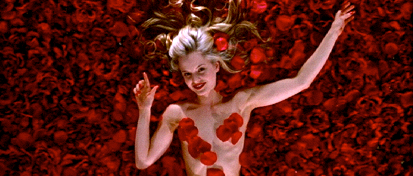
AMERICAN BEAUTY (1999)

Director: Sam Mendes

Writer: Alan Ball

Producers: Bruce Cohen, Dan Jinks

Cast: Kevin Spacey, Annette Bening, Thora Birch, Wes Bentley, Mena Suvari, Chris Cooper, Peter Gallagher, Allison Janney, Scott Bakula, Sam Robards, Barry Del Sherman, Amber Smith, Brenda Wehle, Lisa Cloud, Marisa Jaret Winokur, Dennis Anderson, Joel McCrary, Matthew Kimbrough 

42-year-old Lester Burnham (Kevin Spacey) has been employed ad writing at a magazine for the past 14 years. He is stuck in a joyless, middle class, suburban lifestyle with his career-obsessed, real-estate-agent wife, Carolyn (Annette Bening), and his emotionally distant, teenaged daughter, Jane (Thora Birch). When Lester meets his daughter’s beautiful, blonde classmate, Angela Hayes (Mena Suvari), Lester is smitten and has a midlife awakening. He has ongoing fantasies about young Angela and shirks his adult responsibilities. Lester’s new attitude exacerbates the dysfunction in the Burnham household. 

The Flashback Fanatic movie review 

So, this lover of the lowbrow is reviewing a film that won five Oscars including Best Picture? “Where the hell are my standards?” you scream. Well, it is a pretty old film by now and still an odd one after a quarter century. Er—and uh—well, it’s also kind of transgressive. That’s gotta count for something, right? And—uh—it’s just a great film, dammit! But fear not, for I shan’t start sipping tea with my pinky finger extended while I extol the virtues of prestigious cinema. Trust me. I shall soon resume reviewing my regularly scheduled selection of significant schlock. American Beauty has reinforced my value of being true to oneself. 

I remember first seeing American Beauty in the theater way back in 1999 and really enjoying it. It capped off a decade of indie films that were a relief from Hollywood blockbusteritus. The quirky and personal films getting noticed were welcome alternatives to franchises, generic action hero product, and evermore-bloated “high concept” effects shows trying to engage the video game crowd. While American Beauty, with its $15-million budget on a DreamWorks Pictures production and distribution deal, was hardly down-and-dirty, guerilla filmmaking, it was still made in the indie spirit by refusing to fit neatly into an easily marketed genre. The time was still ripe for another eccentric, challenging, and heartfelt movie. 

The moral in this film may seem obvious: Achieving status and maintaining a lifestyle does not always lead to happiness. However, that is a message that could not be shouted loud enough in the go-go ’90s. Much of America’s so-called freedom has always been about working hard to conform to the routines that will make the money needed to create an image that makes us feel worthy. Always striving to pass the judgment of others to feel accepted and admired is a trap. 

The central event in the story is the midlife crisis suffered by Kevin Spacey’s character. His Lester Burnham does his unfulfilling job for management that he has no respect for. His career is just a means to help provide for a family he feels disconnected from. His sudden infatuation with his daughter’s friend knocks Lester out of his midlife malaise. He is not yet so old that he can’t change, but time’s a-wastin.’ 


Lester begins to rebel by not giving a shit about going through the establishment motions in his life anymore. Now he can tell people exactly what he means and confront their own insincere behavior. I practically stand up and cheer when Lester quits his job while coercing his manager into giving him a decent severance package. Damn, this guy’s a slacker superhero! Then he immediately finds the least demanding job he can think of: flipping burgers like he did back in high school. We are soon treated to the ongoing fallout from this development at the family dinner table where Lester demonstrates that the domestic worm has turned. 


That will-they-or-won’t-they moment between Kevin Spacey’s middle-aged Lester and young Mena Suvari’s Angela really got to me. Everything is perfect: performance, pacing, and lighting complimented by the wonderful source music of Annie Lennox covering Neil Young’s “Don’t Let It Bring You Down” playing on the stereo. Helluva scene. It’s one last gasp of real movie magic before the following century’s cinema would pander to an attention-span-challenged audience with relentless shaky cam, quick cuts, and digital tweaking for practically every goddamn frame of “film.” 

That narration of Kevin Spacey’s character opening the film by letting us know he is already dead is novel, though not original. As director Sam Mendes himself acknowledges, Sunset Boulevard (1950) also began its dystopian look at the Hollywood lifestyle with narration from a dead character. It makes some satirical sense to use that same technique here in a picture about a different dystopian dead end located in American suburbia. It also imparts a bit of tension underlying the whole film leading to the protagonist’s death. 

All of the main adult characters in American Beauty begin this story locked into identities that keep them from being happy and true to themselves. Their issues result from a lack of self-esteem. Jane’s fellow cheerleader, Angela, is also well on her way to falling into the same adult trap of affecting an image and reputation that she thinks will make her better than ordinary. 


The two characters that clearly view their world and those around them are teenagers Jane Burnham and her next-door neighbor and classmate, Ricky Fitts (Wes Bentley). They have their own issues due to the dysfunction of their families. Probably as a result of no emotional bonding and reassurance from her parents, Jane is dealing with her own sense of inadequacy as she is already saving her money for a “boob job.” The voyeuristic Ricky uses his video camera to capture the beauty that only he perceives in the real world. Ricky seems almost ethereal in his remote calm that has resulted from the emotional disconnect he has developed coping in the rigidly disciplined household commanded by his ex-Marine father, Col. Frank Fitts (Chris Cooper). 


All of this seems to be adding up to a dismal kitchen sink drama that can spill over into preachy moralizing. That is hardly the case here. Lester Burnham’s midlife rebirth exposes this film’s truths in amusing ways. It never devolves into a lifestyle farce, but it does create moments that are funny for being recklessly liberating. 

Of course Kevin Spacey won the Best Actor Oscar for a performance here that works because most of the time he seems subdued. His Lester Burnham character is established as repressed and seething with resentment about his life and family. Once he has his midlife attitude conversion, he indulges himself with youthful abandon and rejects any status-dictated responsibilities. However, there are still unresolved dissatisfactions in his home life that can break through that don’t-give-a-damn calm. It is the direction, writing, and cinematography that does the stylish heavy lifting while Spacey’s mundane sincerity rings true. 

There are many other fine performances. Annette Bening’s manic Carolyn becomes almost grotesque in her career-fixated fundamentalism. Thora Birch’s Jane goes beyond sadness to disaffection in her character’s lack of self-esteem. Birch would go on to star in my favorite film of the next century, that quirky delight Ghost World (2001). Wes Bentley exudes a calm confidence as Ricky Fitts that is as much of an influence on Lester’s new attitude as the Angela fixation. Chris Cooper’s intense performance as Ricky’s hard-ass, control-freak father gives us a character that is both despicable and pathetic. Finally, Mena Suvari’s vain and shallow Angela is funny, yet she surprises us with her vulnerability. 

American Beauty skewers the middleclass mainstream’s empty vanity. It does this all in a darkly humorous manner that can be quirky, distressing, and cathartic. It all ends by challenging us to accept a philosophy embracing truth and appreciating life experience rather than lamenting lost goals.


WARNING: COMMENTS CONTAIN SPOILERS!

Friday, October 27, 2023

THE COMEDY OF TERRORS (1963)

Director: Jacques Tourneur

Writer: Richard Matheson

Producers: James H. Nicholson, Samuel Z. Arkoff

Cast: Vincent Price, Peter Lorre, Boris Karloff, Basil Rathbone, Joyce Jameson, Rhubarb (the cat Cleopatra), Beverly Powers (as Beverly Hills), Linda Rogers, Joe E. Brown, Luree Holmes, Alan DeWitt, Buddy Mason, Douglas Williams, (and uncredited cast) Paul Barselou, Harvey Parry, Charles Soldani 

In 19th century New England, underhanded undertakers Waldo Trumbull (Vincent Price) and Felix Gillie (Peter Lorre) are so destitute that they have used a single coffin for the last thirteen years. Once the mourners leave the graveside after each funeral service, Trumbull and Gillie dump the corpse into the hole and bury it to keep reusing the same casket. In spite of such economizing, their rent is a year overdue. Trumbull decides that they must resort to murder to generate more business. 

The Flashback Fanatic movie review 

During American International Pictures’ heyday of Edgar Allan Poe story adaptations, they followed up their Poe-inspired horror-comedy The Raven (1963) with The Comedy of Terrors. The latter film is not a Poe-based project and, surprisingly, not even contrived to be marketed as one. After all, AIP was the studio that tried passing off an adaptation of H.P. Lovecraft’s novel The Case of Charles Dexter Ward as a Poe adaptation by calling it The Haunted Palace (1963), merely using the title of one of Poe’s poems. Despite The Comedy of Terrors taking place in the Poe-appropriate setting of 19th century New England and dealing with that Poe-story peril of premature interment, AIP were content to just deliver another comedy dealing with period piece horror situations without a Poe reference. They probably thought that, between the gothic horrors of Britain’s Hammer Films and their own Poe adaptations, the popularity of classic horror was now firmly established and would contrast enough with humor for The Comedy of Terrors to create an interest all its own. 

The Comedy of Terrors has the talent to make it an absolute joy for the classic horror fan. Genre film stalwarts Vincent Price, Peter Lorre, Boris Karloff, and Basil Rathbone are given the chance to play comedy to the hilt. It is clear that they are enjoying themselves bringing to life the morbid slapstick, crass behavior, and bumbling antics in Richard Matheson’s fun script.

Another surprise is that Roger Corman was not this film’s director. Corman had directed all of the previous Matheson-scripted Poe films. That team seemed to be a safe bet at the box office for AIP’s period piece horror films, including the recent horror-comedy The Raven. Matheson had suggested that Jacques Tourneur direct. Best known as the director for several of producer Val Lewton’s atmospheric and thoughtful horror classics of the 1940s, one of the greatest film noirs with Out of the Past (1947), and the intense British supernatural thriller Night of the Demon (1957), Tourneur may seem like an odd choice to direct a comedy, even if it has macabre aspects. Matheson had been impressed with Tourneur’s thorough preparation and efficiency when directing the Matheson-scripted episode “Night Call” of The Twilight Zone television series (1959-1964). Matheson’s instincts paid off. Tourneur’s direction must have agreed with the entire cast who give spirited performances that result in plenty of laughs. 

Vincent Price is every bit as accomplished in his comedy here as he had been with the horror that is a large part of his cinematic reputation. He is hilariously despicable as the unprincipled, sarcastic, and ill-tempered drunkard Waldo Trumbull. My favorite aspect to this comedy is the oh-so-refined manner that Price’s Trumbull knowingly affects that contrasts with the true crassness of his character. One of the funniest line deliveries I have ever heard is when Price says, “Remove the carcass.” 

As Felix Gillie, Waldo Trumbull’s oppressed and bumbling lackey, Peter Lorre has our sympathy while still earning laughs. Gillie’s lack of ability is apparent at all times. Whether trying to build a coffin, breaking into a house, or even correctly pronouncing Trumbull’s name, Gillie never manages to accomplish much more than irritating his employer. Trumbull keeps Gillie under his thumb because he knows of Gillie’s criminal past and thinks that Gillie has no choice but to remain as Trumbull’s unscrupulous, undertaking assistant. 

Boris Karloff makes a seemingly thankless role as a doddering and ineffectual old man into another comedy highlight. As Amos Hinchley, he is the senior partner of the Hinchley & Trumbull Funeral Parlor. Being hard of hearing, tired, and senile, Hinchley is oblivious to the treachery of his partner. Trumbull’s favorite drunken game is trying to offer the old man “medicine” from a clearly labeled bottle of poison. When Hinchley’s daughter, Trumbull’s neglected wife Amaryllis, keeps preventing her father from being poisoned, Hinchley whines that nobody cares whether or not he lives or dies since he can’t take his “medicine.” 

Making the despicable Waldo Trumbull even more unreasonable is his disdain for his voluptuous wife. The beautiful blonde Amaryllis tries to be faithful to her habitually drunk husband despite his insults and ill temper. Apparently, Amaryllis is stuck in this marriage to her father’s amoral business partner. It must be said that her ear-splittingly awful attempts at operatic singing would test anyone’s patience except her nearly deaf father and the love-struck Felix Gillie. As Amaryllis, Joyce Jameson adds to the silliness with her character’s total lack of self-awareness regarding her terrible singing voice and her ambition to be an opera singer. 

It is interesting to consider that in the 1962 AIP film Tales of Terror, during the segment adapting Poe’s “The Black Cat,” the acting trio of Price, Lorre, and Jameson also played out the situation of the destitute inebriate not appreciating his luscious wife who is charmed by an associate. Price and Lorre are actually almost playing reversed roles in The Comedy of Terrors. Peter Lorre’s role in “The Black Cat” was that of the crude, drunken lout neglecting Joyce Jameson as his wife who falls for the refined and appreciative wine taster played by Vincent Price. Lorre and Price were in fine, if more subdued, comic form there, as well. 

Another cast member from Tales of Terror is Basil Rathbone. Here his John F. Black is the landlord threatening Waldo Trumbull with eviction, which inspires the unsavory undertaker to commit murder to get paying customers in a hurry. Rathbone’s Black is a devotee of Shakespeare and indulges himself acting out with hammy excess scenes from the Bard’s plays. In Poe fashion, Black is afflicted with frequent deathlike spells from catalepsy that keep the audience and the shifty undertakers wondering if he is ever really going to die. 

I can’t recall ever seeing a film where it was more evident that everyone involved must have been having a great time making it. The Comedy of Terrors is a farce that should also give every fan of classic horror a great time watching it.

Saturday, October 7, 2023

SPIDER BABY (1964/released 1967), aka CANNIBAL ORGY, THE MADDEST STORY EVER TOLD, THE LIVER EATERS

Director: Jack Hill

Writer: Jack Hill

Producers: Paul Monka, Gil Lasky

Cast: Lon Chaney, Jr. (as Lon Chaney), Quinn Redeker, Carol Ohmart, Jill Banner, Beverly Washburn, Sid Haig, Mary Mitchel, Karl Schanzer, Mantan Moreland, Joan Keller Stern, Carolyn Cooper 

Due to inbreeding, many generations of the Merrye family have been afflicted with a genetic disorder. At about ten years of age, the Merrye Syndrome causes mental regression. Eventually, the Merryes devolve into a deformed, bestial state. Bruno (Lon Chaney, Jr.) is the chauffeur and caretaker for the last surviving members of the Merrye family line. Bruno swore to his late master that he would always look after the Merrye children, Virginia (Jill Banner), Elizabeth (Beverly Washburn), and Ralph (Sid Haig). Now fully grown, these three siblings have begun mentally regressing to become increasingly childish and emotionally unstable. They can also be quite dangerous if not supervised. When the distant cousins of the Merryes, Peter Howe (Quinn Redeker) and his sister Emily (Carol Ohmart), arrive at Merrye House to become heirs to the Merrye estate and the legal guardians of the Merrye children, there is conflict created by the inevitable upheaval of the Merrye family. 

The Flashback Fanatic movie review 

The term “cult film” gets thrown around a lot these days. Spider Baby is exactly the sort of movie that deserves such a label. It may have been ahead of its time, yet it was almost impossible for its merits to be noticed. It was not released for three years after its completion, and then it had only very limited theatrical releases. Much later it was subjected to years of subpar home videotape presentations. Despite all of these setbacks, Spider Baby mania spread slowly but surely. Decades after its production, Spider Baby was finally discovered and appreciated as a morbid, madcap classic. 

Familial phobia must have been highly contagious back in 1964. Writer-director Jack Hill was finishing the filming of his Spider Baby just as television debuted two classic series about creepy families: The Addams Family (1964-66) and The Munsters (1964-66). While much of the humor in those sitcoms is the result of the weird families either taking pride in their eccentricities or being completely oblivious to their “not fitting in,” Spider Baby’s humor is of a more dark and disturbing sort. 

In addition to the dangers in the dilapidated Merrye House, there are plenty of giggle-worthy, uncomfortable moments. The dinner scene is absolutely brilliant in its succession of one unsavory and inappropriate comment and incident after another. I bust out laughing every time I see the fresh garden greens being served. 

Lon Chaney, Jr., is the top-billed star bound to lure the horror film fans. This was probably Chaney’s last worthy film role. Chaney relished the chance to play the lead in a story laced with dark comedy. As Bruno, the Merrye family caretaker, Chaney displays paternal compassion, stress, and sorrow. He also makes statements that increase apprehensions about this crazy situation. Since his character is protecting the Merrye family by hiding their secrets and crimes, we are never sure what sort of threat he may pose. His Bruno certainly seems to have been affected by the isolation he shares with the strange Merrye family. 

The most oft-told behind-the-scenes anecdote about Spider Baby is the five-minute ovation Chaney received from fellow members of the cast and crew after the tearful talk that his character has with the Merrye “children” as things have gotten way out of hand. Even at this late stage of his career, the underappreciated Chaney could still be as touching as ever. He really adds heart to this creepy and crazy flick. 

In her very first film role, 17-year-old Jill Banner appears as the title character. Her Virginia is the spider-obsessed member of the Merrye family. Her favorite game is “playing spider.” This involves a net Virginia uses as her spider web and butcher knives. Whenever Virginia takes a dislike to someone they remind her of a bug, which means they are spider prey. 

Exploitation movie veteran Sid Haig was off to a running start playing unpleasant characters in his early film role here as Ralph, the oldest and most regressed of the Merrye children. He is mute, infantile, and makes every interaction uncomfortable. His manners are non-existent. Ralph never learned the lesson called “Don’t Stare.” Unfortunately, he indulges in even more offensive behaviors. 

With a long career as a child actor already behind her, Beverly Washburn plays Elizabeth Merrye. Poor old Bruno is always relying on her to be the most responsible of the three afflicted Merrye “children.” With every eye roll and tilt of her head, we know that she is not to be trusted for a minute. Despite Bruno’s admonitions not to hate, Elizabeth always finds reasons for others to be hated. 

Many years later, actor Quinn Redeker was still befuddled as to why Spider Baby was still remembered and revered by its fans. This may be a reflection of his ambivalence about his approach to his role of Peter Howe. Director Jack Hill thought Redeker played it just right, and I would agree. Peter Howe is supposed to be a “normal” and distant relative to the afflicted Merrye family. But he has a dense benevolence that seems to be in denial of the uncomfortable situations and consequences around him. Rather than being the one we expect to restore the social order, Redeker’s willfully ignorant Peter Howe makes us almost as uneasy as the Merrye House residents. 

Carol Ohmart was a former Miss Utah and the fourth place contestant in the 1946 Miss America pageant. Ohmart would go on to many film appearances and guest-starring television roles, but she is probably best remembered for her horror films House on Haunted Hill (1959) and Spider Baby. Here Ohmart plays the greedy, gorgeous Emily Howe, the older sister to the amiable Peter. When Omart’s cold and deliberate character lets her hair down to indulge herself in private by modeling vintage lingerie from a Merrye House closet, it’s an absolute showstopper. Unfortunately, eavesdropping Ralph likes what he sees… 


Karl Schanzer is the lawyer Mr. Schlocker, and Mary Mitchel plays his lovely secretary, Ann. Schanzer’s Schlocker never really does anything wrong, yet his manner is so stuffy and unctuous that you can’t help but dislike him. Of course, he is also facilitating the legal disruption of the Merrye household. Small wonder that spider-fixated Virginia considers him another bug, which is never a good sign. However, everyone seems to like Mitchel’s Ann. That still doesn’t mean that Mitchel won’t have to prove her worth yet again as what director Roger Corman considered “the perfect victim.” 


Old-time film comedian Mantan Moreland had provided comedy relief in plenty 1940s mystery and horror films. He was chauffeur Birmingham Brown to Sidney Toler’s Charlie Chan in the detective film series from Monogram Pictures. Moreland makes an appearance in Spider Baby’s first creepy scene. This establishes the unpredictable and uneasy vibe for the rest of the film. 

Composer Ronald Stein’s music deserves a special mention. He had scored plenty of ’50s and ’60s sci-fi and horror film favorites. In the first of this film’s many offbeat highlights, Stein’s opening theme for Spider Baby is accompanied by Chaney’s lines of demented poetry to really set the crazy pace for this warped film. 

With a cast like this and an eccentric and inspired script by director Jack Hill, it’s a damned shame that it took so long for Spider Baby to get its due. It is a variation on the old-dark-house thrillers of the past while anticipating some of the corruption of family values to be seen in later films like The Texas Chainsaw Massacre (1974), The Hills Have Eyes (1977), and The Unseen (1980). I think Carol Ohmart was onto something when she wondered if Spider Baby would be nominated for an Oscar. Sure, I may be twisted, but Carol Ohmart can do no wrong!

STANLEY (1972)

Director: William Grefé Writers: Gary Crutcher, William Grefé Producer: William Grefé Cast: Chris Robinson, Alex Rocco, Steve Alaimo, Ma...