Showing posts with label Roger Corman. Show all posts

Sunday, February 5, 2023

NOT OF THIS EARTH (1988)

Director: Jim Wynorski

Writers: R.J. Robertson, Jim Wynorski, based on the original 1957 film script by Charles B. Griffith and Mark Hanna

Producers: Murray Miller, Jim Wynorski

Cast: Traci Lords, Arthur Roberts, Roger Lodge, Lenny Juliano, Rebecca Perle, Becky LeBeau, Ace Mask, Michael Delano, Kelli Maroney. Monique Gabrielle, Roxanne Kernohan, Ava Cadell, Cynthia Thompson, Belinda Grant, Joel Hoffman (as Robby Bointon), Kim Sill (as Kimberly Dawn), Ed Morgan, Murray Miller, Zoran Hochstätter, Shawn Klugman, John Dresden, Paul Shaver, R.J. Robertson, Bob Sheridan 

A series of blood-draining murders are being committed in Los Angeles, California. The perpetrator calls himself Mr. Johnson (Arthur Roberts). He is actually an alien being from the planet Davanna. Johnson’s mission is to determine if the blood of earthlings can sustain his dying race. If the blood is compatible, Davanna will invade the Earth and enslave mankind as a food source. While on his mission, the mysterious Mr. Johnson hires Nadine Story (Traci Lords) as his live-in nurse to administer the blood transfusions he needs to stay alive. 

The Flashback Fanatic movie review 

With very few exceptions, film remakes are inferior to the originals and can ruin the viewers’ enjoyment of later seeing the earlier superior productions if too much is simply rehashed. Of course, most remakes just regurgitate a proven formula with the understanding that many modern-day morons will lap it up just because it is new and therefore must be even better the next time around. Using that same logic, such an audience will probably also eat their own vomit. 

Some remakes are worthy if they only use the main plot hook of the original production and then try to tell a different story. The end result may or may not be better than the original, yet it can still be an interesting and satisfying film judged on its own merits. 

In 1988 director Jim Wynorski made a bet with executive producer Roger Corman. Wynorski wagered that he could remake Corman’s 1957 sci-fi fright flick Not of This Earth for the same inflation-adjusted budget and the same number of shooting days. 

Much of the success this remake enjoyed as a video store rental and cable television favorite was due to the inspiration that director Wynorski had in choosing his leading lady. The beautiful Traci Lords had been a popular adult film star. She became a household name when it was discovered that she had been performing in pornographic films as a minor while pretending to be an adult. Wanting to establish herself as a mainstream actress, Lords accepted the role of nurse Nadine Story. In addition to her beauty always being flaunted in and out of a succession of sexy outfits, she brings a lot of the confidence to the role that Beverly Garland’s character had in the original 1957 version. I am sure much to director Wynorski’s relief, Traci Lords could really act and helps make an almost word-for-word remake worthwhile. This was Lords’ first non-porn feature film, and she would go on to have a long and varied career in film, television, and music. 

Arthur Roberts takes on the alien menace role of the deadpan Mr. Johnson. Just as in the original Paul Birch performance, his emotionally empty and socially ignorant manner is a funny contrast to various earthlings he confronts. 

Roger Lodge fills in for Morgan Jones as Nadine Story’s motorcycle cop boyfriend Harry Sherbourne. In 1988 this character and the audience have the advantage of a bit of soft-core sex occurring with the leading lady. 

Lenny Juliano is cast here in the Jonathan Haze role of Mr. Johnson's ex-con chauffeur Jeremy. Juliano pushes the humor even further than in the 1957 original. He seems to be having a real ball ogling Nadine and any other sexy gal in the course of this refabbed flick.

In addition to the re-enactment of the classic vacuum cleaner salesman scene with Michael Delano subbing for Dick Miller, we also have the unreceptive Mr. Johnson being accidentally entertained by gorgeous Becky LeBeau’s strip-o-gram girl. LeBeau is quite charming as she discovers that she read the address wrong when delivering her voluptuous happy birthday message. Her fate is really heartbreaking. 

In this 1988 remake, Mr. Roberts picks up a threesome of sexy prostitutes (Roxanne Kernohan, Ava Cadell, Cynthia Thompson) instead of a trio of drunken bums to bring home for more blood specimens. Swapping out hobos for hookers is yet another inspired Jim Wynorski innovation. Would you rather listen to inebriated singing again or ogle bared breasts? I think Wynorski made the right call. 

In 1988 when another Davanna denizen arrives, it is not a lady dressed like Mr. Roberts in sunglasses and conservative business attire. Instead, it is lovely Rebecca Perle in sunglasses and black straps somehow configured to approximate a swimsuit. 

As should become apparent by now, 1988’s Not of This Earth was striving to be a sexed-up version of the original film. Aside from the nudity, it is almost exactly the same story. 

The only other notable deviations here from the 1957 film are a few optical effects, no flying umbrella monster, and a new angle on the rabies-infected blood gimmick. That last deviation is actually such a seemingly obvious direction to take that I am surprised it was not exploited in the original version. It also sets up a big chunk of footage from Hollywood Boulevard (1976) to be inserted into this film to brazenly pad out the running time. There are also lengthy clips of Humanoids from the Deep (1980) somehow incorporated into this story. Al Adamson ain’t got nothing on Jim Wynorski. 

Ultimately, 1988's Not of This Earth is a copycat of the original 1957 film that fills out its longer running time with some shameless repurposing of unrelated footage from earlier Roger Corman productions. By my highfalutin standards I should hate this movie. However, it is still done with energy and a sense of fun that is infectious. Translation: There is a lot of T&A on display. I think Roger Corman himself would have done the same thing if he could have gotten away with it back in 1957.

Tuesday, January 31, 2023

NOT OF THIS EARTH (1957)

Director: Roger Corman

Writers: Charles B. Griffith, Mark Hanna

Producer: Roger Corman

Cast: Beverly Garland, Paul Birch, Jonathan Haze, Morgan Jones, William Roerick, Anna Lee Carroll, Dick Miller, Roy Engel, Gail Ganley, Ralph Reed, Harold Fong, Tamar Cooper, Pat Flynn, Barbara Bohrer, Lyle Latell, (and uncredited cast members) Jan Boleslavsky, Tom Graeff, John Clark, Hank Mann, Charles B. Griffith 

Nadine Storey (Beverly Garland) accepts a position as a live-in nurse at the Los Angeles, California home of the stoic and impersonal Mr. Johnson (Paul Birch). Nadine is to administer blood transfusions to Johnson who claims that he is dying from a rare blood disease. Johnson is actually an agent from the planet Davanna and is responsible for a series of murders. The blood that he drains from his victims is sent back to his home planet for analysis. Should the earthling blood prove beneficial to Johnson’s dying race, Davanna will invade Earth and enslave mankind to be cattle for the aliens to feed upon. 

The Flashback Fanatic movie review 

Not of This Earth is another stellar example of how the right mix of script, pace, performance, and wit make for a very entertaining film, regardless of its low budget and short shooting schedule. I think it is with this film that director Roger Corman really began to hit his stride. While production efficiency and economy were always foremost in Corman’s mind when directing his films, it is no accident that this and many other Corman productions turned out to be fresh and satisfying. Some very savvy preproduction planning allowed him to get things done quickly and properly. Corman also has the taste to be sure that a script has the offbeat elements to distinguish a story while delivering the gimmicks to meet the genre’s audience expectations. 

Scriptwriter Charles B. Griffith was one of director Corman’s greatest assets. From a brief story suggestion or genre gimmick, Griffith could develop an interesting story full of snappy dialogue with as much humor as the project required. Griffith, along with co-writer Mark Hanna, provide Not of This Earth with the novel science fiction concepts, wit, and surprises that make all the difference. 

Truly using a less-is-more approach, the story employs an interesting sci-fi variation on vampires. This gives us a humanoid menace that is easier to achieve for the filmmakers and more interesting for the audience. Just a pair of milky white eyes capable of frying one’s brain is every bit as startling and probably more effective than the menace of some sort of inhuman monster prop. 

This space vampire is also an interesting personality. Always dressed in a business suit and tie, wearing dark glasses to conceal his blank alien eyes, and speaking in a stilted and formal manner, actor Paul Birch still manages to make us believe in his Mr. Johnson as an actual alien being rather than just a stiff caricature. As Mr. Johnson, Paul Birch is both menacing and amusing. However, his character is never played for campy humor. This feels a lot smarter than the in-our-face attempts at postmodern hipness many later films would strive for to compensate for the lack of any originality. Birch’s character is funny when a bit off in his interactions with the “Earth subhumans” and almost earns our sympathy when confounded by traffic laws or a pushy door-to-door salesman. It is light touches like these that make a simple film lively and involving while validating a strange character. 


A frequent star in Corman’s ’50s films, Beverly Garland is the heroine. As nurse Nadine Storey, she may end up as a damsel in distress, yet she is intelligent and confident. She provides the film a bit of sex appeal while never being the least bit intimidated by the initial sexual harassment of Mr. Johnson’s ex-con chauffeur Jeremy Perrin (Jonathan Haze). 


Jeremy is another example of the cleverness in the screenplay’s character development. At first we assume that he will be just an obnoxious thug deserving punishment. Despite his introductory lechery of Nadine, he actually becomes something of a confidant of hers as they compare notes about their mysterious employer. This is probably Jonathan Haze’s best role. He plays someone that we actually learn to like who also keeps things lively and amusing. Of course, Haze is best known as the dim-witted protagonist Seymour Krelboin of the Corman-directed/Griffith-written 1960 cult comedy The Little Shop of Horrors. 

Dick Miller’s brief appearance is always fondly remembered. In one of the film’s best scenes, Miller portrays the persistent door-to-door vacuum cleaner salesman offering a free demonstration of his product. Ironically, Mr. Johnson decides to demonstrate his blood suction device instead. 

There are other quirky bits of business in the film that make it truly distinctive: teleportation instead of spaceships used to travel through space, telepathy, a floating umbrella-shaped monster assassin, and rabies-infected blood. 

The grimmest aspect in the film is the Nazi-like attitude about the aliens’ plans. No doubt considering themselves a master race, they refer to earthlings as subhumans as if to justify their intent of turning mankind into an enslaved food source. In another unpleasant reminder of World War II atrocities, Mr. Johnson uses his large basement furnace as a body-disposing oven. That all of this takes place in a mundane suburban setting makes the situation relatable while also creating a bizarre and unsettling contrast. 

For many years Not of This Earth was the Roger Corman film that I had most anticipated. When I finally got the chance to see it, I found it well worth the wait. Like many of my film favorites, it does not just pacify me; it amuses, surprises, and involves me. That is why this Earth subhuman can’t stop looking at it.

Monday, May 30, 2022

DEATH RACE 2000 (1975)

Director: Paul Bartel

Writers: Robert Thom, Charles B. Griffith, adapting Ib Melchior’s original short story “The Racer”

Producer: Roger Corman

Cast: David Carradine, Simone Griffeth, Sylvester Stallone, Mary Woronov, Louisa Moritz, Roberta Collins, Fred Grandy, Don Steele (as The Real Don Steele), Joyce Jameson, Carle Bensen, Martin Kove, Leslie McRay, Sandy McCallum, Harriet Medin, Wendy Bartel, Bill Morey, William Shephard, Vince Trankina, Paul L. Ehrmann (as Paul Laurence), John Favorite (as Jack Favorite), John Landis, Sandy Ignon, Darla McDonnell, Roger Rook, Paul Bartel (uncredited), Lewis Teague (uncredited), Charles B. Griffith (uncredtited), Dick Miller (uncredited)

In the year 2000, the United States has become a totalitarian society. It provides the public the distraction and spectacle of the annual Transcontinental Road Race. The racers not only compete to traverse the country in the fastest time, but they also must score points for the kills they make by running over pedestrians. The current champion is Frankenstein (David Carradine). He is so named because of his many racing injuries and surgical reconstructions. In addition to the dangers he and the other drivers face in their sport, there are anti-government rebels attempting acts of sabotage against the race.

The Flashback Fanatic movie review

Celebrity worship, totalitarianism, and dumbing down of the masses are present day concerns that were quite aptly addressed back in 1975 with the dystopian future portrayed in Death Race 2000. Like many Roger Corman productions, it first and foremost means to entertain; yet it still has themes to explore without preaching.

I think the film’s most pertinent point is the depiction of the manic enthusiasm of the fans for the sport and its champions. This gaudy and brutal distraction of the Transcontinental Road Race entertains and ultimately pacifies the citizens. It also cheapens the merit of human life to being worth no more than points to be scored by the racing heroes that they adore. This removes the motivation to demand that a government dedicated to “minority privilege” be responsible for the well being of all the people. The public is idiotically devoted to an entertainment they want to believe has some sort of meaning; it must if it makes them feel good, right? So long as the citizens don’t ever ask themselves what difference a winning score in a sport has to do with anyone’s quality of life, they should be happy.

The film is loosely based on an Ib Melchior short story called “The Racer.” That story also details a futuristic road racing sport that involves scoring points for running down pedestrians. It is told from the perspective of the champion racer being confronted about the morality of such real-life violence used to entertain. Death Race 2000 expands the story to include more characters and additional themes in a satirical manner. 

The wild and witty screenplay is by Robert Thom along with producer Roger Corman’s inventive and humorous writing veteran Charles B. Griffith. Director Paul Bartel has always distinguished himself both in front of and behind the camera in films of bizarre comedy. While many of the characters are laugh-out-loud funny, they all seem to be appropriate to the shallow and empty world of this future dystopia.

Having just wrapped up his popular Kung Fu television series, David Carradine stars as the racing champion called Frankenstein. While nearly every other character is a loutish caricature, Frankenstein is an intriguing enigma. In public he is always hidden behind a mask supposedly to conceal his road accident scars. His manner is stoic while most of those around him are eccentric and volatile. Whether this was a writing choice, a directing decision, or just Carradine’s acting style, I think it is this restraint in an exotic character that makes him interesting and keeps Frankenstein the hub around which the rest of the story revolves.

The other standout in the cast has to be Sylvester Stallone as the hilariously belligerent racer Machine Gun Joe Viterbo. He is both funny and despicable. Being jealous of Frankenstein’s popularity, Viterbo always has a chip on his shoulder and is ready to dole out violence to anyone. Just one year later, the struggling actor Stallone would achieve lasting stardom in Rocky (1976). 

Cult film favorite and frequent Paul Bartel co-star Mary Woronov appears as the racer Calamity Jane Kelly. Unlike the other characters in this film, she actually seems quite likable. 

Special mention must go out to Don Steele as the obnoxious race announcer Junior Bruce. His hyperbole and gung-ho puns keep stressing the superficiality of this race and this society. 


Aside from the humor, the major fun factors in this film are the attention-getting personas worked out for the racers that are complimented by the design of their vehicles. Since Frankenstein is named after a famous monster, his vehicle is called “The Monster” and is decked out like a dragon with huge fangs protruding from the front bumper. The other racers each have their own appropriately adorned cars. 

At this film’s most visceral level, it provides forbidden appeal with the depiction of sanctioned vehicular homicide. There is a sense of sick liberation in the notion that one becomes a hero for violating the rules that we are conditioned to follow as good drivers and citizens. That is the main reason that Death Race 2000 became a very successful film. 

Obviously concocted to cash-in on the futuristic blood sport vibe of the soon-to-be-released Rollerball (1975), Death Race 2000 approaches its subject in a much more freewheeling and humorous manner, yet it is just as thought provoking. Being an exploitation film that has themes worth pondering along with its action and laughs meant that Death Race 2000 was bound for cult status.

Sunday, August 1, 2021

A BUCKET OF BLOOD (1959)

Director: Roger Corman

Writer: Charles B. Griffith

Producer: Roger Corman

Cast: Dick Miller, Barboura Morris, Julian Burton, Antony Carbone, John Shaner, John Brinkley, Ed Nelson, Bert Convy, Myrtle Damerel, Judy Bamber, Jhean Burton, Bruno VeSota, Lynn Storey, Alex Hassilev (singer-guitarist uncredited), Paul Horn (saxophone player uncredited) 

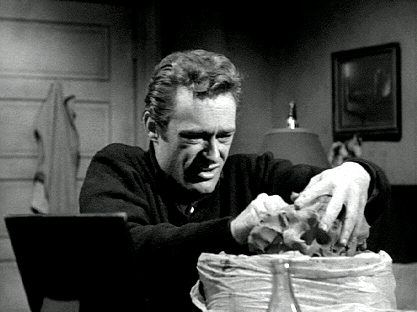
Walter Paisley (Dick Miller) is the lonely and slow-witted busboy at The Yellow Door, a beatnik coffeehouse. Walter wants to be accepted by the artsy bohemian crowd at the coffeehouse and to win the affections of pretty artist Carla (Barboura Morris). Inspired by the resident beatnik poet Maxwell’s (Julian Burton) recitations proclaiming the virtues of art and creativity, Walter strives to be a sculptor. He compensates for his lack of talent by molding clay over the bodies of his murder victims. 

The Flashback Fanatic movie review

Hey, get hip to this hepcat horror mini-masterpiece! A Bucket of Blood is one of my all-time favorites. This film is a horror-comedy just as unique and quirky, yet more touching and thought provoking, than the more famous Corman directed/Griffith written follow-up The Little Shop of Horrors (1960). A Bucket of Blood is a little gem of many facets. Like the best films, especially in the horror genre, A Bucket of Blood settles us intimately into its environment and characters. The storyline is simple and so are the characters, but those people are all distinctive and interesting. That all of this is achieved in just over an hour while delivering so much humor, pathos, and satire along with its horror is admirable.


The film begins with a series of long and mobile shots that immediately immerse us in this beatnik culture. As the film’s title and credits are displayed, the camera moves from the close-up of poet Maxwell reciting his latest verse to roam all around the coffeehouse and its hip patrons while Walter is performing his busboy duties. It is a very efficient and impressive sequence that must have required a lot of planning and some pretty damned reliable actors to pull it off. Corman was always of the hurry-up-and-get-it-done mode of filmmaking, so this seems to be pretty ambitious, as such long sustained takes with so many people and camera moves during an ongoing recitation of poetry could go wrong so many ways. 

The main characters are quickly introduced and their personalities and conflicts established. We are immediately on the side of poor misfit Walter Paisley. He wants to fit in with a beatnik group that most of society ignores or looks down on, but even being accepted by these voluntary outcasts is beyond him. Inspired by poet Maxwell’s artist-adoring rants, Walter figures he can get acceptance by making art. His hopeless naïveté trying to fashion a lump of clay into the likeness of the photo of Carla, the girl he is in love with, is both funny and sad. In just a minute Walter realizes his total lack of talent. When Walter breaks down sobbing his loneliness and squalor really register on the viewer.

Dick Miller stars as Walter Paisley. It is unique in his long series of roles. Miller usually plays cynical and street-wise types. Here he is meek and simple minded. He manages to be funny, pathetic, and have us rooting for him, even though he is this movie’s menace. This atypical role is the most dominant one he ever had in a film. As a sort of in-joke, many characters Miller played in later films were also named Walter Paisley. 

While the story is poking fun at the beatnik culture it is portraying, it also seems that the characters are enjoying their affectations and pretensions. They are grooving on attitudes and language the way an accomplished jazz musician can enjoy improvising solo or as an interaction with others. The beatnik duo of Oscar (John Shaner) and Will (John Brinkley) is the finest example of this loose and self-indulgent art. Every time these two cats make the scene it’s hilarious.

The pomposity of poet Maxwell H. Brock is also terrific. Charles B. Griffith must have had a ball writing his poems, which are quite clever as they play nonsensical word games to laud creativity with a grave earnestness. Julian Burton, as Maxwell, convinces us how he became the star beatnik at The Yellow Door with his spirited delivery. 

An integral element to Roger Corman’s great early films is the writing of Charles B. Griffith. He uses snappy dialogue, interesting characters, and humor to enliven the strange tales that Corman directs. He also provides motivations for his characters that not only propel the plot, but also make us think. In this film we are left to ponder: What is art and what is affectation? Can the motives behind the creation of art corrupt it? Is the reaction an artist seeks from his audience all that is needed to create something worthwhile? Where does sincere expression end and self-indulgent egotism begin? If I knew the answer to that I’d probably stop writing these damned reviews. 

A Bucket of Blood is yet another great example of low budget maestro Roger Corman proving that talent and wit can outclass any over-produced, big-budgeted, hyperactive vanity project that tries to pass itself off as a movie over half a century later. Crazy, man, crazy.

TARANTULA (1955)

Director: Jack Arnold Writers: Robert M. Fresco, Martin Merkeley, Jack Arnold, adapting Robert M. Fresco’s “No Food for Thought” script us...