Showing posts with label Diana Lorys. Show all posts

Sunday, June 1, 2025

THE BLUE EYES OF THE BROKEN DOLL (1974), aka HOUSE OF PSYCHOTIC WOMEN

Director: Carlos Aured

Writers: Jacinto Molina (Paul Naschy), Carlos Aured

Producer: José Antonio Pérez Giner

Cast: Paul Naschy, Diana Lorys, Maria Perschy, Eva León, Eduardo Calvo, Antonio Pica, Inés Morales, Pilar Bardem, Luis Ciges, Sandra Mozarowski

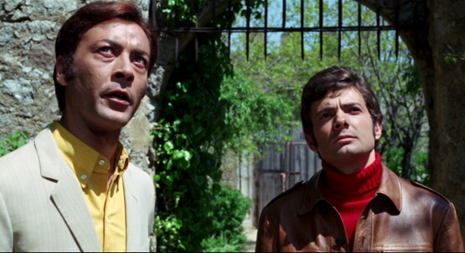
Gilles (Paul Naschy) is a drifter hitchhiking in rural France when he is picked up by Claude (Diana Lorys). She is a bitter woman with a disfigured right hand covered in a prosthetic glove. She offers Gilles handyman work and lodging at her remote country villa. Claude’s two sisters also live there with her, the wheelchair-bound Ivette (Maria Perschy) and nymphomaniac Nicole (Eva León). Gilles performs his chores while having a dalliance with Nicole and imposing upon Claude’s cold and remote demeanor. Despite his confident manner, Gilles is haunted by visions of him strangling a mocking woman. Meanwhile in the nearby village, a black-gloved killer is murdering blonde women and removing their blue eyes.

The Flashback Fanatic movie review

Multitalented Spanish horror film player Paul Naschy toyed with the giallo genre when he wrote and starred in The Blue Eyes of the Broken Doll. Movie fan Naschy always paid homage to a lot of the genre films he loved by incorporating many tropes from them into his scripts. When adding his own attitudes and fixations, Naschy could create lively and often loopy storylines for his films. Naschy showed a bit of restraint here, yet he still provided a twisted, tricky plot with plenty of odd characters that should satisfy the expectations of giallo fans. That uniquely Italian genre seemed to suit Naschy well for this Spanish production.


We are introduced to Naschy’s character of Gilles in an interesting way. The film opens with Gilles amid the sprawling countryside as he walks along a road trying to thumb a ride. This places us on his side, if for no other reason than we can empathize with the plight of someone alone in the middle of nowhere needing a lift. We also can’t help but wonder why he is in this destitute situation and where he is headed. But our comfort with this character is soon disturbed; as he stops for a bite to eat, we see Gilles being eyed with suspicion by the village café patrons, including local police Inspector Pierre (Antonio Pica). Gilles quickly moves on.

As night falls our hitchhiking protagonist is picked up by Claude, an austere, beautiful woman who is self-conscious of her maimed right hand. Gilles seems unperturbed by Claude’s affliction and perhaps appreciates that this makes her feel as much of an outcast as he himself appears to be. Claude is played by Diana Lorys, who had appeared in many genre films. Lorys is perhaps best known for starring in the first Spanish horror film, Jesús Franco’s The Awful Dr. Orlof (1962).

Rather oddly for a giallo film, the kills do not begin until nearly halfway through the running time. Until that point, it is the strange characters of the three afflicted sisters in their remote country villa interacting with the mysterious drifter now staying with them that intrigues us. However, we are teased with some possible violence in Gilles’ past as he has recurring dreams or memories of strangling a beautiful woman laughing at him.


True heroes may be hard to come by in giallo flicks, but you can’t fault Gilles’ work ethic. He is certainly diligent in his chores of chopping wood, raking, milking cows, and laying plenty of pipe. After all, this is a Paul Naschy-written role.


Fortunately, sexy women are always plentiful in the giallo genre, which helps maintain interest until the bloodshed begins. Therefore, our lucky loner and live-in handyman Gilles is testing the boundaries of Claude, the apparent head of the household, appreciating the beauty of the paralyzed Ivette (Maria Perschy), and wallowing in the carnal comfort of nymphomaniacal Nicole (Eva León).


Once a black-clad killer starts murdering women in the nearby village, we are playing the whodunit guessing game. Naturally, Gilles is under audience suspicion due to his violent flashbacks and shady past. The three afflicted women he is living with all have their issues. Ivette’s new nurse named Michelle (Inés Morales) arrives instead of another nurse who was murdered, and she is making secretive phone calls. Jean, the previously fired handyman, attacks Gilles with a knife. René (Luis Siges), the odd character hanging out at the village café, ogles young girls and eavesdrops on discussions of the murders between Inspector Pierre and the local physician treating Ivette, Dr. Phillipe (Eduardo Calvo).


Paul Naschy’s script gives us climaxes that are red herrings just as much as many of the characters themselves. The film ends with a very morbid scene full of sick pathos. This conclusion is supposed to be loosely inspired by an actual 1865 case in Madrid, Spain. While Naschy’s scripts borrowed elements from many previous genre films, his main intent here seems to be emulating the giallo films as popularized in the 1970s by Italian director Dario Argento. Yet this film’s final scene reminds me a lot of Argento’s much later Trauma (1993).

Carlos Aured directed only four of Paul Naschy’s films and this ranks as one of Naschy’s best. Along with cinematographer Francisco Sánchez and editor Javier Moran, Aured has made this a visually nimble and occasionally striking looking film. There is cutting on action to new camera angles during often simple actions of characters, some lighting that ratchets up the mood and suspense, and shots that take advantage of interesting locations and scenery.

Giallo films are often graced with weird and catchy music scores. The Blue Eyes of the Broken Doll does not disappoint with some nice themes by Juan Carlos Calderón. Others have commented on the musical misstep that an almost jaunty theme used to introduce us to Naschy’s Gilles is also used during his final scene, which is totally inappropriate for the mood there. Composer Calderón is probably not to blame for the repeat of that piece of music. Perhaps someone thought that the music used to introduce the character of Gilles would be ironic for his last scene. It was Naschy who had the inspired idea to use the traditional French folk tune “Frère Jacques” as the leitmotif used for the killer. That song had always creeped out Naschy as a child.

The Blue Eyes of the Broken Doll is one of my favorite Paul Naschy films. As a giallo fan, I can appreciate that Naschy is giving us a fine example of the genre that is hardly typical. It has the giallo ingredients of sex, violence, and a mystery killer, while distinguished by its rural setting and damaged characters.

Thursday, February 27, 2025

FANGS OF THE LIVING DEAD (1969), aka MALENKA, THE NIECE OF THE VAMPIRE

Director: Amando de Ossorio

Writer: Amando de Ossorio

Producers: Aubrey Ambert, Rosanna Yanni

Cast: Anita Ekberg, Julián Ugarte, Diana Lorys, Adriana Ambesi, Rosanna Yanni, Gianni Medici (as John Hamilton), César Benet (as Guy Robers), Fernando Bilbao, Carlos Casaravilla, Paul Muller, Adriana Santucci, Juanita Ramírez, Aurelia Treviño, Keith Kendal

Model Sylvia Morel (Anita Ekberg) is notified that she has inherited Walbrooke castle and will be a countess. She leaves Rome to visit her new property and meets her strange uncle, Count Walbrooke (Julián Urgarte). He informs Sylvia that her lookalike grandmother, Malenka, was burned as a witch, but not before discovering the secret of immortality. Malenka made her husband immortal by turning him into a vampire. That vampire is actually the present day Count Walbrooke. The Count will not allow Sylvia to return to Rome as he tries to convince her that she is no longer fit to live with mortals.

The Flashback Fanatic movie review

Originally titled Malenka, the Niece of the Vampire, Fangs of the Living Dead was Spanish writer-director Amando de Ossorio’s first horror film. Perhaps that explains why it is so uneven and confused in terms of its tone and its logic. Some of this is due to the ending being tampered with by the producer, yet that is no less satisfying than the main characters’ behavior at the finish of the film in its original form.

The gorgeous Anita Ekberg stars as Rome model Sylvia Morel. As simplistic as her character is and as nearly uneventful as her situation plays out, her beauty and some of her wild outfits do manage to maintain some interest.


For all of its faults, this flick certainly does not skimp on the feminine eye candy. Joining Ekberg in the cast are Euro-beauties Diana Lorys, Rosanna Yanni, and Adriana Ambesi. It is Ambesi who provides the most eroticism with the low-cut gown she nearly pops out of and the lesbian vibes in her character’s behavior when she first meets the rather submissive (and receptive?) Sylvia. With all of this pulchritude about, it is a shame that de Ossorio did not make this film just a few years later when the film market became more permissive. Whether these ladies would have been game for it or not, I am sure that de Ossorio would have contrived to have made things much more revealing.

Gianni Medici plays Sylvia’s fiancé, Dr. Piero Luciani. He’s the straight man alongside Max (César Benet), his tagalong best friend. It seems as though Max is around to send up the situations a bit, which just diffuses what little menace the story is trying to generate.

Julián Ugarte, having been featured in Paul Naschy’s debut horror film, Frankenstein’s Bloody Terror (1968), stars here as the main source of malevolence in the form of Count Walbrooke. He is always fine as a cold and aristocratic presence.

Speaking of Frankenstein’s Bloody Terror, that film’s great dungeon and some other castle interiors were also used in this film. These sets being actual locations lend a lot of authentic character to the Walbrooke Castle setting that much of the story takes place in.


Writer-director de Ossorio has some terrific assets to exploit in this film, yet his story does not seem willing to really let loose and provide the horror payoffs that the audience is expecting. He is trying to surprise the audience with his climax, yet along the way he rarely provides the thrills to sustain involvement in his story and characters. I am always willing to allow a filmmaker to confound expectations for a satisfying variation that may actually engage one’s attention, but de Ossorio seems to have taken all the bite out of this film’s premise. The final denouement, as originally presented, is dramatically limp. However, the producers-decreed, last-ditch-alteration ending is either totally contradictory, or meant to be a bit ambiguous. Oh hell, they were just trying to salvage this by tossing in a traditional terror tidbit that they thought the fright flick fans would swallow. It still doesn’t go down easy.

Director Amando de Ossorio will always be best known for his four Blind Dead films of the 1970s. The director would go on to become nearly as important an exponent of the Spanish horror film as Paul Naschy. His other horror efforts varied in quality and were often compromised by inadequate budgets, yet he wrote script after script that he kept ready for future production opportunities.

Amando de Ossorio’s Fangs of the Living Dead is chiefly of interest to his fans that want to see how he tentatively approached horror in his debut genre effort. All others should probably steer clear. Sylvia may be allergic to castles, and Max is allergic to garlic, but the most severe reaction will be suffered by an audience allergic to films with the ripe potential for Gothic horror spoiled by plot twists that result in a lot of illogical behavior.

Saturday, August 14, 2021

THE AWFUL DR. ORLOF (1962)

Director: Jesús Franco

Writer: Jesús Franco (as David Khune)

Producers: Leo Max, Marius Lesoeur, Sergio Newman

Cast: Howard Vernon, Ricardo Valle, Conrado San Martin, Diana Lorys, Fernando C. Montes, Perla Cristal, Maria Silva, Mara Laso, Venancio Muro, Félix Dafauce, Fuastino Cornejo, Manuel Våzquez, Elena Maria Tejiero, Juan Antonio Riquelme, Javier de Rivera, Carmen Porcel, Rafael Hernández, Marisa Paredes, Juan Garcia Tiendra, Pilar Gómez Ferrer, Tito Garcia, Jesús Franco 

In 1912 France women are disappearing. They are being abducted by the blind, mute, and disfigured Morpho (Ricardo Valle). He is being controlled by Dr. Orlof (Howard Vernon), a retired prison doctor that managed to falsify convicted murderer Morpho's death. Orlof has surgically altered Morpho to make him his obedient henchman. The women Orlof has abducted are for use in his experiments to restore the beauty of his scarred and catatonic daughter Melissa (Diana Lorys). 

The Flashback Fanatic movie review 

The Awful Dr. Orlof is a seminal film. It is the first Spanish horror film and the first of many horror films made by the man who would become probably the most prolific filmmaker in the world, Jesús Franco.

Prior to this film, most Spanish films were kept in a pretty staid mold. They had to avoid the lurid and sensational, as Spanish censorship was quite stern under the Francisco Franco regime, and traditional Spanish values and culture always had to be positively represented. Jesús Franco got around that by having his horror film set outside of Spain. That was the tactic that he and other Spanish filmmakers would usually have to use when they made horror films. His films were often heavily censored in Spain, but Franco’s films would be shown in some other countries with nudity that was daring in its day. The Awful Dr. Orlof is one of the earliest forebears of the increasingly brazen mixture of eroticism and horror in films. 

Jesús Franco (aka Jess Franco, Jess Frank) brought a mishmash of interests and influences to his films. In his earliest works, this lent them an offbeat vibe at the same time that they dealt with familiar tropes. He seemed to be riffing on characters and situations from earlier genre films while adding his own recurring obsessions. 

The most direct influence would be the Bela Lugosi starring thriller The Dark Eyes of London, aka The Human Monster (1939). The Lugosi character was named Dr.Orloff and had a creepy, blind, huge henchman carry out his murders. Many more Franco films would feature a character named Dr. Orlof or refer to him. 

Of course, the recent French film Eyes Without a Face (1960) had to be a direct antecedent of this film’s plot. It also deals with a doctor abducting women for experiments to restore the damaged face of his daughter. 

Another direct influence was the recent The Brides of Dracula (1960) from Britain’s Hammer Films. Franco has stated that seeing this movie provided the impetus for making a horror film. Since the Hammer films were having great international success and were usually set in a past era, this might have prompted Franco to make his film a period piece rather than a modern day story. 

In this first of Franco’s fright flicks, we have some of his ongoing film fixations make their appearance. As well as the first use of a Dr. Orlof character, he would also have other mad doctors in later films create creepy, mute henchmen to handle the rough stuff. Franco has much of his story take place in a cabaret where we see sexy women perform. This would be a recurrent feature in more of his horror films where beautiful women sing, dance, or strip in drinking establishments. That makes me feel right at home and I save the cover charge. 

Franco uses a very avant-garde score by Jose Págán and Antonio Ramírez Ángel that never seems to establish a melody, but sounds unhinged to create an unhealthy atmosphere. The music in more of his horror films would have a strange combination of prickly and ethereal themes alongside some jazz passages.

I had longed to see this film for many years, being teased by stills of the Morpho character. This wretch looked like one of the creepiest and most depraved fiends in movie history. When I finally had a chance to see this film, Ricardo Valle as Morpho did not disappoint. Those bulging, sightless eyes in that scarred and pale face make for an unforgettable villain. His odd body language and facial tics along with his kill technique of biting people on the neck make for one sick and deadly dude. It is also somehow more disturbing that before Dr. Orlof experimented on him, Morpho looked normal, but he was just as twisted. I still wonder how a blind henchman would be very practical for a mad doctor to use as an assassin, but I must admit this strange touch adds to the eerie vibe in this film. Morpho does have very acute hearing that allows him to zero in on at least one of his victims. Perhaps while Orlof's surgical techniques blinded Morpho they gave him other special senses to help compensate. Yes, I am trying to fill in the logic blanks because I think Morpho is damned cool; creepy, but cool. 

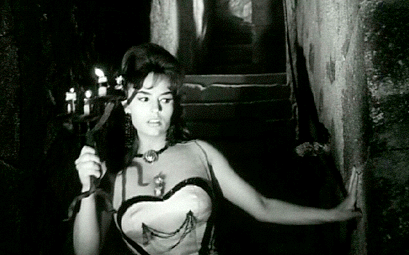
The rest of the cast has some Euro-horror notables. Howard Vernon stars as Dr. Orlof and would go on to star in many more Jesús Franco films. Beautiful Diana Lorys, as ballerina Wanda Bronsky, takes the initiative to track down Dr. Orlof for her fiancé Police Inspector Tanner (Conrado San Martin). She also plays the scarred lookalike daughter of Dr. Orlof. Fernando C. Montes plays Inspector Tanner’s right-hand man Malou. He would go on to be the hero in what may be Franco’s best film, The Diabolical Dr. Z, aka Miss Muerte (1966). Howard Vernon also appears in that latter film. 

Jesús Franco’s The Awful Dr. Orlof is much more accomplished and disciplined in its story and execution than many of his later films. Many feel that Franco was a hack with no talent because they probably saw some of his later works that he had almost no time or money to make. He was also probably someone more interested in the process of making a film than in the coherence of the final product. 

As he continued to churn out film after film with often impossibly small budgets, Franco became more improvisational. His style of filmmaking was perhaps the cinematic equivalent of his beloved jazz music. Franco was grabbing shots in what seems to be an undisciplined artistic abandon or a short schedule-dictated flurry. We are left to ponder whether the director was lazy, hurried, self-indulgent, or inept. I think that the quality of the images and the coherent plot in The Awful Dr. Orlof, and some of his other black-and-white horror films from the '60s, proves he could make uniquely stylized and accomplished films. They are bizarre to be sure and logic may be as strained as the sanity of the villains, but the best of Franco’s films are hardly inept.

STANLEY (1972)

Director: William Grefé Writers: Gary Crutcher, William Grefé Producer: William Grefé Cast: Chris Robinson, Alex Rocco, Steve Alaimo, Ma...