Director: Oliver Stone
Writers: Oliver Stone adapting Marc Brandel’s novel The Lizard’s Tail
Producer: Edward R. Pressman; Cast: Michael Caine, Andrea Marcovicci, Annie McEnroe, Bruce McGill, Mara Hobel, Viveca Lindfors, Rosemary Murphy, Charles Fleischer, Pat Corley, Nicholas Hormann, John Stinson, Ed Marshall, Richard Altman, Sparky Watt, Oliver Stone, Tracey Walter, Brian Kenneth Hume, Lora Pearson, Jack Evans, Scott Evans, Randy Evans, Patrick Evans
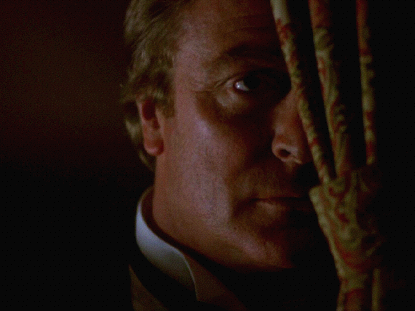
When comic strip artist Jon Lansdale (Michael Caine) loses his right hand in a freak driving accident, he not only loses his drawing ability; he also is losing the bond with his family and may be losing his mind. Lansdale has blackouts and hallucinations of hand imagery. He also senses that his missing hand has a life of its own and that it can kill those who offend him.
The Flashback Fanatic movie review
The response that writer-director Oliver Stone’s second feature film usually gets from the audience is the sound of one hand clapping, but The Hand gets a hearty round of applause from me. It has fine performances from a small cast in a story dealing with the mental turmoil of its main character. When none other than Michael Caine plays that character, it results in a moving, intriguing, and gripping film.

The spectacle of a severed hand scuttling about to kill people is what the audience was probably primed to see, yet it is also a phenomenon that we are constantly challenged to decide just how literally to accept. We experience the story almost completely from the viewpoint of the Michael Caine character of Jon Lansdale. He would qualify as the cinematic version of the unreliable narrator in prose fiction. He has suffered an injury that has not only cost him his right hand; it has ruined his career as a comic strip artist and is a blow to his male ego. He is no longer as complete a physical man as before, he is self-conscious of his appearance and lack of dexterity, and his ability to earn a living is now hindered. Since his wife, Anne (Andrea Marcovicci), was driving the car when his maiming accident occurred, that can only exacerbate Lansdale’s resentment of her in their troubled marriage. All of these stressors take a toll on Lansdale’s temperament, and we are left to ponder if Lansdale’s sanity is also damaged.

Jon Lansdale’s comic strip, Mandro, was about the fantasy world adventures of a sword-wielding barbarian. Lansdale seemed to be venting his own single-minded and macho tendencies through his art. Once he loses the hand he needs to draw his Mandro stories, his inner barbarian has nowhere to go. This sudden handicap would traumatize anyone, but Lansdale’s own sense of his manhood and control in his family is the chink in his psychological armor that has been breached. In a great performance, Michael Caine brings an appealing humanity, vulnerability, and intensity to his role as Jon Lansdale. We always identify with the poor guy’s plight, even if we are unsure of his grip on reality and whether he can be blamed for the horror he senses.

While we also ponder the responsibility that Jon Lansdale has for the dysfunction in his relationship with Anne, it becomes clear that she is not being entirely upfront with her husband about what she really wants to do. She says that she has discussed things with him, but one always gets the feeling that there is something more she has in mind that she won’t tell her unreceptive husband about. Anne is not just a one-note victim or a bitch. She seems like a reasonable person that is probably afraid to be completely open with Jon about her dissatisfaction in their relationship. In her defense, Anne tries to be comforting to Jon after the loss of his hand, but it also seems that she is ready to move on.

Once the Lansdale couple separates so that Jon can move to California to take a teaching job for a community college art class, we can appreciate Jon Lansdale trying to make a new life for himself. We still hold out hope that he can mend his relationship with Anne, who is staying in New York City with their daughter. However, it becomes more apparent that his family is drifting apart.

Therefore, we can’t help but be happy for Lansdale when he gets the chance to fool around with Stella Roche, one of his sexier students. We don’t find out a lot about Stella, but Annie McEnroe’s performance makes us care about this directionless and impulsive young lady. She may just be a free spirit doing what ever feels good in the moment, but she is also just the ego boost the estranged Jon Lansdale needs. It probably helps that Stella seems to fetishize Lansdale’s prosthetic hand during their lovemaking. Lansdale seems to develop an immediate bond with Stella, but whether this can ever approach real love or is just Lansdale’s possessiveness is uncertain.


One of Lansdale’s fellow faculty members, Brian Ferguson (Bruce McGill), teaches psychology at the community college. Over beers at the local bar, Ferguson hands out insight on Lansdale’s mental blackouts. Of course, this does nothing to dispel Lansdale’s concerns, or ours, about his mental state. Drinking pal Ferguson also soon becomes another antagonist in Lansdale’s lonely existence.

The pattern in our one-handed hero’s life seems to be that no one ever really gets close to him. The one person we ever saw Jon Lansdale mutually, truly happy with was his daughter, Lizzie (Mara Hobel), before his estranged wife separated her from him. Once the family reunites in Jon’s cabin in the woods for the yuletide season, it becomes clear that Anne is making other arrangements for her life and Lizzie’s. This ends up being one of those unbearable, just-going-through-the-motions, Christmas family get-togethers. They better crank up the carols and keep spiking the eggnog.

As Lansdale gets more stressed and offended, he not only has more hallucinations, he also imagines that his severed hand is lurking about and can snuff out his enemies. That lost limb had manifested Lansdale’s machismo by illustrating his Mandro stories. Now that it is no longer attached to Lansdale, that missing hand may be acting out darker aggressions from the frustrated Lansdale’s id.

Writer-director Oliver Stone’s first feature was his 1974 horror film, Seizure. After this second effort, Stone decided that he wasn’t suited to the genre. I think he does a fine job with The Hand. Stone was probably disappointed with the generally poor reception that the film received. That reception was probably due to the ambiguity that it leaves us with. You may have a handle on what is going on here until you get to the film’s final scene. Then you are presented with a bit of sleight-of-hand that tosses our assumptions back in our faces to make us try to sort things out all over again. Audiences probably found it maddening, but that is the theme running throughout the entire film. I have learned to appreciate it more over time because there are two interpretations one can arrive at, and either one works. The Hand deserves a lot more thumbs up.