Showing posts with label dramedy. Show all posts

Tuesday, October 25, 2022

ED WOOD (1994)

Director: Tim Burton

Writers: Scott Alexander, Larry Karaszewski, based on Rudolph Grey’s book Nightmare of Ecstasy: The Life and Art of Edward D. Wood, Jr.

Producers: Denise Di Novi, Tim Burton

Cast: Johnny Depp, Martin Landau, Sarah Jessica Parker, Patricia Arquette, Jeffrey Jones, Bill Murray, George “The Animal” Steele, Lisa Marie, Mike Starr, Max Casella, Brent Hinckley, Juliet Landau, Ned Bellamy, Stanley DeSantis, Rance Howard, Korla Pandit, Vincent D’Onofrio, Maurice LaMarche (uncredited as voice of Orson Welles), Norman Alden, Clive Rosengren, G.D. Spradlin, Gregory Walcott, Conrad Brooks

In 1950s Hollywood, aspiring filmmaker Edward D. Wood, Jr. (Johnny Depp), chances to meet faded film star Bela Lugosi (Martin Landau). The two soon become friends. The eager-to-work Lugosi agrees to star in Wood’s very personal film project, and that helps to convince exploitation film producer George Weiss (Mike Starr) to finance Wood’s semi-autobiographical transvestite story Glen or Glenda (1953)Before long, Ed Wood has acquired a group of eccentric characters to work on his strange films.

The Flashback Fanatic movie review

The ’80s excess of mainstream Hollywood films striving for blockbuster status with massive budgets and over-the-top action and effects resulted in a numbing wave of glossy mediocrity. The true film fan was ready for something original and sincere. Apparently, a number of young filmmakers were as well. There were some very interesting and unique films boosting the indie-film trend in the ’90s. Perhaps the time was right for a movie about a notorious cult film director. Although a guy who worked for Disney and had already made some very successful films was hardly a struggling indie-auteur, Tim Burton strove for his own style and directed an absolutely unique film with Ed Wood. This strange, funny, and heartfelt biopic is one of the finest films of the ’90s. 

Ed Wood is about the naïve optimism required to pursue one’s dreams. Even with few resources and a lack of objectivity to realize one’s own shortcomings, a person through sheer perseverance can create something that is a unique and sincere form of expression. That expression’s faults and merits are for others to judge.


For the Ed Wood fan or detractor, it is fun to see the obsessive attention to detail in the reenactments of various scenes from Ed Wood’s films and the behind-the-scenes shenanigans during those productions. The truth of some of these incidents is suspect. As many of those actually involved in Wood’s films have stated, the more coarse behavior of some of the people in Wood’s group as depicted in this film was exaggerated or invented for dramatic and comedic purposes. No one has ever confirmed that Bela Lugosi used the profanity that he is shown to resort to in Ed Wood. Lugosi’s hatred of his horror film rival Boris Karloff is also created to motivate some of his amusing outbursts in the film. Ed Wood’s supportive, one-time girlfriend Dolores Fuller has refuted her shrewish portrayal by Sarah Jessica Parker. These are some of the contrivances used to create both an absurd and tragic edge to the story that pays homage to the lasting, quirky mystique of the Ed Wood career. Tim Burton is not making a documentary but a tragicomedy in the never-never land of 1950s Hollywood.

Johnny Depp captures the cockeyed idealism and enthusiasm of this story’s misfit hero perfectly. His Ed Wood is both determined and inept. He is so driven or insecure that he can’t take the time to realize his production’s shortcomings and figure out how to salvage them. He just forges blindly ahead with faith that somehow things will turn out great.

The touching, tragic, and funny character of Bela Lugosi is brilliantly portrayed by Martin Landau. Again, many of the particulars about some of Lugosi’s antics are fabricated for this film, but the sentiment behind them and the concerns his character has seem genuine.


The film is loaded with other great performers portraying the members in Ed Wood’s filmmaking fringe. Sarah Jessica Parker as Ed’s increasingly frustrated girlfriend Dolores Fuller, professional wrestler George “The Animal” Steele as professional wrestler Tor “Super Swedish Angel” Johnson, Bill Murray as drag queen John “Bunny” Breckinridge, Jeffrey Jones as television psychic Criswell, Lisa Marie as TV horror film hostess Maila “Vampira” Nurmi, and Patricia Arquette as Ed’s tolerant new girlfriend Kathy O’Hara are just some of the characters that make the world of Ed Wood so fascinating.


Tim Burton’s penchant for viewing stories through a prism of playfully weird visuals is indulged as soon as the film begins. His opening scene immediately breaks the fourth wall in much the same way as two of Ed Wood’s films did. Jeffrey Jones’ Criswell character addresses the audience with a variation on the introductory monologues Criswell gave in Wood’s films Plan 9 from Outer Space (1957) and Night of the Ghouls (1959). This is performed in a setting like the old Willows house of Wood’s Bride of the Monster (1955). After this Criswell intro, we are treated to the film’s credits sequence exhibiting iconic images from Wood’s films as they would have been portrayed if the hapless director had access to a large budget and ’90s film technology. This sequence immediately establishes a sense of reverence for the weird visions in Ed Wood’s film canon.

Of special note is the terrific score by Howard Shore. His music perfectly compliments the era of the ’50s and captures the kitsch and sentiment of Ed Wood’s films.

The fate of Tim Burton’s finest film is as frustrating and surprising as that of its cult filmmaker hero. The Ed Wood film was a box office failure, yet it won two Oscars (Martin Landau for Best Supporting Actor and Rick Baker for Best Makeup) and has gone on to become a cult film itself. That is both ironic and fitting for a film based on the life of “the world’s worst director.”

Sunday, August 28, 2022

ART SCHOOL CONFIDENTIAL (2006)

Director: Terry Zwigoff

Writer: Daniel Clowes (inspired by his comic book story)

Producers: Daniel Clowes, John Malkovich, Lianne Halfon, Russell Smith

Cast: Max Minghella, Sophia Myles, John Malkovich, Joel David Moore, Jim Broadbent, Ethan Suplee, Matt Keeslar, Nick Swardson, Steve Buscemi (uncredited), Anjelica Huston, Adam Scott, Jack Ong, Jeremy Guskin, Isaac Laskin, Scoot McNairy, Monika Ramnath, Jeanette Brox, Shelly Cole, Finneus Egan, Jean St. James, Cristen Coppen, Katherine Moennig, Michael Shamus Wiles, Ezra Buzzington, Lauren Lee Smith, Chris L. McKenna, Paul Collins, Travis Walck, Valyn Hall, Lauren Bowles, Marshall Bell, Dick Bakalyan, Kimi Reichenberg, Alex Ryan, Marc Vann, Brian Turk, Michael Lerner, Zachary Maurer, Erik M. Walker

Young Jerome Platz (Max Minghella) decides to attend the Strathmore Institute art school drawn by the photo of the life class model shown in the school’s brochure. Jerome’s artistic ambitions are constantly frustrated by many of his talentless classmates and his apathetic and cynical teachers. When Audrey (Sophia Myles), the nude model from the college brochure, poses for his drawing class, Jerome is immediately smitten. However, Jonah (Matt Keeslar), a hunky and seemingly untalented fellow student, begins dating Audrey sending Jerome’s spirits into a downward spiral. To make college life even grimmer, there has been a series of slayings on campus by the “Strathmore Strangler.”

The Flashback Fanatic movie review

Once again director Terry Zwigoff joined quirky comedic forces with cartoonist Daniel Clowes to adapt another of Clowes’ comic book stories. The original “Art School Confidential” that had appeared in Clowes’ Eightball comic book was a short, autobiographical piece about Clowes’ college days in art school. The movie is a fictional dark comedy written by Clowes and informed by his art school experiences and artistic temperament. Clowes continues to dwell on the dolts, losers, and jerks that are as prevalent in the world of the aspiring artist as anywhere else in society. Affectation, ambition, and ego run rampant and often confound any artistic idealism.

It is a shame that Art School Confidential never achieved as positive a reception as the earlier Zwigoff directed adaptation of Clowes’ comic book serial Ghost World (2001). To be sure, this film is much darker in tone while still delivering plenty of quirky character comedy. It seems far more cynical in its attitude throughout and ends not on a note of “what’s next?” melancholy but with a rather bleak triumph that is perplexing and/or depressing. The whole point of the film seems to be that attention-getting spectacle is more important to the masses than artistic talent. Talent is only lauded if it is noticed, and how it gets noticed is often due to anything but artistry.

Max Minghella plays the central character of the sincere and talented artist Jerome Platz. He resents the lax standards of grading at his school and struggles to grasp just how to achieve any success in the art world when those around him have no talent and can’t appreciate his. The fact that he is away from home for the first time and trying to figure out how one is supposed to get along in the “real world” as an artist makes him quite sympathetic. I had never seen Minghella in a role before and was quite shocked to find out that he is an English actor. He delivers a great performance as the disillusioned American art student.


Sophia Myles is another Britisher in the cast as the American art class model Audrey. She is always convincing as the unaffected free spirit that in other films would probably be trying to hit us over the head with her individualism. Audrey does not make character proclamations or strive to confound anything or anyone. She does not distract from the crux of the story about Jerome seeking artistic validation and Audrey’s love. 

Bardo (Joel David Moore) is probably my favorite character. He is the slacker that quite honestly sums up his character’s rut of continually changing his major rather than ever graduate because he does not know just what the hell he wants to do with his life. Being a seasoned college student, he takes freshman Jerome under his wing to share his wry assessments of the various types that are their classmates.

On the other end of the ambition scale is Jerome’s roommate Vince (Ethan Suplee). He is the crude and driven film student that provides many laugh-out-loud moments. I admire Vince’s enthusiasm, even though his tireless filmmaking efforts always seem as if he is trying to make a silk purse from a sow’s ear.

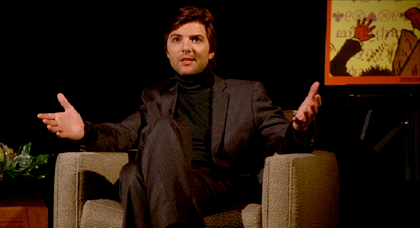
Strathmore’s recent superstar alumnus Marvin Bushmiller (Adam Scott) is an arrogant asshole. We never learn just what his art was about and why he gained success. That is beside the point if all that matters is getting noticed and making money.


Some famed veteran actors are in attendance to further enrich the strange Strathmore Institute experience. John Malkovich and Anjelica Huston play two of the Strathmore faculty while Ghost World’s Steve Buscemi returns here as the ill-tempered proprietor of the nearby coffee house/art gallery.


While there are plenty of oddballs to be found on campus, the most depressing character is the off-campus Strathmore alumnus named Jimmy (Jim Broadbent). Once an idealistic and talented artist like Jerome, he has descended to a squalid life as a drunken, dour recluse. When Bardo introduces Jerome to Jimmy, it is done with the zeal of a carnival barker revealing a sideshow freak to shock and amuse. However, the nihilistic Jimmy becomes an oracle of bitter wisdom for Jerome as Jerome is just beginning to experience the artistic frustration that has long soured the much older failed artist.

As if that were not dark enough, there is also the serial killer roaming the campus and claiming victims. This is one of the things that give Art School Confidential an off-putting tone for many and, at first glance, may seem to be an extraneous bit of nastiness. It is actually used to provoke other characters to actions of artistic exploitation that again grapples with the conundrum of artistic integrity. That extra element really primes the theme of artistic frustration and attention-seeking excess that is the cruel canvas this story is rendered on.

Like the first Zwigoff/Clowes film Ghost World, Art School Confidential also deals with the frustration of young adulthood. In Ghost World friends Enid and Rebecca are coping with their transition after high school into the world of adults without having any certain plans or ambitions. The main difference in Art School Confidential is that Jerome knows what his goals are, but he is continually having his sense of artistic integrity challenged.

As in that earlier film, there are still plenty of hilarious characters here amidst the melancholy and despair. Most of them rouse laughter while still stressing how unfair this situation seems to Jerome. The talentless misfits seem to have as much of a chance for success as Jerome. His talent and dedication seem to be mostly unappreciated.

Despite the drama, comedy, and angst of the situations, the behaviors of all the characters always seem appropriate to the environment. No one ever seems to be striving for the “movie moment” that is supposed to make us notice them or manipulate us. That is why in roles large and small these actors all make memorable impressions. Their performances ring true even as they demonstrate how unhappy, naïve, petty, or offensive they are. All of these characters and their actions are there to serve the movie’s theme and convincingly populate the dismal campus of the Strathmore Institute.

Tuesday, November 30, 2021

GHOST WORLD (2001)

Director: Terry Zwigoff

Writers: Daniel Clowes, Terry Zwigoff (adapting Daniel Clowes’ Ghost World comic book stories)

Producers: Liane Halfon, John Malkovich, Russell Smith

Cast: Thora Birch, Scarlett Johansson, Steve Buscemi, Brad Renfro, Bob Balaban, Illeana Douglas, Stacey Travis, Dave Sheridan, Brian George, Ezra Buzzington, Tom McGowan, Pat Healy, Debra Azar, T.J.Thyne, Rini Bell, Dylan Jones, Ashley Peldon, David Cross, Bruce Glover, Teri Garr  (uncredited)

Best friends Enid (Thora Birch) and Rebecca (Scarlett Johansson) are two contrarian girls that have just graduated high school. As they are both coming to grips with starting adulthood, Enid befriends a much older, eccentric, music buff named Seymour (Steve Buscemi). Enid’s growing relationship with Seymour strains her friendship with Rebecca. 

The Flashback Fanatic movie review

In the late '80s, Daniel Clowes became my favorite contemporary cartoonist. He first created a series of surreal stories in a retro world of the late '50s about a hip and hapless detective named Lloyd Llewellyn. He followed that up with his eccentric anthology comic book series Eightball. Clowes’ work is unique and often bitingly critical. He fixates on the moronic and sometimes unfathomable quirks of popular culture and social attitudes. His Ghost World story was serialized in issues of Eightball.

As soon as I heard that Daniel Clowes’ work would be adapted to film, I knew I had to see it. I was absolutely delighted with the result. Frankly, I remembered very little of the Ghost World comic book stories, so the film made a pretty fresh impression on me. This may come as faint praise from this retro reprobate that disdains much of contemporary popular culture, but heed me when I proclaim that Ghost World is the best film of the twenty-first century! Okay, so I admit it’s also one of the few films that I have seen made in this century. However, that praise IS coming from the man that can discern the merits of neglected masterpieces such as Frankenstein Meets the Space Monster (1965) and Cauldron of Blood (1967), so I must know what the hell I am talking about. 

Since director Terry Zwigoff had made the acclaimed documentary Crumb (1994) about the famous underground comix artist Robert Crumb, adapting the stories of another out-of-the-mainstream cartoonist seems like a natural progression. Clowes and Zwigoff are a match made in pop culture purgatory. They seem to share a quirky, sardonic, and morose simpatico that makes the Ghost World film so unique. 

This dramedy is a coming of age story that does not give us character arcs resulting in triumphant resolutions. It is not teen-centric pandering stroking a youthful audience into believing they have all the answers and that their cynical affectations make them strong. Ghost World deals with that uncertain limbo between adolescence and adulthood. 

The reason that we care about teenagers Enid and Rebecca is that they are interesting personalities. They reject the shallowness and conformity of most of their peers while they are both fascinated and amused by the oddballs in their world. They strive for individualism that will suit them, even as they are frustrated with a world that will impose responsibility upon them. 

Thora Birch is just wonderful as Enid. She is perceptive, sensitive, impulsive, and funny. She may be rude at times, but she is also introspective and confused. We can’t help but empathize with her as she suffers the presence of her ineffectual father (Bob Balaban) and all the louts that she encounters.

Scarlett Johansson, as Enid’s best friend Rebecca, is the terse and stoic counterpoint to Enid’s whimsy and volatility. When Enid refers to herself as cute in an old childhood photo, Rebecca’s response absolutely slays me. Rebecca does share a lot of Enid’s contrarian attitudes, but she seems to be more pragmatic about accepting that the “real world” will demand decisions and responsibilities. 


All around these two funny and frustrated girls are the many strange characters that conform to the silly and dehumanizing world around them. However, conformity does not keep people from becoming puzzling weirdos or grotesque louts. Ghost World is loaded with hilarious performances in roles large and small. 

The one oddball that becomes the most sympathetic character in the movie is Seymour (Steve Buscemi). He is an office worker and loner that obsesses about his old-time blues and jazz record collection and has general contempt for most of contemporary society. He is the victim of an anonymous prank Enid perpetrates. Once Enid meets Seymour, she finds a kindred spirit in the middle-aged man’s eccentricity and nonconformity. 

Melancholy looms over all of the humor in this story. We fear that the demands of dreary adulthood in a shallow culture will destroy the nonconformist idealism of Enid and Rebecca. Now that’s a horror that this fright flick junkie just can’t handle.

STANLEY (1972)

Director: William Grefé Writers: Gary Crutcher, William Grefé Producer: William Grefé Cast: Chris Robinson, Alex Rocco, Steve Alaimo, Ma...