Showing posts with label J. Lee Thompson. Show all posts

Monday, April 10, 2023

THE EVIL THAT MEN DO (1984)


Director: J. Lee Thompson

Writers: R. Lance Hill (as David Henry Lee), John Crowther, Fred A. Wyler (uncredited) (based on R. Lance Hill’s novel)

Producer: Poncho Kohner

Cast: Charles Bronson, Theresa Saldana, Joseph Maher, Antoinette Bower, José Ferrer, René Enriquez, Angélica Aragón, Raymond St. Jacques, John Glover, Amanda Nicole Thomas (as Nicole Thomas), Miguel Ángel Fuentes, Jorge Luke, Mischa Hausserman, Roger Cudney, Jorge Humberto, Robles, Anías de Melo, Carlos Romano, Conrad Hool (as Alan Conrad), Enrique Lucero, Constanza Hool, Joe Seneca, Eduardo López Rojas, Rodrigo Puebla, Richard Brodie, Ernesto Gómez,Cruz, Jorge Zepeda, Fernando Sáenz, Alfredo Tarzan Gutiérrez 

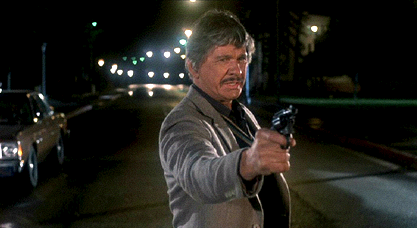
In Suriname, South America, journalist Jorge Hidalgo (Jorge Humberto Robles) is tortured to death by Clement “The Doctor” Molloch (Joseph Maher). Jorge is killed because he was critical of the torture methods Molloch demonstrates to government officials for use on their citizens. Torture specialist Molloch teaches brutal interrogation techniques to similar regimes around the world. Hidalgo’s friend, Hector Homlin (José Ferrer), visits retired assassin Holland (Charles Bronson), another friend of the murdered journalist. Homlin hires the reluctant Holland to stalk and kill the Doctor. 

The Flashback Fanatic movie review 

In 1984 actor Charles Bronson was in the midst of his late-career series of thrillers. Most of them capitalized on the reputation Bronson had achieved as vigilante Paul Kersey in Death Wish (1974) and its sequels. The murderous man of action aspect in Bronson characterizations was never more pronounced than in The Evil That Men Do. 

Films like Dirty Harry (1971) vented anger and anxiety about crime and the frustration over a justice system that seemed broken. Ever since Clint Eastwood’s iconic title role, most film heroes became increasingly brutal, which made lethal force the standard behavior for the good guy. By the 1980s, it was taken for granted in films that wasting the bad guy was the go-to solution for saving the day. Charles Bronson’s assassin Holland epitomizes that moviegoer mindset while impressing with his methodical and coldblooded efficiency. This is more edgy than the ever more elaborate and cartoonish thrills that many ’80s action films were embracing. 

Of course, what justifies Holland’s deadly mission is that his target Clement “The Doctor” Molloch is a practitioner of torture. We see Molloch employing his gruesome skills before an audience of South American government officials. This establishes an overwhelming sense of dread and outrage in the film audience. As in Dirty Harry and Bronson’s own Death Wish films, such villainy is so heinous that a certain death dealt to the perpetrator seems perfectly appropriate. 

There is an almost constant pall of oppression and sleaze hanging over the film. When the scene shifts to Guatemala, where Clement “The Doctor” Molloch is based, The Evil That Men Do demonstrates how appalling life is in a poor country ruled by a militaristic regime. Corruption and brutality are prevalent, and we see some of the villains engaging in their own risky, extracurricular activities. Drugs and casual sex with strangers are how these people find a release in this sordid society. This unsavory atmosphere adds an additional paranoid factor to the situation of Holland and Rhiana Hidalgo tracking down their target to kill.

Too many people dismiss Charles Bronson as wooden, especially in his crowd-pleasing, exploitation films heyday of the ’80s. I think he is effective because he has presence. He was not a showoff and neither were the characters that he played. When someone is truly accomplished, they have self-assurance and do not need to try to convince others of their ability; it is the bullies and frauds that must threaten and brag because they can’t back up their bullshit. It is this aspect of Bronson’s persona that suits the characters he portrays. When we do see some stress or emotion leak through his reserved demeanor, it has greater impact. It seems like a sincere reaction that presents the audience a true emotional gauge to measure the severity of a situation. 

A fine example of this emotional gauge at work in The Evil That Men Do is when Bronson’s Holland is confronted with an enormous brute (Miguel Ángel Fuentes) in a sleazy bar. We know that Holland is offended and also a bit intimidated by the giant lout. It stresses to us that this is not just a movie moment and makes us all too aware of the very real danger in this situation. We soon find out that Holland is very good with his hands in the baddest way possible. 

There are many examples of such nasty intensity in this film. The violence is not glorified; it consists of the protracted sadism of the Doctor’s torture techniques or the quick and deadly action taken by the professional killer Holland. The Evil That Men Do never provides contrived stunts and heroics meant to wow an audience. It coldcocks the audience with coldblooded matter-of-factness. 

Joseph Maher earns our absolute disgust and hatred as Clement Molloch. This ruthless fiend behaves with refined detachment while conducting torture, yet he is easily distressed by any indication of threat. It seems that he is the sort of person who probably compensates for his own inadequacies and cowardice by exercising total power over others during his torture sessions. Anyone who would market torture deserves whatever they get. That is why we can get behind the idea of assassination as a just course of action in this film. 

Antoinette Bower is equally hissable as Molloch’s sister Claire. She seems just as sadistic as the Doctor when she attends his deadly demonstrations. Bower was a familiar guest star in many US television series during the ’60s and ’70s. I never knew she could be so accomplished at being abhorrent. 

As Rhiana Hidalgo, Theresa Saldana adds the emotional motivation to the mission of killing the Doctor. She and her young daughter Sarah (Amanda Nicole Thomas) accompany Holland to make him appear like a family man on holiday when he travels to Guatemala to find Molloch. Seeking revenge for the murder of her journalist husband does not transform Rhiana into a snarky, combat-ready action hero. Although Rhiana is an angry woman wanting justice, she is also traumatized by the ongoing violence and, at one point, wants to abandon the vendetta. This is another realistic aspect to the story that helps it all seem deadly serious. It does not pander to us, as many contemporary thrillers do, by shoehorning in representatives for multiple demographics of the audience to play hero. This is just a badass Bronson flick, so he is the one doing the ass kicking. 

Frequent Charles Bronson director J. Lee Thompson helms this film. Thompson had directed Bronson’s previous picture, the intense police procedural 10 to Midnight (1983). The old pro Thompson salvaged the film when it became apparent that the original director was not going to work out. At a moment’s notice, Thompson arrived in Mexico where the movie was to be shot and got the film in the can. 

This film is based on the novel by R. Lance Hill. Although somewhat streamlined, this adaptation is quite faithful to its prose source. The one major change is the film’s grisly and fitting conclusion. 

The Evil That Men Do is not a film that exists to showcase the machismo of its star performing asinine exploits. This film is about the brutal means used to avenge sanctioned brutality. To make that seem like it matters, The Evil That Men Do delivers danger and death with the one-and-only Charles Bronson instead of stunts and swagger with the wiseass hunk of the moment.

Thursday, June 16, 2022

CAPE FEAR (1962)

Director: J. Lee Thompson

Writers: James R. Webb adapting John D. MacDonald’s novel The Executioners 

Producer: Sy Bartlett 

Cast: Gregory Peck. Robert Mitchum, Polly Bergen, Lori Martin, Martin Balsam, Telly Savalas, Barrie Chase, Jack Kruschen, Joan Staley, Edward Platt, Paul Comi, John McKee, Ward Ramsey, Page Slattery, Will Wright. Norma Yost, Mack Williams, Tom Newman, Alan Reynolds, Alan Wells, Allan Ray, Paul Levitt, Herb Armstrong, Bunny Rhea, Cindy Carol (as Carol Sydes) 

Recently released convict Max Cady (Robert Mitchum) settles in the southern town where lawyer Sam Bowden (Gregory Peck) lives with his wife Peggy (Polly Bergen) and his young daughter Nancy (Lori Martin). Eight years ago Sam Bowden’s witness testimony helped to convict Cady for the crime of assaulting a woman. Now Cady starts a war of nerves with veiled threats against Bowden and his family. Cady has studied the law while in prison and knows how to torment Bowden without crossing any legal lines. Sam Bowden is increasingly provoked to resort to illegal means to protect his family. 

The Flashback Fanatic movie review

Gregory Peck stars as the stalwart family man and lawyer Sam Bowden. He has an ideal life that becomes threatened only because he did the decent thing by interrupting Max Cady’s assault of a woman and testifying as a witness in Cady’s trial. Bowden is always likable and his situation becomes quite sympathetic, yet he maintains our interest with his reactions to Cady’s provocations.

Robert Mitchum played one of the greatest movie villains of all time in Cape Fear. His Max Cady is smart, stealthy, brutal, and funny. He is one laid-back bastard that steals every scene he is in which is the least of his crimes. This performance should make anyone a Mitchum fan. 

My favorite scene is the rendezvous at a bar that Peck’s Sam Bowden has with Mitchum’s Max Cady. All Bowden wants is to make an arrangement to get Cady to stop his harassment, but Cady won’t relent. This is the only time we are given any insight into Cady’s character that he reveals in casual seeming conversation over drinks to the object of his hatred. It seems that the only way Cady can relate to anyone is when he is justifying his motives for the threat he poses. He enjoys explaining his grudge and refusing to be paid off by Sam Bowden. The fun Cady has prolonging this encounter with the increasingly disgusted Bowden is Mitchum at his best. We can’t help but enjoy this scene even as we continue to empathize with the dilemma that Peck’s Bowden has trying to deal with this sociopath. 


The real tension in the story is not just the danger that a violent and vengeful man like Max Cady poses to the Bowden family, but that Cady can keep haunting and taunting Sam Bowden with the implied threat of his presence. Legally, Bowden can’t do anything about this, yet he knows he can’t wait until it is too late. It becomes a conundrum for this lawyer to realize that the law can’t intervene until after Cady actually acts out his vague threats against Bowden and his family. This prompts Bowden to consider more drastic actions. 

Polly Bergen, as Sam Bowden’s wife Peggy, is not only a potential victim of Cady’s vengeance, she is also an additional voice of reason in the Bowden family regarding how to deal with the ex-convict’s looming menace. In a film full of threatening scenes, her confrontation with Mitchum’s Max Cady is probably the most harrowing. 

There are many other fine performances from young Lori Martin as Sam Bowden’s daughter Nancy, Martin Balsam as Bowden’s police chief pal Mark Dutton, and Telly Savalas as private detective Charlie Sievers. A real stand out is dancer Barrie Chase in an early dramatic role as the unfortunate “pick up” Diane Taylor. She uses some subtle body language to effectively indicate the pain and physical impairment of her injuries after a sadistic evening with Max Cady. That also gives us a graphic hint of the sort of treatment Cady has in mind for Sam Bowden’s wife and child. 

Cape Fear was very controversial for its ongoing theme of sexual violence. Max Cady makes his carnal interest in Sam Bowden’s wife and adolescent daughter quite clear. Rape is part of Cady’s revenge tactics that he has used before against his ex-wife. 

Director J. Lee Thompson had just directed star Gregory Peck in the hit war epic The Guns of Navarone (1961). Thompson keeps the tension high in Cape Fear with lots of shadows, stark lighting, prolonged stalking sequences, sudden bursts of violence, and scenes that cut away from ongoing violence to suggest greater brutalities in our imaginations. He would become a frequent Charles Bronson director and dealt once again with the theme of frustration created by the justice system’s legal constraints in the thriller 10 to Midnight (1983). 

Cape Fear is an intense game of cat and mouse between a clever, sadistic brute and a man of integrity trying to bend the rules to protect his family. This film has all the elements that a successful thriller needs with the added bonus of Robert Mitchum’s terrific performance as Max Cady that you ain’t never gonna forget. Never.

Sunday, December 12, 2021

10 TO MIDNIGHT (1983)

Director: J. Lee Thompson

Writers: William Roberts, J. Lee Thompson (uncredited)

Producer: Lance Hool, Poncho Kohner

Cast: Charles Bronson, Andrew Stevens, Gene Davis, Lisa Eilbacher, Wilford Brimley, Geoffrey Lewis, Robert F. Lyons, June Gilbert, Jeana Keough (as Jeana Tomasina), Paul McCallum, Katrina Parish, Shawn Schepps, Bert Williams, Sydna Scott, Ola Ray, Iva Lane, Kelley Preston, Cynthia Reams, Cosie Costa, Barbara Pilavin, Beau Billingslea, James Keane, Carmen Filpi, Jeane Manson, Patti Tippo, Kyle Edward Cranston, Lynette Harrison, Jerome Thor, Breck Costin, Deran Sarafian, Neal Fleming, Daniel Ades, Shay Duffin, John Garwood, Beth Reinglas, Monica Ekblad 

In Los Angeles, Warren Stacy (Gene Davis) is a young, handsome loner that works in an office repairing typewriters. He stalks and kills a co-worker (June Gilbert) that rejected him. This victim was the daughter of friends to Homicide Detective Leo Kessler (Charles Bronson). The case becomes very personal to Kessler, who is increasingly frustrated with the legal restrictions that hamper his investigation.

The Flashback Fanatic movie review

In the '80s, the Cannon Group churned out plenty of exploitation flicks in various genres. One of their biggest stars was Charles Bronson. He was always featured in violent crime thrillers that capitalized on the Bronson movie reputation he established as vigilante Paul Kersey in 1974’s Death Wish. 10 to Midnight again has a Bronson character dealing with the frustration of a legal system not able to deliver the certain justice that he desires. This time around, Bronson’s Homicide Detective Leo Kessler is part of that system. 


This crime thriller was probably influenced by the popularity of the early '80s slasher horror films, but this is not just a body count movie. The villain here is a serial killer whose identity we know all along, and it is this familiarity we have with his methods that holds our interest. We see Warren Stacy’s careful preparation to establish his alibi before he sets out on his deadly mission early in the story. Then our interest is maintained wondering how long he can get away with murder when Detective Leo Kessler almost immediately zeroes in on Warren Stacy as the main suspect. I guess Warren leaving porno mags and one weird-ass sex toy in his bathroom must be a dead giveaway.

Some snooty critics think that Bronson was just coasting along on his performances in this and many other films he starred in at this point in his career. I think he is just right in 10 to Midnight. Of course, he is CHARLES BRONSON. That gives him an immediate authority that he does not have to strain to achieve with his audience. Some guys just got it and that is certainly the case with Bronson. His character of Detective Leo Kessler is certainly sympathetic. He is dedicated to getting his man for all the right reasons, and we know that he should succeed if justice is to be served. The conundrum here is how far should he go to nail Warren Stacy? We have witnessed Stacy committing his crimes but Kessler has not. Kessler may have great instincts deciding that Stacy is the perpetrator he is after, but there is not much real evidence to back up his assumption. 

Gene Davis makes for a very offbeat villain as Warren Stacy. He is well-mannered, poised, fit, and clean cut. When being interrogated he seems almost childish as he tries to excuse his boyhood transgressions. Unfortunately, he has the inappropriate habits of streaking, stalking, and stabbing. Warren Stacy’s murderous rituals are his sexual outlets. 

Andrew Stevens, as Kessler’s rookie detective partner Paul McAnn, gains our sympathy as much as Bronson. After some initial friction, McAnn works well with Kessler and openly admires him. Yet young McAnn is still a by-the-book cop and has some doubts about the conduct of his older and bitter partner. This becomes the central issue of the whole film and gives the audience something to ponder after the end credits roll. His concerns are further complicated by his budding relationship with Kessler’s daughter Laurie.

As Laurie, Lisa Eilbacher is the terse chip-off-the-old-block daughter of Leo Kessler. Even though she resents her father’s career-before-family past, she shares his directness and somewhat confrontational humor. Her character helps to humanize our impression of Bronson’s Kessler and gives him greater urgency to stop the killer. 

My favorite performance is by Geoffrey Lewis as Defense Attorney Dave Dante. I love the way he coaches Warren Stacy before their court appearance. He represents the sleazy side of the court system that fills Kessler with so much bitterness. However, Dante also forces Kessler’s partner McAnn (and the movie audience) to contemplate the burden of proof that is necessary for a fair, if imperfect, legal system to function. 

This was the fourth of nine films that director J. Lee Thompson made starring Charles Bronson. The director of the acclaimed The Guns of Navarone (1961) and the intense and controversial Cape Fear (1962) was not getting much respect for his work in the '80s, but the old pro’s talent made his genre films efficient, slick, and entertaining productions. 

10 to Midnight has gained a cult reputation over the years. It straddles the line between horror and police procedural. It is further distinguished by the sexualized violence of its killer. Almost everything Warren Stacy does is his compensation for failing to have normal relationships with women: obscene phone calls are how he courts his victims, he showers and primps as if he is getting ready for a date before he sets out to do his stalking, he is nude when he consummates his conquest by penetration with a knife, the “rubbers” he wears are not for pregnancy prevention but are rubber gloves that prevent identification of him from fingerprints.

Many critics condemned 10 to Midnight in its day. It has the lurid elements of sex and violence that make any exploitation film a target for those wanting to blame the movies for society’s ills. Critics may have also had a real problem with the story’s conclusion. This movie’s climax is even more thought provoking today. While it is surprising and dramatically satisfying, it also leaves us wondering what we really want to happen next.

STANLEY (1972)

Director: William Grefé Writers: Gary Crutcher, William Grefé Producer: William Grefé Cast: Chris Robinson, Alex Rocco, Steve Alaimo, Ma...