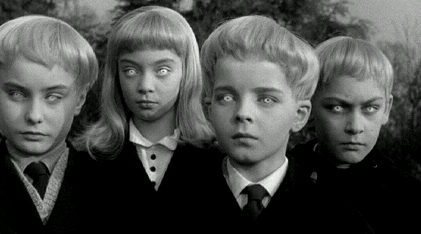
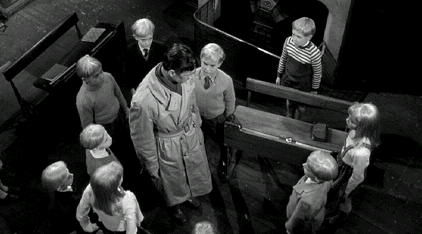
Showing posts with label George Sanders. Show all posts

Sunday, April 20, 2025

ALL ABOUT EVE (1950)

Director: Joseph L. Mankiewicz

Writers: Joseph L. Mankiewicz adapting Mary Orr’s short story “The Wisdom of Eve”

Producer: Darryl F. Zanuck

Cast: Bette Davis, Anne Baxter, George Sanders, Gary Merrill, Celeste Holm, Hugh Marlowe, Thelma Ritter, Gregory Ratoff, Marilyn Monroe, Barbara Bates, Walter Hampden

Broadway theatre star Margo Channing (Bette Davis) is troubled by her entry into middle age. Margo’s friend Karen Richards (Celeste Holm) introduces her to a young, lonely, and ardent fan named Eve Harrington (Anne Baxter). Eve ingratiates herself to Margo and her circle of friends and becomes Margo’s personal assistant. However, the pretty and ambitious young Eve exacerbates Margo’s insecurities.

The Flashback Fanatic movie review

Occasionally, my regular cinematic diet of vintage schlock and offbeat genre fare must be fortified with acknowledged mainstream classics. During such lapses of my bad taste, this immature film fan must sit up straight and eat everything on my plate because it’s good for me. My latest order for a well-balanced and nutritious movie meal was the justly revered All About Eve.

I had almost no preconceptions about this film or its subject matter. I knew that it starred Bette Davis in a great role and that it was considered a great film. Since Bette Davis is a classic movie legend, I thought it was high time that I found out what all the fuss was about. The only other thing I knew about this film was that it gave George Sanders the part that won him the Best Supporting Actor Oscar. I have appreciated the smooth and sardonic wit that Sanders can deliver better than anyone, which he demonstrated as hero Simon Templar in The Saint film series, so he was another factor drawing me to this film for the first time.


All About Eve could have tipped over into maudlin melodrama, yet it is much too nimble and cynical for that. That is not to say that it is just a snarkfest loaded with posturing by so-called characters meant to reassure us all that being presumptuous and conformist is some form of strength. All About Eve has some characters with decent sentiments and insecurities. They can be fallible or flawed, and even friends and lovers may have conflicts with each other that may be resolved by nothing more deliberate than just a cooling-off period. Most of the story’s cynicism is directed at the machinations and egos of some in the theatre and motion picture industry.

Margo Channing was the comeback role for Bette Davis that fit her like a glove. She was not the first choice for the role, but no one could have been more suited for it. As an aging film star herself, Davis may have had concerns that her best days career-wise were behind her. Davis certainly addresses such anxieties in her performance without losing our sympathy. This really surprised me, as I thought her Margo Channing would turn out to be the flamboyant diva that we would love to hate. Bette Davis’s irascible temperament provides the humorous grit the character needs, but her role is written and performed with enough sensitivity to make us engaged rather than judgmental. Nevertheless, that Bette Davis star power is burning brighter than ever when she utters that now-classic film quote, “Fasten your seatbelts. It’s going to be a bumpy night.”


As Eve Harrington, Anne Baxter plays the title character in All About Eve that, initially, seems to be the least interesting. She has some surprises in store for us and prompts theatre diva Margo Channing to confront some of her own fears and develop some perspective. Ironically, the character that Anne Baxter plays would steal some of the thunder from both Bette Davis’s character in the film and perhaps from Davis’s real-life accolades. Since both Davis and Baxter were nominated for the Best Actress Oscar Award for their roles in this film, it may have somehow given Judy Holliday the edge to win the Oscar for her role in Born Yesterday (1950). Bette Davis herself speculated that Gloria Swanson’s nomination (for the role of another aging actress in 1950’s Sunset Boulevard) may have helped to cancel out Davis’s Oscar chances. Did three great performances about actresses that year make each of them seem less Oscar-worthy?

George Sanders’ voice is so good that it could qualify as a special effect. As theatre critic Addison DeWitt, his sardonic narration sets the tone for this film perfectly. Of all the characters in this film, DeWitt ends up being the most surprising, yet this is not done as any sort of redemptive act. He is anything but heroic. He is simply someone that remains true to his character, yet, in doing so, enacts a strange form of justice. While DeWitt is too cynical and egotistical to be truly righteous, it is his moment of prideful indignation at this picture’s climax that must have won Sanders the Oscar.
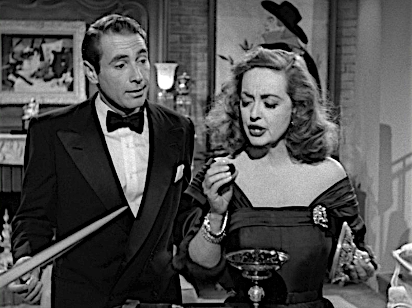
I had only seen Gary Merrill in the episode “The Human Factor” of the science fiction television series The Outer Limits (1963-65). Here he plays Bill Sampson, the Broadway theatre director and lover of Bette Davis’s Margo Channing. Merrill’s Sampson delivers some very verbose repartee throughout the film. This is all very dramatic and amusing, yet it still rings true to me. After all, theatre folk are accustomed to the wielding of words on stage for emotionally pointed effect, so it stands to reason that such people would be able to express theirselves that way in an impromptu manner. In yet another case of life imitating art from All About Eve, Merrill and Davis, having met on this film, began a relationship that led to their marriage of ten years.

Celeste Holm has the role of the nicest person in the film as Margo’s best friend, Karen Richards. As the amusing observation of Addison DeWitt’s opening narration points out, Karen only became part of the theatre crowd when she married playwright Lloyd Richards. My cynicism was immediately roused at that point, and I assumed that she would be a conniving hanger-on, yet she manages to remain seemingly wholesome. Once again, this film does not dole out obvious character payoffs to the audience. Karen is the catalyst of the story when she introduces fawning fan Eve Harrington to her idol Margo Channing. As Karen seems to be a very decent person, we can empathize with some of the emotional stress she is put through by others exploiting her goodwill efforts.

As Karen’s husband and Margo Channing’s frequent playwright, Lloyd Richards, Hugh Marlowe gets into a great shouting match with his temperamental star. Marlowe usually seems like the earnest everyman character in his roles, but that certainly does not mean his roles lacked range. He is probably best known for playing the world’s biggest heel in the sci-fi classic The Day the Earth Stood Still (1951). Marlowe would heroically redeem himself by trying to save the world from another extraterrestrial threat in Earth vs. the Flying Saucers (1956).

Two small roles are performed by very noteworthy ladies. The reliably amusing and acerbic Thelma Ritter plays Birdie, Margo Channing’s maid. Ritter was just one of many highlights in that Alfred Hitchcock classic Rear Window (1954). All About Eve also features a young bit player by the name of Marilyn Monroe. (Perhaps you’ve heard of her.) In this early role, she appears as Claudia Casswell. We meet her as critic Addison DeWitt’s escort trying to charm her way into the entertainment industry by flirting and flaunting what she’s got.

With a great cast to embody writer-director Joseph L. Mankiewicz’s conflicted characters and deliver his smart dialogue, this picture may have seemed like a shoo-in for Best Picture, Best Screenplay, and Best Director honors at the Academy Awards. But even Mankiewicz himself has acknowledged that the 20th Century Fox producer he had so much contention with, Darryl F. Zanuck, also made contributions by honing and simplifying his films to make them more effective. It was also Zanuck who changed this film’s title from Best Performance to All About Eve.

According to Joseph L. Mankiewicz’s son, All About Eve expressed many of his filmmaker father’s misgivings about the entertainment industry. Mankiewicz seemed to have more respect for the theatre scene, but enjoyed the greater financial rewards of Hollywood filmmaking and the greater control he could exert over a film than a live stage performance. 

While he seemed disdainful of the Hollywood crowd, the married Mankiewicz didn’t mind cavorting with various Hollywood starlets. This obviously contributed to a very stressful homelife in the Mankiewicz household. The marital dysfunction with his ex-actress wife must have inspired much of the attitude the writer-director portrays in that great cocktail party scene at Margo Channing’s residence. A bumpy night indeed!

It is rather fitting that a filmmaker who had more respect for the world of Broadway stages than Hollywood film studios would win Academy Awards for a film about theatre talents that plays out like a stage drama. Mankiewicz thought that the writing and performances should carry the story. Aside from just a few establishing shots, nearly everything occurs in interior settings that would be ideal for a stage play. Yet All About Eve also uses close-ups to allow its players to share feelings with us through subtle facial expressions that punctuate great dialogue. That is the simple power that can make a film classic.


WARNING: COMMENTS CONTAIN SPOILERS!

Sunday, December 31, 2023

THE SAINT STRIKES BACK (1939)

Director: John Farrow

Writers: John Twist and A.C. Edington (uncredited) adapting Leslie Charteris’ Saint novel Angels of Doom, aka She Was a Lady, The Saint Meets His Match

Producer: Robert Sisk

Cast: George Sanders, Wendy Barrie, Jonathan Hale, Neil Hamilton, Jerome Cowan, Barry Fitzgerald, Gilbert Emery, Robert Elliott, Russell Hopton, Edward Gargan, Robert Strange, James Burke. Nella Walker, (and uncredited cast) Willie Best, Paul E. Burns, Tristram Coffin, Robert Homans, Gerald Hamer, Ray Turner, Kernan Cripps, Jack Gargan, Tex Brodus, Tom McGuire, Howard M. Mitchell, Frank O’Connor, Ted Oliver, Tom Quinn, Bob Reeves, Ben Taggart, Dale Van Sickel 

In San Francisco, California at the Colony Club New Year’s Eve party, a gunshot rings out at the stroke of midnight. The victim is a notorious gunman that was drawing a bead on another guest at the party. He was shot by Simon Templar (George Sanders), an adventurer, amateur sleuth, and criminal-robbing thief better known as the Saint. Templar is in San Francisco to expose Waldeman, the mysterious leader of a group of criminals. Templar is also at odds with Val Travers (Wendy Barrie). She is the beautiful blonde that was accompanied by the gunman Templar shot. Travers’ father was a police inspector framed for robbery involving the Waldeman gang. That disgrace led to his suicide. Travers has allied herself with underworld characters to help her avenge her father. Simon Templar tries to charm the vengeful Val Travers at the same time he is trying to expose the criminals that she wants to destroy, though she may also be associating with them. 

The Flashback Fanatic movie review 

Simon Templar, alias the Saint, was introduced in Leslie Charteris’ 1928 novel Meet the Tiger. This led to an ongoing series of stories written by Charteris until 1963. Charteris collaborated with other writers for more Saint adventures that were published until 1983. Simon Templar was an English antihero often seen as something of a precursor to James Bond. The popularity of the character’s stories led to more Saint adventures in radio shows, comic strips, comic books, movies, and television. 

RKO Radio Pictures produced the first film presentation of the Saint, 1938’s The Saint in New York starring Louis Hayward. The film was very successful, and a series soon followed. Due to commitments to appear in other films, Hayward was unable to continue playing Simon Templar, so George Sanders began his five-film stint as the Robin Hood of Modern Crime. Until Roger Moore starred as Leslie Charteris’ hero in the 1960s television series The Saint (1962-69), George Sanders was the actor most identified with the role. 

The Saint Strikes Back provides a striking introduction for Sanders as Simon Templar. No sooner are we presented with the perceptive gaze of Templar spotting an assassination in the offing during a ritzy New Year’s Eve party, then the would-be assassin gets shot, the dead man’s beautiful accomplice makes for the exit, she is intercepted on the street by Templar, and during his smooth barrage of quips he reveals that he is the assassin’s assassin, and none other than the Saint, while he does his brash best to charm and tease her at the same time. 

That scene perfectly demonstrates what the George Sanders style of his Saint is all about. I find Sanders’ somehow-relaxed, rapid-fire delivery of witty banter mingled with his one-step-ahead-of-everyone-else trickery to be as amusing as a great Marx Brothers routine. Even if my head is spinning trying to keep track of the alliances and deceptions between characters in the story, Sanders’ wry manner ensures that I still enjoy the ride on this mystery merry-go-round. 

Of course George Sanders had a long acting career, often playing smooth-talking cads, and he won an Academy Award for Best Supporting Actor in 1950’s All About Eve. The Saint’s creator, author Leslie Charteris, was often very critical of the various media adaptations of his hero. He seemed quite unhappy with George Sanders as Simon Templar. As is often the case, film adaptations take liberties with their source material and must succeed with the audience on their own merits. Perhaps Charteris felt that both Sanders’ performance and Hollywood’s Motion Picture Production Code smoothed over the most ruthless edge of his character. Nevertheless, we are still provided with a hero in the Sanders films that often operates just outside the law, even as he aids it to see justice done. 

Returning from the previous Louis Hayward starring film is the character of New York Police Inspector Henry Fernack played by Jonathan Hale. Fernack provides a lot of humor, usually at his own expense, as he is alternately assisted and confounded by the daring and elusive Simon Templar. While Fernack is always suspicious of the Saint’s true motives, he is also an admirer of the Saint’s abilities used to defeat criminals in the past. No matter how irritated Fernack becomes with some of the Saint’s subterfuge, he can always be convinced one more time to aid the Saint’s crime-busting schemes. 

Wendy Barrie co-stars as the vengeful Val Travers. She is allying herself with crooks to expose and kill those who framed her father and drove him to suicide. Not only her beauty, but also her outside-the-law determination to see that her father is avenged appeals to Simon Templar. Her steely determination is initially immune to Templar’s charm, and she is only slowly won over by his efforts to expose the criminals she is also after. Barrie would appear in two more of the Sanders-starring Saint films as different characters. When RKO shifted George Sanders into the hero role of Gay Laurence/The Falcon in a similar series of mystery films, Wendy Barrie would also star as his love-interest in two of them. 

Another very familiar face to lovers of crime fighter series is Neil Hamilton as Valerie Travers’ smitten accomplice, Allan Breck. Hamilton would gain lasting fame late in his acting career as Police Commissioner Gordon on the Batman television series (1966-68). In two episodes of that show’s first season, Hamilton would be joined by George Sanders as the first actor to play the villain Mr. Freeze. 

The 1930s launched many film series featuring sleuths of all sorts. Many probably considered the Saint films just more of the same. Yet these jaunty flicks were distinguished by George Sanders’ assured performance as a witty and quick-witted hero that dealt with crime as if it was just a lark.

Wednesday, February 16, 2022

VILLAGE OF THE DAMNED (1960)

Director: Wolf Rilla

Writers: Stirling Silliphant, Wolf Rilla, Ronald Kinnoch (as George Barclay), adapted from John Wyndham’s novel The Midwich Cuckoos

Producer: Ronald Kinnoch

Cast: George Sanders, Barbara Shelley, Michael Gwynn, Martin Stephens, Laurence Naismith, John Phillips, Richard Vernon, Thomas Heathcote, Jenny Laird, Richard Warner, Sarah Long, Charlotte Mitchell, Pamela Buck, Rosamund Greenwood, Bernard Archard, Susan Richards, Peter Vaughan, John Stuart, Keith Pyott, Alexander Archdale, Sheila Robins, Tom Bowman, Anthony Harrison, Diane Aubrey, Gerald Paris, Bruno (the dog), Clive Powell (uncredited) 

Everyone in the English village of Midwich simultaneously passes out. Anyone entering the perimeter of the town also faints. After several hours the unconscious victims of the strange phenomenon awaken with no ill effects. However, it is soon discovered that all the village women of childbearing age have become pregnant at the time of the Midwich blackout. 

The Flashback Fanatic movie review

Bachelorhood has its advantages: I don’t have to pick up after myself, I can decorate my pad in any bizarre manner I see fit, there is no one about to scold me if I forget to put down the toilet seat, and no rugrats are around to disturb my peace and quiet. This last advantage is especially important when there are extraterrestrial forces that can impregnate a townful of women at once to perpetuate their species with soulless, mind-controlling, little bastards. Marriage might be wonderful, but I don’t think that “for better, for worse” business in the vows can make me feel duty bound to be stepfather to an alien brat that will eat all of my chocolate.

Village of the Damned is based on the 1957 John Wyndham novel The Midwich Cuckoos. This is a perfect example of the kind of science fiction that I prefer. It deals with the contemporary, real world consequences of one fantastic phenomenon. Wyndham, like H.G. Wells before him, preferred introducing one fantasy element into a normal setting to create the interest and conflict in a story. I could not agree more. There is a visceral reaction to such scenarios that make the circumstances much more immediate and relatable. This is contrary to far-flung fantasy world movie settings that are presented to bury us in visual effects and usually require accepting mountains of make-believe bullshit. Those often seem like nothing more than daydreams without rules and therefore have no suspension of disbelief.

Like many of my favorite stories, there is a lot of intrigue developed as we are first presented with an inexplicable event that leaves us as puzzled as the story’s characters. Much of the interest is maintained seeing the characters try to understand why the Midwich blackout happened and trying to anticipate the results. Once it becomes apparent that the young women in town are all pregnant, we not only wonder how and why this occurred, but we also wonder just what sort of children these unnatural pregnancies will produce. It is speculated that in Midwich, as in several other locations on Earth, an extraterrestrial force could have caused the mass pregnancies. Once it is apparent that the newborns are all nearly identical, develop much more quickly than normal children, and have mental abilities that are far superior to humans, the town of Midwich and the British government must decide if they can cope with this new breed of beings that could threaten the rest of mankind. 

George Sanders gives a very atypical performance as the optimistic Midwich scientist Gordon Zellaby. Sanders usually played smooth and sardonic cads or smooth and sardonic heroes. Here his customary cynicism is gone. His Gordon Zellaby is a character of great humanity, decency, and good humor. We are always on his side, even if he may be a bit too hopeful trying to manage the education and control of the Midwich brood of cold-blooded, alien hybrids. 

Gordon Zellaby has our sympathies because his wife Anthea (Barbara Shelly) is mother to David, the leader of the dangerously powerful children. Both Gordon and Anthea try to raise David with love and respect, yet such sentiments are never returned. David addresses his parents with a detached formality and courtesy that gives the impression he is merely tolerating them. 


Young Martin Stephens plays David Zellaby, the leader of the gang of superbrats. He is always controlled and confident. His only hints of emotion are concern about opposition to his plans and the subtle satisfaction he takes in the deadly results of the power he can exert over the humans in the village.


The deadly kids in Village of the Damned clearly demonstrate that absolute power corrupts absolutely. Children are often thought of as innocent, but they could be capable of great evil if they had the ability to get what they want. As Gordon Zellaby explains, moral values must be taught. It is only because children are not empowered that adults can condition them to have ethics and empathy for others. Society can’t function without those values. We see all too often how some people in high places never learned that lesson. Unfortunately, many of us see such sociopathic behavior as admirable. Having the power to get what you want and to hell with the consequences is seen by the selfish and ignorant as strength. Apparently, it never occurred to those idiots that the sociopaths they admire could grind them underfoot to achieve their ends. 

Britain produced many fine sci-fi horror films in the '50s and '60s that often were a bit more cerebral and sophisticated than the American productions. Being scary, tragic, and thought-provoking, Village of the Damned is one of the best and must-see viewing for fans of the genre.

STANLEY (1972)

Director: William Grefé Writers: Gary Crutcher, William Grefé Producer: William Grefé Cast: Chris Robinson, Alex Rocco, Steve Alaimo, Ma...