Showing posts with label Frankenstein. Show all posts

Wednesday, October 8, 2025

FRANKENSTEIN (1931)


Director:
James Whale

Writers: John L. Balderston, Garrett Fort, Francis Edward Faragoh, adapted from Mary Shelley’s 1818 novel Frankenstein; or, The Modern Prometheus and Peggy Webling’s 1927 stage play Frankenstein

Producer: Carl Laemmle, Jr.

Cast: Colin Clive, Boris Karloff, Mae Clarke, Edward Van Sloane, Dwight Frye, John Boles, Frederick Kerr, Lionel Belmore, Marilyn Harris, Michael Mark, Francis Ford (uncredited)

In Europe, obsessed scientist Henry Frankenstein (Colin Clive) wants to create life. He assembles a new being from various stolen human body parts. Frankenstein believes that he can harness a lifeforce from lightning. During a thunderstorm, Frankenstein conducts his experiment. He succeeds in animating his creation (Boris Karloff), who is as ignorant as any newborn. Unfortunately, Frankenstein’s assistant Fritz (Dwight Frye) provided the brain of a criminal for transplanting into the skull of the huge, grotesque creature. Frankenstein’s neglect and Fritz’s abuse prompt the monster to become violent.

The Flashback Fanatic movie review

When Universal Pictures’ 1931 Dracula proved to be a much-needed hit, Frankenstein would seem to be a sure-fire follow-up. Like Dracula, this film would also credit an earlier stage play adaptation of its source novel. Peggy Webling’s 1927 play can probably primarily be credited with proving to Universal Pictures that Frankenstein had commercial potential due to its recent English stage productions. Since John L. Balderston apparently hated Webling’s stage script, one would assume his film story treatment was hardly faithful to it.

An early contender for the director’s chair, Robert Florey, is supposed to have ignored any previous film treatments and wrote an uncredited script that may have shaped what is now a film classic. Florey had gone so far as to direct a 20-minute test film with none other than Dracula’s Bela Lugosi as the monster. There have been many contradictory accounts of how Lugosi’s monster in that test footage was depicted. Some have said his appearance was based on the animated clay being in Paul Wegener’s German film The Golem (1920). Others have suggested that the Lugosi monster makeup already had characteristics that would eventually be used in the final film, and that some of that makeup was based on Robert Florey’s ideas. This horror fan can think of no lost film footage that would be more thrilling to be found and shown one day than Florey’s Frankenstein film test. Ultimately, Florey did not get to direct Frankenstein and Lugosi was denied the monster role. That may have been an awful career move for Lugosi, yet he was not very enthusiastic about playing a mute role buried under extensive makeup. Of course, Lugosi would eventually play the monster in 1943’s Frankenstein Meets the Wolf Man.

One distinction of Webling’s play would be that it is supposed to be the first time that Frankenstein’s monster is called “Frankenstein.” It was probably the Frankenstein film’s posters with the monster prominently featured that helped perpetuate the popular monster misnomer. Apparently by 1933, the name of Frankenstein being used as a euphemism for monstrous ugliness was common. In Mystery of the Wax Museum (1933), actress Glenda Farrell refers to that film’s disfigured menace as someone who “made Frankenstein look like a lily.”

It is interesting to note that the original 1818 novel of Frankenstein; or, The Modern Prometheus by the English author Mary Shelley, while being a world-famous story of Gothic horror, is an early example of science fiction. Frankenstein is a scientist whose pioneering medical research and experimentation birth a being that becomes a menace and turns on its creator. The 1931 movie adaptation has little resemblance to the source novel, yet the film still shares the book’s themes of scientific irresponsibility, parental neglect, and man’s inhumanity to one who is different.

English director James Whale had recently established himself as a respected talent at Universal. His background in theater made him valuable as a director in the era when films were transitioning from silents to talkies. Whale had been involved in three World War I films, the last of which was the successful Waterloo Bridge (1931) for Universal Pictures. When the critically acclaimed, recent arrival at Universal was given his pick of projects for his next film to direct, he chose Frankenstein. World War I veteran James Whale wanted a change of pace from war films and certainly must have relished the stylized visual and dramatic opportunities suited to Gothic horror.

Whale brought not only his filmmaking craft to the project, for he was also instrumental in discovering the talent who would portray his film’s monster and become an icon of horror: Boris Karloff. The fellow Englishman’s unique, angular features must have struck Whale as being the perfect foundation for the strange being that needed to be built into the starring menace of his film.

Jack Pierce, Universal’s head makeup man, was about to become as revered to horror fans as Boris Karloff when he concocted the creature’s look. Mary Shelley’s original novel is vague on the details of the monster’s creation. Therefore, Pierce’s makeup expertise had to devise ways to depict the surgical improvisation and augmentation that Frankenstein used to construct a new being from various corpses that could be brought to life with electricity. He turned Karloff into the most recognizable character in horror history. There has been a multitude of Frankenstein films made all over the world since 1931, but Universal’s pale, scarred giant with the flattop skull and electrodes in its neck is still the world’s most famous movie monster. Pierce’s monster design played a huge role in the picture’s success and solidified Universal Pictures’ reputation as a fear film factory with Pierce as the chief monster maker.

Just as instrumental in the success of the film was Boris Karloff’s performance as the monster. Karloff is not only playing a character with the attention-getting advantage of a monstrous appearance. He is also bringing nuances of emotion to a being without the benefit of dialogue. Karloff’s inarticulate monster can only whimper, moan, and roar. Despite his heavy makeup and costuming, Karloff registers a wide array of expressions with a wonderful mime performance. This was something extraordinary at that time; what other film character was given so much emotional depth without being able to speak or even be considered truly human? Despite the monster receiving a criminal brain, we are left to wonder if it has only become dangerous as a reaction to abuse and neglect. Nearly a century later, Karloff’s performance still can’t be taken for granted. 

I was surprised to learn that, in addition to many years of stage work, the relatively unknown, 43-year-old actor had already appeared in 81 film roles by that time. I knew Karloff had already paid his dues as an actor, but I didn’t realize how often he had already been before movie cameras. All that dedication and experience finally paid off, and films were due for many more great, starring performances from Boris Karloff.

With Frankenstein’s sensational debut of Karloff’s monster, it is easy to forget what a fine performance Colin Clive contributes as Henry Frankenstein. Colin Clive was an English actor who had worked with director Whale before in the English stage production of Journey’s End before appearing in Whale’s 1930 film adaptation. Clive brings both obsessive intensity and sensitivity to the role. His wonderful speaking voice draws us in when he explains his ambition to make scientific discoveries. Clive’s unhinged victory rant of “It’s Alive! It’s Alive!” is a famous film quote and horror movie catchphrase. Horror fans appreciate Clive reprising his role in Bride of Frankenstein (1935) and starring in another ’30s creepy classic, Mad Love (1935). Unfortunately, Colin Clive was as emotionally tormented as his film characters and would soon die at just 37 years of age in 1937.

Two of the supporting cast were lifted from Universal’s pioneering, sound-era, horror classic Dracula: Edward Van Sloan and Dwight Frye. Van Sloane appears as another scientist, Dr. Waldman, who tries to help Frankenstein avoid the disaster his experiment is leading to. Frye plays another unsavory ally to the title character, this time around as hunchbacked lab assistant Fritz.


Mae Clarke plays Henry Frankenstein’s fiancée, Elizabeth. Clarke had drawn fine notices acting in director Whale’s recent Universal hit, Waterloo Bridge. Bette Davis was considered for the role of Elizabeth, but Whale must have preferred working again with Clarke after proving herself in his previous film. Mae Clarke had a very extensive filmography, yet her most famous film moment is probably having James Cagney smash half a grapefruit in her face in The Public Enemy (1931).

Despite its familiarity so many generations later, James Whale’s Frankenstein is still vital and entertaining to the discerning fright flick fan. Its expressionistic interior and stylized exterior sets create a mood ripe for nightmares. Whale’s camera moves establish settings and his shot choices cut abruptly to closeups that ratchet up character conflict or apprehension. In the early days of the sound era, this was very agile filmmaking that defied the “handicap” of coping with new sound recording technology which often hindered mobile camera work and varied perspectives in a scene.

Another trademark of Whale’s horror films is wit. This was not just ham-handed comic relief but touches of irreverence and eccentricity. One could argue that Frederick Kerr’s elderly Baron Frankenstein is a comic-relief character, but he is quite appealing in his blustery ignorance and jovial energy. One of my favorite bits in the film is after Dwight Frye’s Fritz refuses admittance to visitors trying to interrupt Frankenstein’s experiment. Whale’s camera lingers on the hobbling hunchback just long enough for us to see Fritz pause to pull up a droopy sock on his grubby ankle. That action serves no story purpose, but it is such a “non-movie” moment that it feels both real and funny.

Universal Pictures’ Frankenstein established many horror film tropes that would be indulged in by the genre’s filmmakers ever since: the indeterminant time and place of its European setting, graverobbing, the torch-bearing mob of angry villagers, monsters created by mad scientists, and extravagant and arcane mad science gadgetry. Electrician Kenneth Strickfaden’s impressive array of sparking, buzzing, and blazing gizmos used in Henry Frankenstein’s experiment were to be recycled and elaborated on in many more sci-fi scenarios for Universal Pictures over the years. This film defined the state-of-the-art for mad scientist labs.

Frankenstein became another much-needed box-office hit for Universal Pictures. It also drew a lot of criticism for its then-objectionable content. The horror genre was always a lightning rod for moral condemnation, and Frankenstein attracted its share of outrage. For decades after its initial release, prints of the film were trimmed of Henry Frankenstein blaspheming about feeling like God. Another more shocking incident was the monster’s unintentional drowning of the child (Marilyn Harris) that befriends him. Even today, death to children is a touchy subject in horror films. Fortunately, these trims have been restored to this horror classic.

With the 1931 back-to-back box office hits of Dracula and Frankenstein, horror at the sound era cinema was a proven crowd-pleaser. For the next 15 years, Universal Pictures was the predominant purveyor of fright flicks that created scary characters who are now American pop culture icons. They have achieved a legendary status that exemplifies all things spooky for all ages and all time.

Wednesday, March 29, 2023

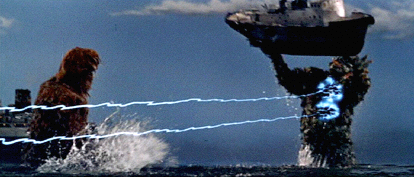
THE WAR OF THE GARGANTUAS (1966), aka FRANKENSTEIN'S MONSTERS: SANDA VS. GAIRA

Director: Ishiro Honda

Writers: Reuben Bercovitch, Ishiro Honda, Takeshi Kimura

Producers: Tomoyuki Tanaka, Kenichiro Tsunoda, Henry G. Saperstein

Cast: Russ Tamblyn, Kumi Mizuno, Kenji Sahara, Haruo Nakajima, Yu Sekida, Nobuo Nakamura, Kipp Hamilton, Jun Tazaki, Hisaya Ito, Ren Yamamoto, Hisaya Ito, Yoshifumi Tajima 

Biologist Dr. Paul Stewart (Russ Tamblyn) is a specialist in giant animals. He has been called in to investigate reports of attacks by a giant, green, humanoid creature rising from the seas around Japan. It is suspected that this man-eating monster is a gargantua, the name given to the species when Stewart’s team had discovered and studied one infant creature years earlier until it escaped. Since the little, brown creature was always gentle and lived in the mountains, Dr. Stewart surmises that this deadly, sea-dwelling, green giant must be a full-grown, mutant offshoot. If the ferocious giant grew from cells of the gentle gargantua, destroying it with military firepower would scatter cells that could grow into more monsters. 

The Flashback Fanatic movie review 

There is probably no better example of the helpless horror that the kaiju film realizes than the opening scene in The War of the Gargantuas. During a thunderstorm at sea, a giant octopus attacks a ship only to be attacked by a second sea monster, the green gargantua. It’s a real grabber and is elaborated on in a flashback when we see the sailors swimming for their lives only to become monster munchies. 


My favorite bit of mean monster etiquette is when the evil, green gargantua gobbles up his human hors d’oeuvres; after chewing up his victims, he spits out their clothes. It’s a fine, grisly touch that makes this monster’s behavior even more personally vindictive than just leveling buildings that a lot of those tasty humans might be occupying. 


Aside from the original Godzilla (1954) that initiated the Japanese kaiju films, The War of the Gargantuas is my favorite of the genre. Its appeal for me is mostly due to the humanoid appearance of the giant monsters that allows them more agility and expression. It also still operates as a horror film rather than just a monster rally and sci-fi fantasy aimed at the kiddies. Sure, kids will love it, as I did and still do (I’ll never grow up), but I appreciate its directness focusing on just one type of monster that we find out has a brother. Since one brother’s brotherly love won’t excuse snacking on human beings, we also get the monster fight action that delights kaiju film fans. 


The War of the Gargantuas is another one of those wild flicks that went through a twisted process of reinvention. It originated as a sequel to Frankenstein vs. Baragon (1965), aka Frankenstein Conquers the World. The two giant monster brothers were supposed to be grown from cells of the Frankenstein monster seen in the previous film. The good, brown-haired giant was called Sanda (Yu Sekida) and the evil, green-haired giant was called Gaira (Haruo Nakajima). The new monsters were not referred to as gargantuas until the American English dub for this film was done, which eliminates any reference to Frankenstein. The gargantua concept was probably more easily understood by American audiences who had not seen the earlier film. The Japanese take on Frankenstein was already outrageous enough. To somehow link two new and very different monsters to the Frankenstein monster of the previous film would be perplexing. 

The US alteration of the monsters’ origins makes them seem like enormous versions of the legendary Tibetan creature the Yeti, aka the Abominable Snowman. This furry, mountain-dwelling anthropoid had an American cousin called Bigfoot that was generating more media attention in the late ’60s around the time that the US version of The War of the Gargantuas was being modified. 

According to both director Ishiro Honda and US co-producer Henry G. Saperstein, their American star Russ Tamblyn was difficult, to say the least. Tamblyn ignored Honda’s direction and hated his lines, so he made up his own. Somehow, Tamblyn’s original voice tracks were lost. Then when it came time to dub his dialogue for the US English version, Tamblyn could not remember his original lines. Tamblyn had to recreate his dialogue from watching his filmed lip movements. I would have to say that he did a very fine job, as his words always seem perfectly in synch with his image. However, having to dub his lines in such difficult circumstances may be an additional factor contributing to the rather blasé air of his performance. 

As a result, we have a scientist hero in a sci-fi flick that often seems aloof and testy. There is even one scene aboard a bullet train to Tokyo when Tamblyn’s Dr. Stewart is squinting, pale, and sweaty; too much saki the night before? I’ve never been on a bullet train, but I know the feeling. 

Dr. Stewart also has an unusually cynical attitude that is kind of refreshing. When referring to the comparison of the green and brown gargantuas with the biblical brothers Cain and Abel, Dr. Stewart says, “Brother against brother, huh? Sounds like some countries I know. Well, maybe this time the nonviolent one will win, huh? Ha. Ha.” What other scientist hero of ’50s and ’60s sci-fi flicks would make such a sour comment? 

Tamblyn’s performance may have been tapping into the attitudes of the 1960s disaffected youth. Some of his offhand quips actually play better due to his dour manner. In many scenes Tamblyn’s Dr. Paul Stewart acts like he is a paid-by-the-hour laborer that can’t wait to go home instead of the dedicated genius we expect to save the day. I get a kick out of all of the news reporters clamoring for insight from the esteemed scientist who acts like he doesn’t give a damn. 


Only Stewart’s assistant, the beautiful Dr. Akemi Togawa (Kumi Mizuno), seems able to mellow out the apathetic scientist. He manages to be a bit more relaxed and likable around her. They seem comfortable together, yet there is never any real indication of a romance between them, which is another deviation from the norm in sci-fi horror films of this period.

Due to the reproductive abilities of the gargantuas and this film’s somewhat open-ended conclusion, it seems likely that the film’s Japanese production company Toho was entertaining the possibility of yet another sequel. It would probably be inevitable that the gargantuas would tangle with other monsters in Toho’s kaiju universe, but I am glad that they never did. Despite this film’s origin as a loose sequel to the most far out Frankenstein variation ever, The War of the Gargantuas still remains its own offbeat spectacle.
 

Friday, May 13, 2022

LADY FRANKENSTEIN (1971)

Directors: Mel Welles, Aureliano Luppi (uncredited)

Writers: Dick Randall, Mel Welles, Edward Di Lorenzo

Producer: Mel Welles

Cast: Rosalba Neri (as Sara Bay), Joseph Cotton, Paul Muller, Mickey Hargitay, Herbert Fux, Marino Masé (uncredited), Riccardo Pizutti (as Peter Whiteman), Renate Kasché (as Renata Cash), Lorenzo Terzon (as Lawrence Tilden). Ada Pometti (as Ada Pomeroy), Gaultiero Rispoli (as Richard Beardley), Joshua Sinclair (as Johnny Loffrey), Andrea Aureli (as Andrew Ray), Petar Martinovic (as Peter Martinov), Adam Welles, Herb Andress (uncredited), Romano Puppo (uncredited), Allesandro Perrella (uncredited), Ferruccio Fregonese (uncredited) 

In nineteenth-century Europe, Tania Frankenstein (Rosalba Neri) has finished her medical studies and returns home to her father, Baron Frankenstein (Joseph Cotton). Tania is now a licensed surgeon and wishes to collaborate with her father on his medical experiments. The Baron is on the verge of completing his life’s work to endow life to a being (Petar Martinovic) he has assembled from pieces of various human cadavers. When the Baron brings his creation to life, it immediately kills him and wanders off. Tania carries on her father’s work by creating a second creature to destroy the first. 

The Flashback Fanatic movie review

In 1957, Britain’s Hammer Films had galvanized the horror genre with the mammoth jolt of The Curse of Frankenstein. With their bold color emphasizing bright red blood and warm, creamy cleavage, Hammer gained immediate notoriety and became the international brand for horror.

However, by the '70s, the Gothic horror of Britain’s Hammer Films was becoming all too familiar. As films were allowed to become more explicit in their content, Hammer had to follow the trend rather than create one to stay relevant at the box office. Their films became a bit bloodier and a lot more sexual. Those were the contemporary currents animating Italy’s answer to Hammer: Lady Frankenstein.

The title of this film and its tagline (“Only the monster she made could satisfy her strange desires!”) tells us all that we need to know to distinguish this Frankenstein film from those that had gone before. That’s exploitation, folks! All that remains is to see just how far it will go.

Lady Frankenstein checks off all the boxes to make it a sexy variation on the Hammer style Gothic horror film. While it does hold one’s interest with a few good dialogue scenes, monster mayhem, sex, and Rosalba Neri’s sultry beauty, the film’s overall execution is a bit muddled. There are a lot of awkward edits that abruptly cut away from scenes the split second that the action or dialogue is finished. Then there is that final reveal of Tania Frankenstein’s intentions that is supposed to be some sort of surprise betrayal that still has me scratching my head in confusion. Perhaps something was lost in the Italian-to-English translation, but the monster seems just as bewildered as I am. 


As Baron Frankenstein, Joseph Cotton is the big name topping the cast list. At this late point in his career, Cotton had also appeared in a couple of other European fright flick favorites, The Abominable Dr. Phibes (1971) and Baron Blood (1972). 


There are a few other familiar faces to fans of Euro-horror in the cast. Herbert Fux has some of the best lines (at least in the English dub) as the drunk and debauched grave robber, Tom Lynch. Paul Muller plays Baron Frankenstein’s assistant, Charles Marshall. Bodybuilder-turned-actor Mickey Hargitay appears as cynical police investigator Harris. Curiously, Marino Masé receives no billing. He plays the important role of Thomas Stack, the slow-witted stable boy that figures prominently in Tania Frankenstein’s plans.


This film was my introduction to that sexy icon of Italian genre films throughout the '60s and '70s, Rosalba Neri. Her dark beauty would cast a sexual spell on the viewer in any role she played, and that is just what is required in Lady Frankenstein. She is also able to project an obsessive determination and intelligence that makes us believe she is both a siren and a scientist. I can’t be certain, but here she may have played the first character in cinema to orgasm during a sex partner’s murder. 

Aside from the gender switch of the main scientist in this Frankenstein film, the other novel ingredient is the women’s lib sensibility addressed by Tania. She is conscious of her daring in achieving a medical education in a male dominated society. There are some that criticize this film as vilifying a woman for being determined, educated, and sexually aggressive. However, those are exactly the same qualities that Peter Cushing’s amoral portrayal of Baron Frankenstein had in the Hammer Films Frankenstein series. If a man behaving badly can be shown to be the villain, so can a woman; that’s equality. 

Ultimately, Lady Frankenstein is almost entirely motivated by the attention-getting gimmick of a beautiful woman in the role of a sexy mad scientist. If you want to complain that such a character also has to get naked, well, you got me there. Although Peter Cushing is one of my all-time favorite actors, I must admit that Rosalba Neri is much more qualified to ditch her lab smock and play doctor with her creation.

Thursday, July 15, 2021

FRANKENSTEIN'S DAUGHTER (1958)

Director: Richard Cunha

Writer: H.E. Barrie

Producers: George Foley, Marc Frederic

Cast: John Ashley, Sandra Knight, Donald Murphy, Sally Todd, Harold Lloyd, Jr., Felix Locher, Wolfe Barzell, John Zaremba, Robert Dix, Harry Wilson, Voltaire Perkins, Charlotte Portney, Bill Coontz, George Barrows, Page Cavanaugh and His Trio (the band as themselves)

In the suburban residence of elderly Dr. Carter Morton (Felix Locher), his assistant Oliver Frank (Donald Murphy) is conducting secret experiments in Morton’s home laboratory. Frank is actually a descendant of the legendary Frankenstein family that created life from the dead. He tests a serum on Morton’s niece Trudy (Sandra Knight) that temporarily disfigures and deranges her. He soon creates an even more horrible being.

The Flashback Fanatic movie review

Another entry in the teenage monster genre, Frankenstein’s Daughter is as outrageous as any of them. This flick never gets any respect, but I thoroughly enjoy it. Its juxtaposition of idyllic 1950s suburbia with mad science and monsters keeps me fixated. I hope all of you realize that anyone who uses the word “juxtaposition” in a review must really know what the hell he is talking about. Therefore, if I like this film that must mean all who dismiss it are utter fools.

There are plenty of cockeyed elements here to appreciate:
  • There are trigger-happy police immediately blasting away at anyone ugly enough to be a monster. 
  • Then the same cops being conveniently blind enough to run right past the fence that the monster girl and Oliver Frank are barely hiding behind.  
  • Elsu (Wolfe Barzell), the crusty old gardener in the Morton household, is treated like some lower form of life by both Dr. Morton and his niece, though they both seem to be otherwise decent people. 
  • Elsu inexplicably thinks Trudy is “sweet,” though we never see her show him any emotion except obvious discomfort.  Of course, Elsu is assisting Oliver Frank in his vile experiments, so maybe he just exudes some kind of creep factor. 
  • You have got to hand it to that slick operator Oliver Frank/Frankenstein managing to get the assistant to his father’s experiments placed in the Morton household with him. 
  • When Oliver Frank puts the female brain of his murder victim into his creation, he assumes it will be obedient and not bear him any grudge. 
  • The female brain in a very ugly male body is a new spin on mad science. 
  • A monster that would take an hour to walk around the block manages to leave the Morton house and commit a murder at a nearby warehouse and make it back the next evening without being seen. 
  • The monster has damaged the front door when leaving, but the next night the door is undamaged. It is just possible for it to have been repaired the next day, or it is also possible that it is a continuity error. Surely, even if the Mortons were not aware of a monster in their house, they would be concerned about what appears to be a break in. Trudy does ask Oliver Frank if he knows who did this, as he is acting very strangely, but no more is made of it. 
  • There is the pool party barbecue and jam session going on at the Morton place while Frankenstein’s latest creation is chained up in the attic.  
  • As the film ends, the horrendous events of the story have just made the local headlines and the surviving main characters are full of fun and joy, regardless of the people they were close to that did not survive. I guess Johnny Bruder (John Ashley) must have gotten that promotion to assistant manager; that surely makes everything come up roses.

It may seem like I am bashing Frankenstein’s Daughter, but that’s not the case at all. I like these reckless and absurd elements. I also enjoy the almost constant conflict between characters in this movie. Even when there is no “horror stuff” going on, there are interesting and often-uncomfortable situations happening, and Oliver Frank is usually at the center of them.

There’s never a dull moment with Oliver Frank around.  He is contentious and insubordinate with his employer Dr. Morton. When he’s not doping her fruit punch with experimental drugs, Oliver Frank sexually harasses Morton’s niece Trudy. Oliver Frank has the audacity to be building a monster in his spare time in his employer’s home lab and storing the results in an unused wine cellar with no one the wiser. He nearly date-rapes Trudy’s friend Suzie (Sally Todd). When she spurns him, Oliver Frank really shifts his villainy into high gear. Oliver Frank decides to try and strangle old Dr. Morton in his own home to get the run of his lab. Within minutes of the police knocking on the Morton household door and interrupting his attempted murder of the “nutty old man,” Frank manages to get the police to arrest Dr. Morton and suggest that he is senile. Oliver Frank/Frankenstein is frankly one of the greatest and most enjoyable jerks in movie history.

Donald Murphy as Oliver Frank/Frankenstein really takes the acting honors in Frankenstein’s Daughter. His character is an absolute sociopath and egomaniac, and Murphy certainly must have had the most fun of all the cast in the film.

The other principals in the cast play the material sincerely and for what it’s worth. John Ashley and Sandra Knight make a likable couple. They are the two we are supposed to be rooting for and they never become cloying or obnoxious. Sally Todd is fun as the hard-to-get tease Suzie Lawler. She and Murphy share the best scene in the film when their necking session in a lover’s lane takes a really nasty turn. The tension builds, as we know that Oliver Frank is going from horny to homicidal. I actually feel sorry for Suzie in that moment.

Director Richard Cunha cranked out three other horror and sci-fi films the same year as this one. His She Demons (1958) is much wackier than Frankenstein’s Daughter, and I highly recommend it to all vintage schlock cinema fans.

One of the things I always appreciate in Frankenstein movies is the new look that will be given the featured monsters. After Universal’s classic monster design for Boris Karloff and other actors in their films of the '30s and '40s, it was mandatory that other filmmakers not imitate Jack Pierce’s work, or risk legal action. Make-up man Harry Thomas’ monster designs are certainly distinctive. In a six-day shoot that was only budgeted at about $65,000, Thomas has complained that he was always rushed and often not given clear direction about just what the director needed. After he had created his stitched-together creature, he was mortified to learn that it was supposed to have the head of a female. All he could do was smear lipstick on it. Thankfully, his suggestion to put a blonde wig on this monster was not allowed. During the film’s climax, Thomas’ hurry-up-and-get-it-done acid burn makeup is very effective and a gruesome highlight.

Frankenstein’s Daughter works for me due to the extremes of behavior and horror happening in the midst of a cozy suburb; those contrasts create interest. The appealing and accessible world everything takes place in allows me to invest much more involvement in the crazy yarn unfolding. The absurd and the horrific presented sincerely may be one person’s trash or this flashback fanatic’s treasure.

Monday, June 28, 2021

DRACULA VS. FRANKENSTEIN (1971)

Director: Al Adamson

Writers: William Pugsley, Samuel M. Sherman

Producers: Al Adamson, Samuel M. Sherman, John Van Horne

Cast: J. Carrol Naish, Lon Chaney, Jr., Regina Carrol, Anthony Eisley, Anne Morrell, Greydon Clark, Zandor Vorkov (Roger Engel), John Bloom, Jim Davis, Russ Tamblyn, Maria Lease, Angelo Rossitto, Shelly Weiss, Forrest J. Ackerman, William Bonner

Las Vegas entertainer Judith Fontaine (Regina Carrol) heads to Venice, California looking for her missing sister Joan (Maria Lease). She runs into hippies, bikers, and Dr. Durea, the proprietor of a spook show exhibit at the beachside carnival. Dr. Durea (J. Carrol Naish) had his brutish henchman Groton (Lon Chaney, Jr.) kill Joan and others to use their bodies for strange blood experiments. Durea is actually the last of the Frankenstein family that created a man-made monster. That monster has been exhumed and brought to Dr. Durea by Count Dracula (Zandor Vorkov). Dracula wants Durea to revive the monster and to continue his blood experimentation that will grant Dracula even greater power.

The Flashback Fanatic movie review

Dracula vs. Frankenstein is the most well known of director Al Adamson’s films. This is due primarily to the famous monster duo in the title, not to any cinematic merit. It is a seriously compromised project because of its constant reinvention to try to turn the original attempt called The Blood Seekers into a commercially successful exploitation product. I have always wondered how The Blood Seekers, as originally completed, would have played. It had to be more cohesive than what Dracula vs. Frankenstein became.

The kid in me can still get off on the offbeat elements in the film: mad science, monsters, violence, and sexy women. The whole exploitative and schlocky vibe of this thing keeps drawing me back to it. Yet with all of that tantalizing stuff jammed haphazardly into it, I also see this film as a big missed opportunity.

As producer and co-writer Samuel M. Sherman has explained in interviews and the DVD audio commentary, the Dracula and Frankenstein characters were not part of the original film. They were added in with additional rewrites and new film footage thinking it would make the movie more commercial. Knowing that production history, one can almost marvel at the audacity of trying to reconfigure an already finished film to such an extent. The original storyline may have been exploitation fodder, but all the added Dracula and Frankenstein stuff give the impression that the whole film seems like it is being improvised.


The two horror genre veterans, J. Carrol Naish and Lon Chaney, Jr., give their last film performances in Dracula vs. Frankenstein. One can only assume that the original The Blood Seekers film would have been a better showcase for them, if it were more coherent. Perhaps scenes were cut that gave the Naish and Chaney characters more depth or motivation. 

As it stands now, the audience is expected to accept a lot based on horror movie character tropes; Dr. Durea is a mad scientist and Groton is his simple-minded henchman. The point of Durea’s blood experimentation is vague. Groton’s need for injections that transform him into a pasty-faced killer, and then are used to also calm his spontaneous transformations, is a Jekyll-and-Hyde movie gimmick. Although I love tried-and-true movie gimmicks, I just wish there was a little better setup for these characters and their motives. 

Much of Naish’s dialogue is of that roundabout drivel that is supposed to sound lofty and intelligent in low-budget schlock. Chaney has no dialogue, as he is once again reduced to the mute menace role. Unfortunately, this was a necessity because of the throat cancer that he was suffering from at the time.

Regina Carrol is a voluptuous attraction in many Al Adamson films, as she was also his wife. Her cleavage always steals the scene. The routine we see her perform in her first scene, as Judith Fontaine, was part of Regina’s act when she actually did perform in Las Vegas.

Anthony Eisley as Mike is just about the most atypical hero in any horror movie. He comes across like a slick establishment type that decided to stop parting his hair and throw on some love beads over his turtleneck pullover and live on the beach. He seems like a nice enough guy until he makes his free love move on Judith. I can’t say I blame him, but that “We don’t want to get involved, do we? Just be good friends” line before he starts tongue wrestling with her always struck me as wonderfully sleazy. Lounge lizard or hippie wannabe, it’s still all about the old in-and-out.

Russ Tamblyn emits that don’t-give-a-damn vibe as Rico, the lead troublemaker in a trio of bikers. This character was almost a reprise of his biker character Anchor from an earlier Adamson/Sherman production Satan’s Sadists (1969). Unfortunately, his Rico role was edited down from The Blood Seekers version of the film to make room for the new Dracula/Frankenstein footage. With seemingly no effort and little screen time, Tamblyn’s Rico still manages to be despicable, especially when menacing the lovely hippie Samantha (Anne Morrell).


Then we have the two title characters that keep us from ever being able to appreciate the pure cinematic splendor that could have been The Blood Seekers. Zandor Vorkov’s Dracula has been roundly condemned as the worst Dracula in movie history. With his often inane rambling dialogue that always has a spooky echo, his plastic joke shop fangs, and pasty white make-up that becomes so heavy in the final scenes that he looks like a mime, Vorkov’s Dracula probably makes the film’s most lasting impression for all the wrong reasons. The Frankenstein monster is little more than a prop in this movie. The design of the face is pretty interesting and, with 7’4” John Bloom in the role, this monster has impressive height. But the monster is shoehorned into the movie along with Dracula, and they only interact with three of the main characters; that is the three actors (Naish, Carrol, and Eisley) that would return from The Blood Seekers to shoot additional scenes.

With the budget limitations, the rewriting, the reshooting, and the re-editing, it was impossible that Dracula vs. Frankenstein would turn into a good film. An appreciation of schlock is necessary to derive any enjoyment out of it. I also derive an added interest by knowing its history of reconfiguration. It takes real nerve to graft seemingly unrelated pieces of narrative together into a film in the hopes of improving it. Everything about Dracula vs. Frankenstein has a slapdash feel to it, but I’ll be damned if I don’t look forward to watching it again.

STANLEY (1972)

Director: William Grefé Writers: Gary Crutcher, William Grefé Producer: William Grefé Cast: Chris Robinson, Alex Rocco, Steve Alaimo, Ma...