Showing posts with label Jamie Lee Curtis. Show all posts

Friday, December 6, 2024

ESCAPE FROM NEW YORK (1981)


Director:
John Carpenter

Writers: John Carpenter, Nick Castle

Producers: Larry Franco, Debra Hill

Cast: Kurt Russell, Lee Van Cleef, Donald Pleasence, Adrienne Barbeau, Harry Dean Stanton, Ernest Borgnine, Isaac Hayes, Tom Atkins, Charles Cyphers, John Diehl, Season Hubley, Arden Young, Frank Doubleday, Ox Baker, Buck Flower, Jamie Lee Curtis (uncredited narrator and automated voice), Joe Unger (in deleted scene) 

By 1997 the entire island of Manhattan has been sealed off and used as the dumping ground for all of the criminals in the United States of America. Once exiled in the neglected metropolis, the convicts are left to fend for themselves and are never released. When terrorists crash land the Air Force One jet in New York City, the leader of the prison city’s gangs, the Duke of New York (Isaac Hayes), takes the U.S. president (Donald Pleasence) hostage. Liberty Island Security sends a recent convict, decorated former Special Forces veteran Snake Plissken (Kurt Russell), on a rescue mission into New York City. If Plissken succeeds bringing out the president and an important audiocassette tape that he was carrying to a peace conference, Plissken will receive a full pardon. If Plissken fails to accomplish his mission in 24 hours, two explosive capsules injected into his neck will kill him. 

The Flashback Fanatic movie review 

During the 1970s, director John Carpenter had helmed several well-received television movies and a couple of cult films before he made one of the most famous horror films ever with 1978’s Halloween. Although that horrific holiday favorite would become his calling card, Carpenter would continue regularly making many more feature films of various genres for the rest of the century. After Halloween, Carpenter’s Escape from New York is probably his most successful film that also has continued to be a venerable cult favorite. He has made other cult films with reputations that have grown over the years, despite lackluster profits or indifferent critical responses at the time of their release. But it seems that Carpenter hit the sweet spot for genre filmmaking with Escape from New York; it was original, offbeat, and immediately profitable. Fans loved it then and revere it now. 

The post-apocalyptic and dystopian sci-fi film was becoming a popular genre in the 1980s. The no-holds-barred action and destruction of social norms provided the edgy thrills that tantalized the audience. Escape from New York lands neatly into that genre and was also an influence on it. 

The world of this film is not explored in any great detail. We only know that the United States is at war and the crime rate has increased enormously, which would seem to indicate that the government is not addressing the needs of the people and civilization. All that we see depicted in this future world is a militarized prison system and the prison island of Manhattan. This drastic measure of dealing with crime by offering convicts the choice of death or being abandoned for the rest of their lives in the lawless ruins of New York City is an indication of the fascism used as a last resort to maintain order. It is never mentioned what conditions and federal failures have led to this bleak state. 

One of the most intriguing aspects of this film is seeing how people behave when they are trapped in a society without rules. These convicts are left to their own devices in the neglected ruins of what was once one of the world’s grandest cities. When these criminal exiles are not preying upon each other, they indulge in entertainments that have devolved to the norms of previous centuries. A dilapidated theater has an all-male cast in drag (as in times before women were allowed to appear on the stage) dreadfully performing a musical and an old boxing ring is used for a gladiatorial combat to the death. 


What everyone remembers about this film is Snake Plissken. The fact that our criminal anti-hero is a decorated veteran of the U.S. military drives home this film’s cynical tone. Plissken is apparently as disillusioned as John Carpenter and many others were with the country after the Vietnam War and Watergate. I do not believe that Carpenter and his character Snake Plissken are making a specific political statement. Plissken never shares any feelings or philosophies; he just reacts and resents authority of any kind. 

Kurt Russell was a frequent child guest actor on many television series of the 1960s and was a popular star in pictures for Walt Disney Productions during his ten-year contract. Although he had an established career since a young age playing wholesome characters, Russell was cast against type in some made-for-television movies, such as The Deadly Tower (1975) and John Carpenter’s bio-film Elvis (1979). 

His role of Snake Plissken made everyone forget about the youth phase of Kurt Russell’s career. The timing was perfect; at age thirty Russell became a one-eyed, anti-authoritarian, ass-kicking icon. Plissken’s dialogue is terse and direct. He does not make wisecracks but still generates laughs with the disarming and confrontational nature of his comments. Best of all, Snake Plissken does not show off. His actions are as direct as his words. That is what keeps this film from falling into action movie absurdity. 
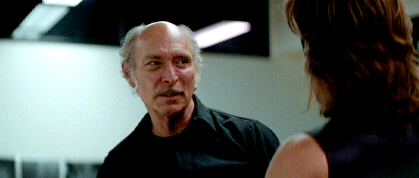
Lee Van Cleef is terrific as Police Commissioner Bob Hauk, the chief of the Liberty Island Security Control facility that admits convicts to be exiled into New York City. Van Cleef has a great presence and I could watch him verbally sparring with Russell’s Plissken for the entire film. Hauk is just as direct and unsentimental as Plissken. He is also quite ruthless in how he enlists Plissken’s cooperation.


This cast is loaded with other great names like Ernest Borgnine, Donald Pleasence, Adrienne Barbeau, Harry Dean Stanton, and Isaac Hayes. Players from other John Carpenter films, such as Tom Atkins, Charles Cyphers, Nancy Stephens, and Buck Flower, are featured in small roles. None other than Jamie Lee Curtis supplies narration to open the film and is also the automated voice at the Liberty Island prisoner admittance facility. 

While Escape from New York never preaches or teaches any lessons, it has an absolutely cynical attitude towards fascistic authority. One may try to discern a political leaning in the film, but that is probably a futile endeavor. Its only message seems to be disdain for those that would want to rule over a dysfunctional world.

Sunday, November 6, 2022

ROADGAMES (1981), aka ROAD GAMES

Director: Richard Franklin

Writers: Everett De Roche, Richard Franklin

Producer: Richard Franklin

Cast: Stacy Keach, Jamie Lee Curtis, Marion Edward, Grant Page, Killer (Boswell the dog), Thaddeus Smith, Steve Millichamp, Alan Hopgood, Robert Thompson, Bill Stacey, John Murphy, Ed Turley, Angie La Bozzetta, Tony Bishop, Abbe Holmes, Colin Vancao, Paul Harris, Rochelle Harris, Carol Ann Aylett, Les James (uncredited), Tom Ryan (uncredited)

Pat Quid (Stacy Keach) is an American independent trucker in Australia. During his long, lonely drives, Quid resorts to several means to pass the time. His latest roadgame involves supposing that the driver of a dark green van he keeps passing along the remote Outback roadway may be connected to the recent serial killings in the news.

The Flashback Fanatic movie review

With Roadgames the devout Alfred Hitchcock fan Richard Franklin directs a wonderful variation on Hitchcock’s Rear Window (1954). Hitchcock’s hero with a broken leg (James Stewart) was cooped up in his apartment and alleviated his boredom staring out the window at his neighbors. He eventually comes to suspect one of them of foul play. Franklin’s protagonist Pat Quid is cooped up in his semi-trailer truck for hours on end and alleviates his boredom making assumptions about the lives of the various motorists he passes during his trips. Quid begins to suspect that one of them is a murderer. This hardly makes Roadgames a rip-off. Although it uses the same character quirk of filling idle time with morbid fancies that become obsessive, its settings, characters, and humor make it unique and engaging.

Star Stacy Keach is as important to the success of Roadgames as director Franklin. As trucker Pat Quid, he is an eccentric, intelligent, and witty character. We spend a lot of time with him alone on the road with only his pet dingo Boswell for company. His one-sided conversations with the dog are funny and demonstrate how independent his character is. With just a dog to share his life aboard his truck, which is equipped with a small sleeping compartment, Pat Quid is the ultimate, self-sufficient loner. When he happens to converse with others, he often stresses that he is a truly individualistic character and not just a “truck driver.”

It is also nice to see that while Pat Quid seems like a guy that can take care of himself, he can make some missteps. His heroics are all the more gripping because he is not infallible. The story never devolves into asinine and unbelievable action hero overkill.

Jamie Lee Curtis appears in the fifth of the six scream queen roles that began her feature film stardom. She plays Pamela, the hitchhiker that Quid eventually picks up. In a nod to director Franklin’s filmmaker idol, Quid refers to the hitchhiking Pamela as “Hitch.” Pamela has a nice chemistry with Quid, and their relationship has a bit of built-in suspense. Of course, there is the will-they-or-won’t-they-get-it-on aspect. Additionally, as the story progresses, Quid’s changing feelings for Pamela make him vulnerable. Eventually, Quid’s association with her winds up making him a person of interest to the law.

Roadgames creates much of its audience involvement with its suggestions of the grisly deeds of its killer. Hinting at the deadly details makes us want to find out more and to be sure of the killer’s identity. Most of the time we are being led to certain conclusions by the assumptions of Pat Quid and the things he observes. One of the creepiest scenes is Quid’s nighttime inspection of the sides of pork that are hanging inside the trailer he is hauling. We are along for the ride in Quid’s big rig and can’t help but play his roadgame of look-for-the-killer.

Throughout the film the killer remains an enigma. This bonds the viewer more closely to Quid’s point of view. While Quid has his suspicions, he has them confounded and this raises doubts in him and the audience. In turn there are other characters that are suspicious of Quid and his behavior. We immediately take Quid’s side because he is the main character through which we glean a lot of information, yet the conclusions we share with Quid may be flawed.

Director Richard Franklin’s visual set pieces are very engrossing. He presents tense and creepy situations with little or no dialogue. These images intercut with Stacy Keach’s expressions get our imaginations working to arrive at some morbid conclusions. No doubt Franklin’s hero Alfred Hitchcock would have approved.

One can’t attribute enough credit to the script co-written by Franklin’s frequent collaborator Everett De Roche. Despite Hitchcock’s preference for purely visual storytelling, his films were also graced with provocative and witty dialogue. Franklin’s Roadgames is also loaded with fun dialogue that intrigues and amuses. Whether talking to his pet dingo during his long drives or to hitchhikers, Quid’s conversations are always interesting.

Prolific Australian composer Brain May’s music is just right. It serves to present a theme for Pat Quid that can be carefree or assertive. May’s score gets the adrenaline pumping when Quid takes action and raises goose bumps when something nasty is developing.

On the basis of this great Hitchcock-inspired film, Richard Franklin was picked to direct Psycho II (1983), the sequel to the Hitchcock masterpiece Psycho (1960).

Unfortunately, Roadgames went unappreciated by the movie-going public during its initial release in both its native Australia and the US. However, it has developed into a cult film over the years, thanks to home video. That’s how I first thumbed a ride on this big rig of suspense, and it still gets this fright flick fan to where I’m headed.

Saturday, January 1, 2022

TERROR TRAIN (1980)

Director: Roger Spottiswoode

Writers: T.Y. Drake, Daniel Grodnik (uncredited), Judith Rascoe (uncredited)

Producer: Harold Greenberg

Cast: Jamie Lee Curtis, Ben Johnson, Hart Bochner, Timothy Webber, Sandee Currie, Derek McKinnon, Joy Bouschel, Vanity (as D.D. Winters), David Copperfield, Anthony Sherwood, Howard Busgang, Greg Swanson, Steve Michaels, Donald Lamoureux, Charles Biddles, Sr., Elizabeth Cholette, Thom Haverstock, Peter Feingold, Richard Weinstein, John Busby, Andrea Kenyon, Roland Nincheri, Elaine Lakeman, Gerald Eastman, Charles Biddles, Jr., Nadia Rona, Larry Cohen, Brenda Gagnier, Phil Albert 

At a New Year’s Eve college fraternity party, freshman Kenny Hampson (Derek McKinnon) is traumatized by a gruesome prank played on him by his fraternity brothers. Three years later, the same college pranksters are hosting their last big party on New Year’s Eve aboard an old steam engine train. Among the many masked and costumed students, a killer moves about unnoticed by acquiring new disguises from each new victim. 

The Flashback Fanatic movie review

1978’s Halloween initiated the slasher film craze and stardom for Jamie Lee Curtis as its heroine. She soon appeared in a rapid succession of horror films that would be assured of success by her very welcome presence in them. Terror Train is one of those released just before the bloody wave of slasher flicks would crest the following year.

This film was early enough in the trend that it still felt fresh, even as it hit all the bases that the slasher film would usually run through: There is a nasty tragedy that is the root cause of the murderous mayhem years later, the horror is linked to a holiday, the killer is masked, most of the victims are young adults, and the bodies are bloody.

What really sets Terror Train apart is its setting. The bulk of the story occurring during a masquerade party aboard a passenger train traveling through an isolated winter wilderness makes for an interesting situation. Once it is apparent that there is a murderer about, the conductor can’t just call the cops and the kids can’t just flee for home. Everyone is in the middle of nowhere during freezing winter weather. They all need to stay on that train and get back to civilization. 

Despite its nasty subject matter, Terror Train is given pretty classy treatment. Suspense is given as much attention as the jump scares. The lighting and cinematography create a lot of atmosphere and the editing effectively displays the psychological trauma suffered by the killer. 

Jamie Lee Curtis makes for the likable lead in a cast of simple characters that are only revealed by how they clown around or conflict with each other during just two nights: the New Year’s Eve party college pledge prank that opens the film and another New Year’s Eve party aboard the train three years later. That is really all that is needed to make this story work within its novel setting as people get picked off one-by-one. 

The film’s dramatic friction is provided by Curits’ character Alana. She resents that her boyfriend Mo (Timothy Webber) remains friends with Doc (Hart Bochner) who masterminded the nasty prank that kicks off the story. She is also probably feeling guilty because of the role she played in that scheme. Alana may be the heroine of this film, yet she is not completely blameless. 

Despite the fact that Mo pals around with that asshole Doc (soon to major in proctology?), you have to admire this pre-med student’s willpower as Mo tries to avoid playing doctor with the drunk and curvy exhibitionist “Pet” (Joy Boushel). 


Other notable cast members are veteran actor Ben Johnson as the train conductor, magician David Copperfield as the mysterious magician providing party entertainment, and Sandee Currie as Alana’s leggy best friend Mitchy. Playing another coed named Merry is D.D. Winters who would gain fame in the '80s as the pop music star Vanity. 

Terror Train was the directing debut for former film editor Roger Spottiswoode. Although he is blessed with cinematographer John Alcott, Spottiswoode should be credited with making a very polished looking film that set a pretty high bar for the many other slasher films to come. Spottiswoode would go on to direct big-budget mainstream fare such as the Pierce Brosnan/James Bond film Tomorrow Never Dies (1997) and the Arnold Schwarzenegger starring sci-fi flick The 6th Day (2000). 

So if you are as morbid as this flashback fanatic, ringing in the New Year aboard Terror Train should be an easy resolution for us all to follow through on. Just don’t get blood in my bubbly. Cheers!

STANLEY (1972)

Director: William Grefé Writers: Gary Crutcher, William Grefé Producer: William Grefé Cast: Chris Robinson, Alex Rocco, Steve Alaimo, Ma...