Showing posts with label drama. Show all posts

Sunday, April 20, 2025

ALL ABOUT EVE (1950)

Director: Joseph L. Mankiewicz

Writers: Joseph L. Mankiewicz adapting Mary Orr’s short story “The Wisdom of Eve”

Producer: Darryl F. Zanuck

Cast: Bette Davis, Anne Baxter, George Sanders, Gary Merrill, Celeste Holm, Hugh Marlowe, Thelma Ritter, Gregory Ratoff, Marilyn Monroe, Barbara Bates, Walter Hampden

Broadway theatre star Margo Channing (Bette Davis) is troubled by her entry into middle age. Margo’s friend Karen Richards (Celeste Holm) introduces her to a young, lonely, and ardent fan named Eve Harrington (Anne Baxter). Eve ingratiates herself to Margo and her circle of friends and becomes Margo’s personal assistant. However, the pretty and ambitious young Eve exacerbates Margo’s insecurities.

The Flashback Fanatic movie review

Occasionally, my regular cinematic diet of vintage schlock and offbeat genre fare must be fortified with acknowledged mainstream classics. During such lapses of my bad taste, this immature film fan must sit up straight and eat everything on my plate because it’s good for me. My latest order for a well-balanced and nutritious movie meal was the justly revered All About Eve.

I had almost no preconceptions about this film or its subject matter. I knew that it starred Bette Davis in a great role and that it was considered a great film. Since Bette Davis is a classic movie legend, I thought it was high time that I found out what all the fuss was about. The only other thing I knew about this film was that it gave George Sanders the part that won him the Best Supporting Actor Oscar. I have appreciated the smooth and sardonic wit that Sanders can deliver better than anyone, which he demonstrated as hero Simon Templar in The Saint film series, so he was another factor drawing me to this film for the first time.


All About Eve could have tipped over into maudlin melodrama, yet it is much too nimble and cynical for that. That is not to say that it is just a snarkfest loaded with posturing by so-called characters meant to reassure us all that being presumptuous and conformist is some form of strength. All About Eve has some characters with decent sentiments and insecurities. They can be fallible or flawed, and even friends and lovers may have conflicts with each other that may be resolved by nothing more deliberate than just a cooling-off period. Most of the story’s cynicism is directed at the machinations and egos of some in the theatre and motion picture industry.

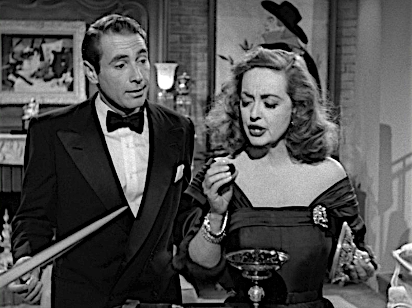
Margo Channing was the comeback role for Bette Davis that fit her like a glove. She was not the first choice for the role, but no one could have been more suited for it. As an aging film star herself, Davis may have had concerns that her best days career-wise were behind her. Davis certainly addresses such anxieties in her performance without losing our sympathy. This really surprised me, as I thought her Margo Channing would turn out to be the flamboyant diva that we would love to hate. Bette Davis’s irascible temperament provides the humorous grit the character needs, but her role is written and performed with enough sensitivity to make us engaged rather than judgmental. Nevertheless, that Bette Davis star power is burning brighter than ever when she utters that now-classic film quote, “Fasten your seatbelts. It’s going to be a bumpy night.”


As Eve Harrington, Anne Baxter plays the title character in All About Eve that, initially, seems to be the least interesting. She has some surprises in store for us and prompts theatre diva Margo Channing to confront some of her own fears and develop some perspective. Ironically, the character that Anne Baxter plays would steal some of the thunder from both Bette Davis’s character in the film and perhaps from Davis’s real-life accolades. Since both Davis and Baxter were nominated for the Best Actress Oscar Award for their roles in this film, it may have somehow given Judy Holliday the edge to win the Oscar for her role in Born Yesterday (1950). Bette Davis herself speculated that Gloria Swanson’s nomination (for the role of another aging actress in 1950’s Sunset Boulevard) may have helped to cancel out Davis’s Oscar chances. Did three great performances about actresses that year make each of them seem less Oscar-worthy?

George Sanders’ voice is so good that it could qualify as a special effect. As theatre critic Addison DeWitt, his sardonic narration sets the tone for this film perfectly. Of all the characters in this film, DeWitt ends up being the most surprising, yet this is not done as any sort of redemptive act. He is anything but heroic. He is simply someone that remains true to his character, yet, in doing so, enacts a strange form of justice. While DeWitt is too cynical and egotistical to be truly righteous, it is his moment of prideful indignation at this picture’s climax that must have won Sanders the Oscar.
I had only seen Gary Merrill in the episode “The Human Factor” of the science fiction television series The Outer Limits (1963-65). Here he plays Bill Sampson, the Broadway theatre director and lover of Bette Davis’s Margo Channing. Merrill’s Sampson delivers some very verbose repartee throughout the film. This is all very dramatic and amusing, yet it still rings true to me. After all, theatre folk are accustomed to the wielding of words on stage for emotionally pointed effect, so it stands to reason that such people would be able to express theirselves that way in an impromptu manner. In yet another case of life imitating art from All About Eve, Merrill and Davis, having met on this film, began a relationship that led to their marriage of ten years.

Celeste Holm has the role of the nicest person in the film as Margo’s best friend, Karen Richards. As the amusing observation of Addison DeWitt’s opening narration points out, Karen only became part of the theatre crowd when she married playwright Lloyd Richards. My cynicism was immediately roused at that point, and I assumed that she would be a conniving hanger-on, yet she manages to remain seemingly wholesome. Once again, this film does not dole out obvious character payoffs to the audience. Karen is the catalyst of the story when she introduces fawning fan Eve Harrington to her idol Margo Channing. As Karen seems to be a very decent person, we can empathize with some of the emotional stress she is put through by others exploiting her goodwill efforts.

As Karen’s husband and Margo Channing’s frequent playwright, Lloyd Richards, Hugh Marlowe gets into a great shouting match with his temperamental star. Marlowe usually seems like the earnest everyman character in his roles, but that certainly does not mean his roles lacked range. He is probably best known for playing the world’s biggest heel in the sci-fi classic The Day the Earth Stood Still (1951). Marlowe would heroically redeem himself by trying to save the world from another extraterrestrial threat in Earth vs. the Flying Saucers (1956).

Two small roles are performed by very noteworthy ladies. The reliably amusing and acerbic Thelma Ritter plays Birdie, Margo Channing’s maid. Ritter was just one of many highlights in that Alfred Hitchcock classic Rear Window (1954). All About Eve also features a young bit player by the name of Marilyn Monroe. (Perhaps you’ve heard of her.) In this early role, she appears as Claudia Casswell. We meet her as critic Addison DeWitt’s escort trying to charm her way into the entertainment industry by flirting and flaunting what she’s got.

With a great cast to embody writer-director Joseph L. Mankiewicz’s conflicted characters and deliver his smart dialogue, this picture may have seemed like a shoo-in for Best Picture, Best Screenplay, and Best Director honors at the Academy Awards. But even Mankiewicz himself has acknowledged that the 20th Century Fox producer he had so much contention with, Darryl F. Zanuck, also made contributions by honing and simplifying his films to make them more effective. It was also Zanuck who changed this film’s title from Best Performance to All About Eve.

According to Joseph L. Mankiewicz’s son, All About Eve expressed many of his filmmaker father’s misgivings about the entertainment industry. Mankiewicz seemed to have more respect for the theatre scene, but enjoyed the greater financial rewards of Hollywood filmmaking and the greater control he could exert over a film than a live stage performance. 

While he seemed disdainful of the Hollywood crowd, the married Mankiewicz didn’t mind cavorting with various Hollywood starlets. This obviously contributed to a very stressful homelife in the Mankiewicz household. The marital dysfunction with his ex-actress wife must have inspired much of the attitude the writer-director portrays in that great cocktail party scene at Margo Channing’s residence. A bumpy night indeed!

It is rather fitting that a filmmaker who had more respect for the world of Broadway stages than Hollywood film studios would win Academy Awards for a film about theatre talents that plays out like a stage drama. Mankiewicz thought that the writing and performances should carry the story. Aside from just a few establishing shots, nearly everything occurs in interior settings that would be ideal for a stage play. Yet All About Eve also uses close-ups to allow its players to share feelings with us through subtle facial expressions that punctuate great dialogue. That is the simple power that can make a film classic.


WARNING: COMMENTS CONTAIN SPOILERS!

Tuesday, September 3, 2024

AMERICAN BEAUTY (1999)

Director: Sam Mendes

Writer: Alan Ball

Producers: Bruce Cohen, Dan Jinks

Cast: Kevin Spacey, Annette Bening, Thora Birch, Wes Bentley, Mena Suvari, Chris Cooper, Peter Gallagher, Allison Janney, Scott Bakula, Sam Robards, Barry Del Sherman, Amber Smith, Brenda Wehle, Lisa Cloud, Marisa Jaret Winokur, Dennis Anderson, Joel McCrary, Matthew Kimbrough 

42-year-old Lester Burnham (Kevin Spacey) has been employed ad writing at a magazine for the past 14 years. He is stuck in a joyless, middle class, suburban lifestyle with his career-obsessed, real-estate-agent wife, Carolyn (Annette Bening), and his emotionally distant, teenaged daughter, Jane (Thora Birch). When Lester meets his daughter’s beautiful, blonde classmate, Angela Hayes (Mena Suvari), Lester is smitten and has a midlife awakening. He has ongoing fantasies about young Angela and shirks his adult responsibilities. Lester’s new attitude exacerbates the dysfunction in the Burnham household. 

The Flashback Fanatic movie review 

So, this lover of the lowbrow is reviewing a film that won five Oscars including Best Picture? “Where the hell are my standards?” you scream. Well, it is a pretty old film by now and still an odd one after a quarter century. Er—and uh—well, it’s also kind of transgressive. That’s gotta count for something, right? And—uh—it’s just a great film, dammit! But fear not, for I shan’t start sipping tea with my pinky finger extended while I extol the virtues of prestigious cinema. Trust me. I shall soon resume reviewing my regularly scheduled selection of significant schlock. American Beauty has reinforced my value of being true to oneself. 

I remember first seeing American Beauty in the theater way back in 1999 and really enjoying it. It capped off a decade of indie films that were a relief from Hollywood blockbusteritus. The quirky and personal films getting noticed were welcome alternatives to franchises, generic action hero product, and evermore-bloated “high concept” effects shows trying to engage the video game crowd. While American Beauty, with its $15-million budget on a DreamWorks Pictures production and distribution deal, was hardly down-and-dirty, guerilla filmmaking, it was still made in the indie spirit by refusing to fit neatly into an easily marketed genre. The time was still ripe for another eccentric, challenging, and heartfelt movie. 

The moral in this film may seem obvious: Achieving status and maintaining a lifestyle does not always lead to happiness. However, that is a message that could not be shouted loud enough in the go-go ’90s. Much of America’s so-called freedom has always been about working hard to conform to the routines that will make the money needed to create an image that makes us feel worthy. Always striving to pass the judgment of others to feel accepted and admired is a trap. 

The central event in the story is the midlife crisis suffered by Kevin Spacey’s character. His Lester Burnham does his unfulfilling job for management that he has no respect for. His career is just a means to help provide for a family he feels disconnected from. His sudden infatuation with his daughter’s friend knocks Lester out of his midlife malaise. He is not yet so old that he can’t change, but time’s a-wastin.’ 


Lester begins to rebel by not giving a shit about going through the establishment motions in his life anymore. Now he can tell people exactly what he means and confront their own insincere behavior. I practically stand up and cheer when Lester quits his job while coercing his manager into giving him a decent severance package. Damn, this guy’s a slacker superhero! Then he immediately finds the least demanding job he can think of: flipping burgers like he did back in high school. We are soon treated to the ongoing fallout from this development at the family dinner table where Lester demonstrates that the domestic worm has turned. 


That will-they-or-won’t-they moment between Kevin Spacey’s middle-aged Lester and young Mena Suvari’s Angela really got to me. Everything is perfect: performance, pacing, and lighting complimented by the wonderful source music of Annie Lennox covering Neil Young’s “Don’t Let It Bring You Down” playing on the stereo. Helluva scene. It’s one last gasp of real movie magic before the following century’s cinema would pander to an attention-span-challenged audience with relentless shaky cam, quick cuts, and digital tweaking for practically every goddamn frame of “film.” 

That narration of Kevin Spacey’s character opening the film by letting us know he is already dead is novel, though not original. As director Sam Mendes himself acknowledges, Sunset Boulevard (1950) also began its dystopian look at the Hollywood lifestyle with narration from a dead character. It makes some satirical sense to use that same technique here in a picture about a different dystopian dead end located in American suburbia. It also imparts a bit of tension underlying the whole film leading to the protagonist’s death. 

All of the main adult characters in American Beauty begin this story locked into identities that keep them from being happy and true to themselves. Their issues result from a lack of self-esteem. Jane’s fellow cheerleader, Angela, is also well on her way to falling into the same adult trap of affecting an image and reputation that she thinks will make her better than ordinary. 


The two characters that clearly view their world and those around them are teenagers Jane Burnham and her next-door neighbor and classmate, Ricky Fitts (Wes Bentley). They have their own issues due to the dysfunction of their families. Probably as a result of no emotional bonding and reassurance from her parents, Jane is dealing with her own sense of inadequacy as she is already saving her money for a “boob job.” The voyeuristic Ricky uses his video camera to capture the beauty that only he perceives in the real world. Ricky seems almost ethereal in his remote calm that has resulted from the emotional disconnect he has developed coping in the rigidly disciplined household commanded by his ex-Marine father, Col. Frank Fitts (Chris Cooper). 


All of this seems to be adding up to a dismal kitchen sink drama that can spill over into preachy moralizing. That is hardly the case here. Lester Burnham’s midlife rebirth exposes this film’s truths in amusing ways. It never devolves into a lifestyle farce, but it does create moments that are funny for being recklessly liberating. 

Of course Kevin Spacey won the Best Actor Oscar for a performance here that works because most of the time he seems subdued. His Lester Burnham character is established as repressed and seething with resentment about his life and family. Once he has his midlife attitude conversion, he indulges himself with youthful abandon and rejects any status-dictated responsibilities. However, there are still unresolved dissatisfactions in his home life that can break through that don’t-give-a-damn calm. It is the direction, writing, and cinematography that does the stylish heavy lifting while Spacey’s mundane sincerity rings true. 

There are many other fine performances. Annette Bening’s manic Carolyn becomes almost grotesque in her career-fixated fundamentalism. Thora Birch’s Jane goes beyond sadness to disaffection in her character’s lack of self-esteem. Birch would go on to star in my favorite film of the next century, that quirky delight Ghost World (2001). Wes Bentley exudes a calm confidence as Ricky Fitts that is as much of an influence on Lester’s new attitude as the Angela fixation. Chris Cooper’s intense performance as Ricky’s hard-ass, control-freak father gives us a character that is both despicable and pathetic. Finally, Mena Suvari’s vain and shallow Angela is funny, yet she surprises us with her vulnerability. 

American Beauty skewers the middleclass mainstream’s empty vanity. It does this all in a darkly humorous manner that can be quirky, distressing, and cathartic. It all ends by challenging us to accept a philosophy embracing truth and appreciating life experience rather than lamenting lost goals.


WARNING: COMMENTS CONTAIN SPOILERS!

Sunday, March 27, 2022

THE GYPSY MOTHS (1969)

Director: John Frankenheimer

Writers: William Hanley adapting James Drought’s original novel

Producers: Hal Landers, Bobby Roberts

Cast: Burt Lancaster, Gene Hackman, Scott Wilson, Deborah Kerr, William Windom, Bonnie Bedelia, Sheree North, John Napier, Carl Reindel, Ford Rainey 

Mike Rettig (Burt Lancaster), Joe Browdy (Gene Hackman), and Malcolm Webson (Scott Wilson) are a team of skydivers that drive from town to town to perform their aerial stunts for public exhibitions. When they arrive in young Malcolm’s childhood hometown of Bridgeville, Kansas, Malcolm suggests that they stay at the home of Elizabeth and John Brandon (Deborah Kerr and William Windom). The Brandons are Malcolm’s aunt and uncle that he has not seen since he was orphaned. It soon becomes apparent that the Brandons are an unhappy and distant couple. While the skydiving trio prep for their performance that July 4th weekend, the risk-taking Rettig seems drawn to Elizabeth. 

The Flashback Fanatic movie review

The attention-getting skydiving sequences may distinguish this film, but The Gypsy Moths is primarily a strange drama. The trio of Rettig, Browdy, and Webson are always on the move in a nomadic existence of travel, promotion, and performance to score some quick cash before packing up and moving on. One can’t really say that these guys are just trying to find themselves. Their motivations are mostly unspoken. We don’t know much about their background or why they risk death time after time in their performances. They never define goals they are striving for. At one point Browdy does suggest that maybe someday he’ll head to Hollywood to become a stuntman, yet no one is listening to him.


Burt Lancaster’s Mike Rettig is the uneasy subcurrent running through this story. Rettig keeps taking greater risks in his performances. He spends a lot of the film saying very little and we learn almost nothing about him. We only become aware of some of his feelings when he tells Deborah Kerr’s Elizabeth Brandon what he wants. Afterwards we are still left to wonder just what is running through Rettig’s mind and how he will react. 

This film’s stunt casting is the reunion of Lancaster with Deborah Kerr. From Here to Eternity (1953) had immortalized them with their iconic love-in-the-surf scene. Here they are two characters with different temperaments that are drawn to each other, yet both are risk-takers. Rettig’s risks are how he makes his living and that deadly edge seems to validate his life. Elizabeth risks upending the joyless security of her marriage by taking a growing interest in Rettig.

Scott Wilson, as Malcolm Webson, is the youngest member of the skydiving team. Although it is not stated, Webson was probably the replacement for a previous member of the group killed during a performance. This “kid” in the group shows the most safety-conscious sense of the trio. He is aware of Rettig’s growing recklessness in the act and tries to express that concern to him. Even though Webson is having his group stay with his relatives, he is not close to his aunt and uncle. He has not seen the Brandons since he was a child and still seems as alone in the world as his co-performers.

Bonnie Bedelia makes one of her earliest film appearances as Annie Burke, the college student also rooming with the Brandons. Despite the chemistry Annie has with Webson, there is still a bit of awkwardness between them. While this is perfectly natural between people that have only recently met, it seems that all of the main characters in this story have difficulty communicating and connecting at an emotional level. 

The live wire that provides most of the energy in the cast is Gene Hackman. As the boisterous Joe Browdy, he usually does most of the talking and provides some good humor. Browdy seems to be an absolutely carefree character, but this good-time Charley can be a bit sensitive about his devout churchgoing. Whether he does this to atone for his bawdy nightlife, to pray for safety during his daredevil performances, or to be sure he is ready to meet his maker if one of his stunts goes wrong is unclear. 

With this cast and some very impressive free-falling camerawork capturing the skydiving action, anyone should become involved with this unique story. However, Sheree North, as the Paradise Club waitress and stripper Mary, is the film’s most bedazzling spectacle. With her world-weary wit, big blue eyes, and fine form, her character deserved to headline a film all her own. This flashback fanatic has been hopelessly smitten once again.

The Gypsy Moths is an odd film that may leave many unsatisfied. Its characters are often defined by what they will not say or the choices that they won’t make. It does not provide the predictable and pat resolutions that we probably wish for some of its characters. Most viewers may find this sort of narrative frustrating, but those same people probably felt something along the way and are made to ponder whether the characters’ decisions will make them happy.

STANLEY (1972)

Director: William Grefé Writers: Gary Crutcher, William Grefé Producer: William Grefé Cast: Chris Robinson, Alex Rocco, Steve Alaimo, Ma...