Showing posts with label Lon Chaney Jr.. Show all posts

Sunday, June 14, 2026

MR. MOTO'S GAMBLE (1938)

Director: James Tinling

Writers: Charles Belden, Jerry Cady, based on the Mr. Moto character created by John P. Marquand

Producers: John Stone, Sol M. Wurtzel (uncredited)

Cast: Peter Lorre, Keye Luke, Maxie Rosenblum, Harold Huber, Lynn Bari, Dick Baldwin, Douglas Fowley, Jayne Regan, John Hamilton, George E. Stone, Bernard Nedell, Ward Bond, Charles Williams, Pierre Watkin, Lon Chaney, Jr., Paul Fix, Adrian Morris, (and uncredited cast) Olin Howard, Lester Dorr, Gladden James

Japanese sleuth Mr. Moto (Peter Lorre) is in San Francisco, California teaching a course in criminology. Among his pupils is Lee Chan (Keye Luke), the son of famed Honolulu, Hawaii Police Detective Charlie Chan. While Mr. Moto and Lee Chan attend a boxing match that will determine the next challenger to the current heavyweight champion, the knocked-out fighter dies. It is soon determined that the dead fighter (Russ Clark) was poisoned. As there were many heavy bets placed on the outcome of the fight, there is no shortage of suspects for Mr. Moto to sort through to help the police solve the case.

The Flashback Fanatic movie review

This third film in the Mr. Moto series from the 20th Century-Fox studio has a rather convoluted production history. This was originally intended as an installment in Fox’s popular series of Charlie Chan detective films starring Warner Oland. Charlie Chan at the Ringside began filming in January of 1938. Oland was going through a contentious divorce and was becoming more disenchanted with the studio. Production was halted when Warner Oland left the set never to return, either due to illness or a temperamental act of rebellion. Unfortunately, Oland caught pneumonia and passed away on August 6th, 1938. Without their star to finish portraying the Chinese detective hero, the studio salvaged their investment in the unfinished film by changing it to feature another East Asian sleuth, namely Mr. Moto of their burgeoning series starring Peter Lorre.

Now retitled Mr. Moto’s Gamble, this film was a change of pace for the Moto series. There are no international criminal schemes to foil or globe-hopping intrigue for Moto to deal with here. This time around, Mr. Moto is concerned with solving a murder mystery. The repurposed plot is a Charlie Chan case that is slightly reconfigured to have Moto do all the detective work that Chan was originally intended to do. To accommodate this, Mr. Moto is introduced instructing a criminology course in San Francisco. In an early instance of popular culture series crossovers, none other than Lee Chan (Keye Luke), Charlie Chan’s number one son, is one of Moto’s pupils.

In the first two Mr. Moto films, we were not made immediately aware of Moto’s goals and ethics. He seemed polite and mild-mannered while employing devious and deadly means to achieve his objectives. With this entry in the series, it is immediately established that Mr. Moto is one of the good guys. As a respected international detective, Moto is not only teaching a criminology course, but he is also assisting the police on this case, just as Charlie Chan had in numerous films.

While the action and scope of the plot have been dialed down for Mr. Moto to pinch hit for Charlie Chan in a more conventional murder mystery, we are still in good hands with Peter Lorre as our hero. In addition to his intelligence and criminology expertise, Lorre’s Mr. Moto still displays his usual humility stating that he and others are amateurs in comparison to the absent detective Charlie Chan. I have always felt such mild-mannered grace on Moto’s part demonstrates his confidence in his abilities far more effectively than all the bad boy antics of many so-called heroes in modern films. Moto’s humble attitude also sets up his enemies, as well as the audience, to be surprised by his tactics.

The need for Charlie Chan to be referenced at all is due to the inclusion of Chan’s son in the story. Keye Luke is very likable as he portrays Lee Chan’s typical youthful enthusiasm for crime-solving in this case of prizefighting homicide. As I recall, the master detective Charlie Chan would always try to reign in his well-meaning offspring’s rash actions, yet Lee always seemed to idolize his “pop.” It is amusing that, despite his father not being around, Lee is still contending with his father’s dismissive authority by pretending he went to San Francisco to study art instead of criminology.

Along with Lee Chan is his fellow criminology pupil and comedy relief figure, Horace “Knockout” Wellington. As played by former prize fighter Maxie Rosenbloom, Knockout is quite funny. His comedic role is immediately established as an ex-boxer and kleptomaniac taking criminology to help him solve cases of his own larceny, because he can’t remember who he steals from. Knockout becomes a handy plot device when he swipes an overcoat containing an important clue. Luke and Rosenbloom are a fun duo and play well off each other as they compete with Mr. Moto to solve the murder case. They would be the first of the comical cohorts to assist Moto in some of his adventures.

From the previous Thank You, Mr. Moto (1937), Jayne Regan returns to the series as a different and less central character, the spoiled rich girl Linda Benton trying to tempt aspiring boxer Bill Steele (Dick Baldwin) away from his gal, newspaper reporter Penny Kendall (Lynn Bari).

It is a nice touch that Bari’s Penny is concerned about the physical risks associated with her beau’s profession. We get reminders of how grueling and unglamorous the fight game can be.


Two Perry Whites are in the cast. John Hamilton is featured as Philip Benton, Linda Benton’s father and head of the corporation that owns the boxing arena. Hamilton was much more likably gruff as The Daily Planet newspaper editor Perry White in the 1950s Adventures of Superman television series (1952–58). Pierre Watkin, the first on-camera actor to play Perry White in the serials Superman (1948) and Atom Man vs. Superman (1950), has a bit part here as a district attorney.


Even if you don’t know his name, any vintage film fan will immediately recognize George E. Stone. He was a prolific character actor often turning up in old movies being sneaky, suspicious, or associating with the wrong crowd. Stone’s shifty screen persona was tempered a bit by his recurrent role as “The Runt,” the sidekick to the crime-solving hero Boston Blackie in a series from the Columbia Films studio. Here Stone plays Jerry Connors, the shady manager of murdered fighter Frankie Stanton.

Another hard-working actor at the time that would become quite a name was Ward Bond. Here he plays reigning heavyweight champion Biff Moran, who is scheduled to defend his title against Bill Steele. Bond was a USC college football teammate of John Wayne’s and would go on to co-star in plenty of The Duke’s films. Bond’s enormous filmography was capped off starring as Major Seth Adams in the Western television series Wagon Train (1957–61).

Keep your eyes peeled for Lon Chaney, Jr., allowed only two lines in his role as Joey, the intimidating-looking thug accompanying gambling gangster Nick Crowder (Douglas Fowley). After appearing in a ton of films as bit parts, supporting players, and occasional low-budget leads during the 1930s, Chaney was just one year away from his most acclaimed film role as Lennie in Of Mice and Men (1939). Of course, in the 1940s, Chaney would become a horror film staple for Universal Pictures.

Despite the unlucky hand dealt to 20th Century-Fox, their Mr. Moto’s Gamble must have paid off. The change of tone for this third Mr. Moto movie did not derail the popularity of the series. A fun cast helps this installment play well with its own distinctive charm. It is a fine example of the polished entertainments that the movie factories of classic Hollywood could crank out, even while improvising around unexpected production challenges.

Saturday, October 7, 2023

SPIDER BABY (1964/released 1967), aka CANNIBAL ORGY, THE MADDEST STORY EVER TOLD, THE LIVER EATERS

Director: Jack Hill

Writer: Jack Hill

Producers: Paul Monka, Gil Lasky

Cast: Lon Chaney, Jr. (as Lon Chaney), Quinn Redeker, Carol Ohmart, Jill Banner, Beverly Washburn, Sid Haig, Mary Mitchel, Karl Schanzer, Mantan Moreland, Joan Keller Stern, Carolyn Cooper 

Due to inbreeding, many generations of the Merrye family have been afflicted with a genetic disorder. At about ten years of age, the Merrye Syndrome causes mental regression. Eventually, the Merryes devolve into a deformed, bestial state. Bruno (Lon Chaney, Jr.) is the chauffeur and caretaker for the last surviving members of the Merrye family line. Bruno swore to his late master that he would always look after the Merrye children, Virginia (Jill Banner), Elizabeth (Beverly Washburn), and Ralph (Sid Haig). Now fully grown, these three siblings have begun mentally regressing to become increasingly childish and emotionally unstable. They can also be quite dangerous if not supervised. When the distant cousins of the Merryes, Peter Howe (Quinn Redeker) and his sister Emily (Carol Ohmart), arrive at Merrye House to become heirs to the Merrye estate and the legal guardians of the Merrye children, there is conflict created by the inevitable upheaval of the Merrye family. 

The Flashback Fanatic movie review 

The term “cult film” gets thrown around a lot these days. Spider Baby is exactly the sort of movie that deserves such a label. It may have been ahead of its time, yet it was almost impossible for its merits to be noticed. It was not released for three years after its completion, and then it had only very limited theatrical releases. Much later it was subjected to years of subpar home videotape presentations. Despite all of these setbacks, Spider Baby mania spread slowly but surely. Decades after its production, Spider Baby was finally discovered and appreciated as a morbid, madcap classic. 

Familial phobia must have been highly contagious back in 1964. Writer-director Jack Hill was finishing the filming of his Spider Baby just as television debuted two classic series about creepy families: The Addams Family (1964-66) and The Munsters (1964-66). While much of the humor in those sitcoms is the result of the weird families either taking pride in their eccentricities or being completely oblivious to their “not fitting in,” Spider Baby’s humor is of a more dark and disturbing sort. 

In addition to the dangers in the dilapidated Merrye House, there are plenty of giggle-worthy, uncomfortable moments. The dinner scene is absolutely brilliant in its succession of one unsavory and inappropriate comment and incident after another. I bust out laughing every time I see the fresh garden greens being served. 

Lon Chaney, Jr., is the top-billed star bound to lure the horror film fans. This was probably Chaney’s last worthy film role. Chaney relished the chance to play the lead in a story laced with dark comedy. As Bruno, the Merrye family caretaker, Chaney displays paternal compassion, stress, and sorrow. He also makes statements that increase apprehensions about this crazy situation. Since his character is protecting the Merrye family by hiding their secrets and crimes, we are never sure what sort of threat he may pose. His Bruno certainly seems to have been affected by the isolation he shares with the strange Merrye family. 

The most oft-told behind-the-scenes anecdote about Spider Baby is the five-minute ovation Chaney received from fellow members of the cast and crew after the tearful talk that his character has with the Merrye “children” as things have gotten way out of hand. Even at this late stage of his career, the underappreciated Chaney could still be as touching as ever. He really adds heart to this creepy and crazy flick. 

In her very first film role, 17-year-old Jill Banner appears as the title character. Her Virginia is the spider-obsessed member of the Merrye family. Her favorite game is “playing spider.” This involves a net Virginia uses as her spider web and butcher knives. Whenever Virginia takes a dislike to someone they remind her of a bug, which means they are spider prey. 

Exploitation movie veteran Sid Haig was off to a running start playing unpleasant characters in his early film role here as Ralph, the oldest and most regressed of the Merrye children. He is mute, infantile, and makes every interaction uncomfortable. His manners are non-existent. Ralph never learned the lesson called “Don’t Stare.” Unfortunately, he indulges in even more offensive behaviors. 

With a long career as a child actor already behind her, Beverly Washburn plays Elizabeth Merrye. Poor old Bruno is always relying on her to be the most responsible of the three afflicted Merrye “children.” With every eye roll and tilt of her head, we know that she is not to be trusted for a minute. Despite Bruno’s admonitions not to hate, Elizabeth always finds reasons for others to be hated. 

Many years later, actor Quinn Redeker was still befuddled as to why Spider Baby was still remembered and revered by its fans. This may be a reflection of his ambivalence about his approach to his role of Peter Howe. Director Jack Hill thought Redeker played it just right, and I would agree. Peter Howe is supposed to be a “normal” and distant relative to the afflicted Merrye family. But he has a dense benevolence that seems to be in denial of the uncomfortable situations and consequences around him. Rather than being the one we expect to restore the social order, Redeker’s willfully ignorant Peter Howe makes us almost as uneasy as the Merrye House residents. 

Carol Ohmart was a former Miss Utah and the fourth place contestant in the 1946 Miss America pageant. Ohmart would go on to many film appearances and guest-starring television roles, but she is probably best remembered for her horror films House on Haunted Hill (1959) and Spider Baby. Here Ohmart plays the greedy, gorgeous Emily Howe, the older sister to the amiable Peter. When Omart’s cold and deliberate character lets her hair down to indulge herself in private by modeling vintage lingerie from a Merrye House closet, it’s an absolute showstopper. Unfortunately, eavesdropping Ralph likes what he sees… 


Karl Schanzer is the lawyer Mr. Schlocker, and Mary Mitchel plays his lovely secretary, Ann. Schanzer’s Schlocker never really does anything wrong, yet his manner is so stuffy and unctuous that you can’t help but dislike him. Of course, he is also facilitating the legal disruption of the Merrye household. Small wonder that spider-fixated Virginia considers him another bug, which is never a good sign. However, everyone seems to like Mitchel’s Ann. That still doesn’t mean that Mitchel won’t have to prove her worth yet again as what director Roger Corman considered “the perfect victim.” 


Old-time film comedian Mantan Moreland had provided comedy relief in plenty 1940s mystery and horror films. He was chauffeur Birmingham Brown to Sidney Toler’s Charlie Chan in the detective film series from Monogram Pictures. Moreland makes an appearance in Spider Baby’s first creepy scene. This establishes the unpredictable and uneasy vibe for the rest of the film. 

Composer Ronald Stein’s music deserves a special mention. He had scored plenty of ’50s and ’60s sci-fi and horror film favorites. In the first of this film’s many offbeat highlights, Stein’s opening theme for Spider Baby is accompanied by Chaney’s lines of demented poetry to really set the crazy pace for this warped film. 

With a cast like this and an eccentric and inspired script by director Jack Hill, it’s a damned shame that it took so long for Spider Baby to get its due. It is a variation on the old-dark-house thrillers of the past while anticipating some of the corruption of family values to be seen in later films like The Texas Chainsaw Massacre (1974), The Hills Have Eyes (1977), and The Unseen (1980). I think Carol Ohmart was onto something when she wondered if Spider Baby would be nominated for an Oscar. Sure, I may be twisted, but Carol Ohmart can do no wrong!

Sunday, July 4, 2021

THE MUMMY'S GHOST (1944)

Director: Reginald LeBorg

Writers: Griffin Jay, Henry Sucher, Brenda Weisberg

Producer: Ben Pivar

Cast: Lon Chaney, Jr., John Carradine, Robert Lowery, Ramsay Ames, Barton MacLane, George Zucco, Frank Reicher, Harry Shannon, Emmett Vogan, Lester Sharpe, Claire Whitney, Oscar O’Shea, Jack C. Smith, Jack Rockwell, Carl Vernell, Stephen Barclay, Dorothy Vaughan, Mira McKinney, Bess Flowers, Caroline Cooke, Eddy Waller, Fay Holderness, Ivan Triesault, Anthony Warde, Peter (Pietro) Sosso, Martha MacVicar, David Bruce

Yousef Bey (John Carradine), an Egyptian High Priest of Arkham, travels to the town of Mapleton in America to find the living mummy Kharis (Lon Chaney, Jr.). Bey’s mission is to reunite Kharis with the mummy of his ancient lover Princess Ananka. They try stealing the mummy of Ananka from a museum, but it disintegrates because Ananka’s spirit has been reincarnated in a living woman. That woman is Amina Mansouri (Ramsay Ames), an Egyptian exchange student at the local college in Mapleton. Bey and the Mummy seek her out and kill anybody that gets in their way.

The Flashback Fanatic movie review 

The Mummy’s Ghost was the third of the four Kharis Mummy films from Universal Pictures. Although all of the Kharis films, except this one, used footage from the earlier film The Mummy (1932) for flashbacks to Kharis’ origins, that Boris Karloff starring film is an unrelated story. The continuity through the four film Kharis series was always pretty shaky. In this film, when the Mummy makes his first appearance, he just comes shambling from out of the countryside. No explanation is given for how he survived the fire that should have destroyed him in the last film, nor is there information regarding his whereabouts since then. This is a less egregious oversight than the time warp that must have occurred between the previous two Mummy films to cause two characters to age 30 years, or the relocation from New England to Louisiana bayou country another 25 years later in the next installment!

Critics of the Mummy films often cite the repetitive plot points. Many of them are to be found in this entry, as well. All film series hinge on some sort of formula, and the Mummy films can be more restrictive than most, but I enjoy them. The fun is in returning to the same circumstances that generate the conflicts and seeing what new elements are introduced. The reincarnation concept is lifted from the unrelated film The Mummy, but it is played out in a much different manner that makes this film quite distinctive.

I consider this the best of the three Mummy films starring Lon Chaney, Jr., as Kharis. There is no heavy-duty drama going on here, but the interaction between all the main characters seems livelier in this installment. I think a lot of the credit goes to John Carradine as the villainous Yousef Bey and Robert Lowery as Tom Hervey. Carradine’s voice and the fanatical gleam in his eye make you pay attention to his scheming and never forget that he is as much of a menace as the Mummy. Robert Lowery is a welcome relief from the utterly bland young heroes of the other two Chaney Mummy films. Some have noted that his performance is a bit surly, but I welcome that bit of character. Lowery’s Tom Hervey is probably possessive of his beautiful girlfriend Amina and also worried about her. He is frustrated with anything that can feed Amina’s seemingly irrational dread that stems from the spirit of Ananka reincarnating in her.

Ramsay Ames as Amina Mansouri is more decorative than dramatic. She is very beautiful and looks great in that silvery nightdress she wears, but her acting has drawn criticism from many. While I don’t think she hurts the film, she just doesn’t make us feel as deeply as we should for the fear and confusion her character is suffering. In her defense, I will say that even Meryl Streep would probably have a tough time bringing conviction to lines like “Isn’t it wonderful? I can laugh again.”

Lon Chaney, Jr., seems a bit more animated this time around as the Mummy, perhaps too animated for some members of the cast and crew of this film. According to director Reginald LeBorg, Chaney really throttled elderly actor Frank Reicher. Later when killing the museum guard (Oscar O’Shea), Chaney purposely broke a large pane of real glass in a door when the prop department did not supply the breakaway glass on time. It is a bit unclear whether the take seen in the film was the instance when the real glass was broken. If so, it was incredibly dangerous, as Chaney was dragging actor O’Shea into the glass when it shattered. We see O’Shea clutching the back of his head after the glass breaks before he succumbs to the Mummy’s strangling grip. Is this good acting on O’Shea’s part, or a real physical reaction to shards of real glass pelting him? If the glass was real, it is awfully impressive of O’Shea to stay in character in that shot and continue to allow Chaney’s strangling to finish him off. Chaney is supposed to have gotten some glass stuck in his hand. There are dark spots on the Mummy’s chin in that scene that some have speculated are blood, perhaps from Chaney’s injured hand. It appears that those spots are also on his chin as he approaches the guard before breaking the glass. It would not seem that this is part of the Mummy make-up, as we don’t see those spots in any other scene. If they were indeed blood, it would be reassuring to know that they occurred in an earlier take that did not endanger O’Shea.

Chaney’s recklessness has been attributed to actor’s zeal, too much alcohol, or a macho bit of showing off. He is also said to have been trying to impress director LeBorg, whom he hoped to be joining on more films. Another contributing factor was probably Chaney’s frustration of being stuck in the monster rut at Universal. He desired more human roles, and he could get pretty irritated with the lengthy and uncomfortable make-ups that his monster characters required.


The most distinctive thing about this film, which not only sets it apart from all the other Universal Mummy movies, but also makes it quite special among most horror films prior to the 1970s, is the very tragic finish. Aside from some of producer Val Lewton’s horror films at RKO Pictures and Universal’s The Wolf Man (1941), there were not many fright flicks of this era that would wrap up their horrors on such a downer. Director LeBorg is said to have pushed for this ending and I am glad that he did. A lingering aftermath makes the horror matter. Even if we forget about the victims that died during the story, there are still consequences for the survivors. Other lesser films often forget that.

Saturday, July 3, 2021

INDESTRUCTIBLE MAN (1956)

Director: Jack Pollexfen

Writers: Vy Russell, Sue Dwiggins, Jack Pollexfen

Producer: Jack Pollexfen
 
Cast: Lon Chaney, Jr., Casey Adams (aka Max Showalter), Marian Carr (credited as Marion Carr), Ross Elliott, Stuart Randall, Robert Shayne, Roy Engel, Kenneth Terrell, Marvin Ellis, Robert Foulk, Marjorie Stapp, Joe Flynn, Ann Doran, Rita Green, Madge Cleveland, Peggy Maley

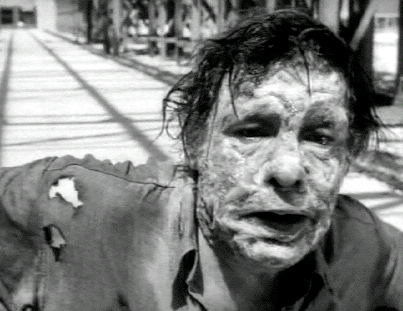
Charles 'Butcher' Benton (Lon Chaney, Jr.) is sent to the electric chair for a murder he committed during an armored car robbery. Before he is executed, he vows an unlikely revenge on his three accomplices that betrayed him and refuses to divulge where he hid the stolen money. After Benton’s execution, scientist Dr. Bradshaw (Robert Shayne) acquires Benton’s corpse for his experiments. His electrical treatments restore life to Benton and render him mute, but also endow him with impenetrable skin and superhuman strength. Benton realizes that he can make good on his threats of revenge and goes on a killing spree.

The Flashback Fanatic movie review

A low-budget flick buoyed almost entirely by the Chaney name heading the cast, Indestructible Man is a peculiar blend of genres. Its best aspect is the film noir elements (shady lawyer collaborating with crooks, burlesque dancers, detectives, and a death house vow of revenge) that distinguish it from other '50s sci-fi horror films. Just about any character we spend time with in this movie is seedy, except the police detective hero on the case that comes across like a smug boy scout until the conclusion. Then he turns into a presumptuous asshole!

Director Jack Pollexfen did the uncredited first draft of the screenplay for Indestructible Man. Prior to this film, he had produced other sci-fi horrors such as The Man from Planet X (1951) and The Neanderthal Man (1953). He would go on to produce more in the genre.

Indestructible Man is told Dragnet-style from the perspective of Police Lieutenant Dick Chasen (Casey Adams) narrating “The 'Butcher' Benton Case.” If not for this cops-and-robbers angle, it would play out very much like the early Chaney flick Man-Made Monster (1940). There Chaney was also made into a mute, death-dealing being due to electrical experiments by an amoral scientist. Indestructible Man is not as polished as that earlier Universal Pictures film, but it is more interesting because of its police procedural and disreputable character elements. As derivative as this film’s menace may seem, Indestructible Man itself was swiped for 1961’s Most Dangerous Man Alive. The latter film substituted an atomic radiation accident for electrical experimentation, but still has a film noir storyline.

Indestructible Man is at its best in Chaney’s first appearance. It is a simple and bleak scene with Chaney’s 'Butcher' Benton behind bars conversing with the sleazy lawyer Paul Lowe (Ross Elliot) that helped him plan the heist that has him awaiting execution. Benton is convinced Lowe arranged for his conviction, and he swears an unlikely revenge against Lowe and the two others with whom he committed the robbery. This quickly sets the agenda for our monster-to-be, and Chaney underplays it well using his gravelly voice and tired brute’s face to make it all seem inevitable. It is Chaney’s only dialogue scene, since he next appears as a corpse revived by the mad science that burns out his vocal chords.

For the rest of the picture, Chaney’s emoting consists of acts of violence and his twitching, crazy eyes shown in an endless series of close-ups. Okay, it’s not quite endless; it’s only six twitchy-eyed close-ups. But I just had to know, and now so do you. You are bound to be a big hit at your next cocktail party with trivia as fascinating as that up your sleeve and a stiff martini or two under your belt. You owe me one.

Lieutenant Dick Chasen, as played by Casey Adams, is an odd choice for hero. He has an oily announcer’s voice and an earnest everyman attitude that seems ill-suited for the film noir environment his character travels in. Although not possessed of rugged leading man looks, he could be a believable enough workaday hero, but he comes across as smug and naïvely idealistic. Dick Chasen takes some getting used to, but just wait for his last scene! “Smug” does not begin to do him justice. The shit that is smeared on his nose during his sewer chase of Benton seems fitting.

Marian Carr plays Eva Martin, the beautiful, blonde burlesque dancer that manages to be as wholesome as June Cleaver. She had a small and memorable bit as the sexiest woman in the film noir classic Kiss Me Deadly (1955). Her character used to be a casual acquaintance of Benton, and she becomes of interest to detective Dick Chasen for all the right reasons. That is, until Dick really lives up to his name in the last scene of Indestructible Man. That finale is far more disturbing than all the onscreen carnage committed against women in 1978’s The Toolbox Murders!

Monday, June 28, 2021

DRACULA VS. FRANKENSTEIN (1971)

Director: Al Adamson

Writers: William Pugsley, Samuel M. Sherman

Producers: Al Adamson, Samuel M. Sherman, John Van Horne

Cast: J. Carrol Naish, Lon Chaney, Jr., Regina Carrol, Anthony Eisley, Anne Morrell, Greydon Clark, Zandor Vorkov (Roger Engel), John Bloom, Jim Davis, Russ Tamblyn, Maria Lease, Angelo Rossitto, Shelly Weiss, Forrest J. Ackerman, William Bonner

Las Vegas entertainer Judith Fontaine (Regina Carrol) heads to Venice, California looking for her missing sister Joan (Maria Lease). She runs into hippies, bikers, and Dr. Durea, the proprietor of a spook show exhibit at the beachside carnival. Dr. Durea (J. Carrol Naish) had his brutish henchman Groton (Lon Chaney, Jr.) kill Joan and others to use their bodies for strange blood experiments. Durea is actually the last of the Frankenstein family that created a man-made monster. That monster has been exhumed and brought to Dr. Durea by Count Dracula (Zandor Vorkov). Dracula wants Durea to revive the monster and to continue his blood experimentation that will grant Dracula even greater power.

The Flashback Fanatic movie review

Dracula vs. Frankenstein is the most well known of director Al Adamson’s films. This is due primarily to the famous monster duo in the title, not to any cinematic merit. It is a seriously compromised project because of its constant reinvention to try to turn the original attempt called The Blood Seekers into a commercially successful exploitation product. I have always wondered how The Blood Seekers, as originally completed, would have played. It had to be more cohesive than what Dracula vs. Frankenstein became.

The kid in me can still get off on the offbeat elements in the film: mad science, monsters, violence, and sexy women. The whole exploitative and schlocky vibe of this thing keeps drawing me back to it. Yet with all of that tantalizing stuff jammed haphazardly into it, I also see this film as a big missed opportunity.

As producer and co-writer Samuel M. Sherman has explained in interviews and the DVD audio commentary, the Dracula and Frankenstein characters were not part of the original film. They were added in with additional rewrites and new film footage thinking it would make the movie more commercial. Knowing that production history, one can almost marvel at the audacity of trying to reconfigure an already finished film to such an extent. The original storyline may have been exploitation fodder, but all the added Dracula and Frankenstein stuff give the impression that the whole film seems like it is being improvised.


The two horror genre veterans, J. Carrol Naish and Lon Chaney, Jr., give their last film performances in Dracula vs. Frankenstein. One can only assume that the original The Blood Seekers film would have been a better showcase for them, if it were more coherent. Perhaps scenes were cut that gave the Naish and Chaney characters more depth or motivation. 

As it stands now, the audience is expected to accept a lot based on horror movie character tropes; Dr. Durea is a mad scientist and Groton is his simple-minded henchman. The point of Durea’s blood experimentation is vague. Groton’s need for injections that transform him into a pasty-faced killer, and then are used to also calm his spontaneous transformations, is a Jekyll-and-Hyde movie gimmick. Although I love tried-and-true movie gimmicks, I just wish there was a little better setup for these characters and their motives. 

Much of Naish’s dialogue is of that roundabout drivel that is supposed to sound lofty and intelligent in low-budget schlock. Chaney has no dialogue, as he is once again reduced to the mute menace role. Unfortunately, this was a necessity because of the throat cancer that he was suffering from at the time.

Regina Carrol is a voluptuous attraction in many Al Adamson films, as she was also his wife. Her cleavage always steals the scene. The routine we see her perform in her first scene, as Judith Fontaine, was part of Regina’s act when she actually did perform in Las Vegas.

Anthony Eisley as Mike is just about the most atypical hero in any horror movie. He comes across like a slick establishment type that decided to stop parting his hair and throw on some love beads over his turtleneck pullover and live on the beach. He seems like a nice enough guy until he makes his free love move on Judith. I can’t say I blame him, but that “We don’t want to get involved, do we? Just be good friends” line before he starts tongue wrestling with her always struck me as wonderfully sleazy. Lounge lizard or hippie wannabe, it’s still all about the old in-and-out.

Russ Tamblyn emits that don’t-give-a-damn vibe as Rico, the lead troublemaker in a trio of bikers. This character was almost a reprise of his biker character Anchor from an earlier Adamson/Sherman production Satan’s Sadists (1969). Unfortunately, his Rico role was edited down from The Blood Seekers version of the film to make room for the new Dracula/Frankenstein footage. With seemingly no effort and little screen time, Tamblyn’s Rico still manages to be despicable, especially when menacing the lovely hippie Samantha (Anne Morrell).


Then we have the two title characters that keep us from ever being able to appreciate the pure cinematic splendor that could have been The Blood Seekers. Zandor Vorkov’s Dracula has been roundly condemned as the worst Dracula in movie history. With his often inane rambling dialogue that always has a spooky echo, his plastic joke shop fangs, and pasty white make-up that becomes so heavy in the final scenes that he looks like a mime, Vorkov’s Dracula probably makes the film’s most lasting impression for all the wrong reasons. The Frankenstein monster is little more than a prop in this movie. The design of the face is pretty interesting and, with 7’4” John Bloom in the role, this monster has impressive height. But the monster is shoehorned into the movie along with Dracula, and they only interact with three of the main characters; that is the three actors (Naish, Carrol, and Eisley) that would return from The Blood Seekers to shoot additional scenes.

With the budget limitations, the rewriting, the reshooting, and the re-editing, it was impossible that Dracula vs. Frankenstein would turn into a good film. An appreciation of schlock is necessary to derive any enjoyment out of it. I also derive an added interest by knowing its history of reconfiguration. It takes real nerve to graft seemingly unrelated pieces of narrative together into a film in the hopes of improving it. Everything about Dracula vs. Frankenstein has a slapdash feel to it, but I’ll be damned if I don’t look forward to watching it again.

STANLEY (1972)

Director: William Grefé Writers: Gary Crutcher, William Grefé Producer: William Grefé Cast: Chris Robinson, Alex Rocco, Steve Alaimo, Ma...