Showing posts with label Russ Tamblyn. Show all posts

Wednesday, March 29, 2023

THE WAR OF THE GARGANTUAS (1966), aka FRANKENSTEIN'S MONSTERS: SANDA VS. GAIRA

Director: Ishiro Honda

Writers: Reuben Bercovitch, Ishiro Honda, Takeshi Kimura

Producers: Tomoyuki Tanaka, Kenichiro Tsunoda, Henry G. Saperstein

Cast: Russ Tamblyn, Kumi Mizuno, Kenji Sahara, Haruo Nakajima, Yu Sekida, Nobuo Nakamura, Kipp Hamilton, Jun Tazaki, Hisaya Ito, Ren Yamamoto, Hisaya Ito, Yoshifumi Tajima 

Biologist Dr. Paul Stewart (Russ Tamblyn) is a specialist in giant animals. He has been called in to investigate reports of attacks by a giant, green, humanoid creature rising from the seas around Japan. It is suspected that this man-eating monster is a gargantua, the name given to the species when Stewart’s team had discovered and studied one infant creature years earlier until it escaped. Since the little, brown creature was always gentle and lived in the mountains, Dr. Stewart surmises that this deadly, sea-dwelling, green giant must be a full-grown, mutant offshoot. If the ferocious giant grew from cells of the gentle gargantua, destroying it with military firepower would scatter cells that could grow into more monsters. 

The Flashback Fanatic movie review 

There is probably no better example of the helpless horror that the kaiju film realizes than the opening scene in The War of the Gargantuas. During a thunderstorm at sea, a giant octopus attacks a ship only to be attacked by a second sea monster, the green gargantua. It’s a real grabber and is elaborated on in a flashback when we see the sailors swimming for their lives only to become monster munchies. 


My favorite bit of mean monster etiquette is when the evil, green gargantua gobbles up his human hors d’oeuvres; after chewing up his victims, he spits out their clothes. It’s a fine, grisly touch that makes this monster’s behavior even more personally vindictive than just leveling buildings that a lot of those tasty humans might be occupying. 


Aside from the original Godzilla (1954) that initiated the Japanese kaiju films, The War of the Gargantuas is my favorite of the genre. Its appeal for me is mostly due to the humanoid appearance of the giant monsters that allows them more agility and expression. It also still operates as a horror film rather than just a monster rally and sci-fi fantasy aimed at the kiddies. Sure, kids will love it, as I did and still do (I’ll never grow up), but I appreciate its directness focusing on just one type of monster that we find out has a brother. Since one brother’s brotherly love won’t excuse snacking on human beings, we also get the monster fight action that delights kaiju film fans. 


The War of the Gargantuas is another one of those wild flicks that went through a twisted process of reinvention. It originated as a sequel to Frankenstein vs. Baragon (1965), aka Frankenstein Conquers the World. The two giant monster brothers were supposed to be grown from cells of the Frankenstein monster seen in the previous film. The good, brown-haired giant was called Sanda (Yu Sekida) and the evil, green-haired giant was called Gaira (Haruo Nakajima). The new monsters were not referred to as gargantuas until the American English dub for this film was done, which eliminates any reference to Frankenstein. The gargantua concept was probably more easily understood by American audiences who had not seen the earlier film. The Japanese take on Frankenstein was already outrageous enough. To somehow link two new and very different monsters to the Frankenstein monster of the previous film would be perplexing. 

The US alteration of the monsters’ origins makes them seem like enormous versions of the legendary Tibetan creature the Yeti, aka the Abominable Snowman. This furry, mountain-dwelling anthropoid had an American cousin called Bigfoot that was generating more media attention in the late ’60s around the time that the US version of The War of the Gargantuas was being modified. 

According to both director Ishiro Honda and US co-producer Henry G. Saperstein, their American star Russ Tamblyn was difficult, to say the least. Tamblyn ignored Honda’s direction and hated his lines, so he made up his own. Somehow, Tamblyn’s original voice tracks were lost. Then when it came time to dub his dialogue for the US English version, Tamblyn could not remember his original lines. Tamblyn had to recreate his dialogue from watching his filmed lip movements. I would have to say that he did a very fine job, as his words always seem perfectly in synch with his image. However, having to dub his lines in such difficult circumstances may be an additional factor contributing to the rather blasé air of his performance. 

As a result, we have a scientist hero in a sci-fi flick that often seems aloof and testy. There is even one scene aboard a bullet train to Tokyo when Tamblyn’s Dr. Stewart is squinting, pale, and sweaty; too much saki the night before? I’ve never been on a bullet train, but I know the feeling. 

Dr. Stewart also has an unusually cynical attitude that is kind of refreshing. When referring to the comparison of the green and brown gargantuas with the biblical brothers Cain and Abel, Dr. Stewart says, “Brother against brother, huh? Sounds like some countries I know. Well, maybe this time the nonviolent one will win, huh? Ha. Ha.” What other scientist hero of ’50s and ’60s sci-fi flicks would make such a sour comment? 

Tamblyn’s performance may have been tapping into the attitudes of the 1960s disaffected youth. Some of his offhand quips actually play better due to his dour manner. In many scenes Tamblyn’s Dr. Paul Stewart acts like he is a paid-by-the-hour laborer that can’t wait to go home instead of the dedicated genius we expect to save the day. I get a kick out of all of the news reporters clamoring for insight from the esteemed scientist who acts like he doesn’t give a damn. 


Only Stewart’s assistant, the beautiful Dr. Akemi Togawa (Kumi Mizuno), seems able to mellow out the apathetic scientist. He manages to be a bit more relaxed and likable around her. They seem comfortable together, yet there is never any real indication of a romance between them, which is another deviation from the norm in sci-fi horror films of this period.
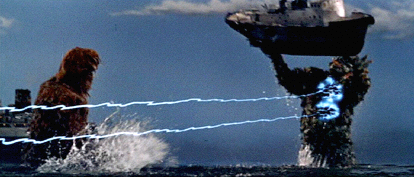
Due to the reproductive abilities of the gargantuas and this film’s somewhat open-ended conclusion, it seems likely that the film’s Japanese production company Toho was entertaining the possibility of yet another sequel. It would probably be inevitable that the gargantuas would tangle with other monsters in Toho’s kaiju universe, but I am glad that they never did. Despite this film’s origin as a loose sequel to the most far out Frankenstein variation ever, The War of the Gargantuas still remains its own offbeat spectacle.
 

Monday, June 28, 2021

DRACULA VS. FRANKENSTEIN (1971)

Director: Al Adamson

Writers: William Pugsley, Samuel M. Sherman

Producers: Al Adamson, Samuel M. Sherman, John Van Horne

Cast: J. Carrol Naish, Lon Chaney, Jr., Regina Carrol, Anthony Eisley, Anne Morrell, Greydon Clark, Zandor Vorkov (Roger Engel), John Bloom, Jim Davis, Russ Tamblyn, Maria Lease, Angelo Rossitto, Shelly Weiss, Forrest J. Ackerman, William Bonner

Las Vegas entertainer Judith Fontaine (Regina Carrol) heads to Venice, California looking for her missing sister Joan (Maria Lease). She runs into hippies, bikers, and Dr. Durea, the proprietor of a spook show exhibit at the beachside carnival. Dr. Durea (J. Carrol Naish) had his brutish henchman Groton (Lon Chaney, Jr.) kill Joan and others to use their bodies for strange blood experiments. Durea is actually the last of the Frankenstein family that created a man-made monster. That monster has been exhumed and brought to Dr. Durea by Count Dracula (Zandor Vorkov). Dracula wants Durea to revive the monster and to continue his blood experimentation that will grant Dracula even greater power.

The Flashback Fanatic movie review

Dracula vs. Frankenstein is the most well known of director Al Adamson’s films. This is due primarily to the famous monster duo in the title, not to any cinematic merit. It is a seriously compromised project because of its constant reinvention to try to turn the original attempt called The Blood Seekers into a commercially successful exploitation product. I have always wondered how The Blood Seekers, as originally completed, would have played. It had to be more cohesive than what Dracula vs. Frankenstein became.

The kid in me can still get off on the offbeat elements in the film: mad science, monsters, violence, and sexy women. The whole exploitative and schlocky vibe of this thing keeps drawing me back to it. Yet with all of that tantalizing stuff jammed haphazardly into it, I also see this film as a big missed opportunity.

As producer and co-writer Samuel M. Sherman has explained in interviews and the DVD audio commentary, the Dracula and Frankenstein characters were not part of the original film. They were added in with additional rewrites and new film footage thinking it would make the movie more commercial. Knowing that production history, one can almost marvel at the audacity of trying to reconfigure an already finished film to such an extent. The original storyline may have been exploitation fodder, but all the added Dracula and Frankenstein stuff give the impression that the whole film seems like it is being improvised.


The two horror genre veterans, J. Carrol Naish and Lon Chaney, Jr., give their last film performances in Dracula vs. Frankenstein. One can only assume that the original The Blood Seekers film would have been a better showcase for them, if it were more coherent. Perhaps scenes were cut that gave the Naish and Chaney characters more depth or motivation. 

As it stands now, the audience is expected to accept a lot based on horror movie character tropes; Dr. Durea is a mad scientist and Groton is his simple-minded henchman. The point of Durea’s blood experimentation is vague. Groton’s need for injections that transform him into a pasty-faced killer, and then are used to also calm his spontaneous transformations, is a Jekyll-and-Hyde movie gimmick. Although I love tried-and-true movie gimmicks, I just wish there was a little better setup for these characters and their motives. 

Much of Naish’s dialogue is of that roundabout drivel that is supposed to sound lofty and intelligent in low-budget schlock. Chaney has no dialogue, as he is once again reduced to the mute menace role. Unfortunately, this was a necessity because of the throat cancer that he was suffering from at the time.

Regina Carrol is a voluptuous attraction in many Al Adamson films, as she was also his wife. Her cleavage always steals the scene. The routine we see her perform in her first scene, as Judith Fontaine, was part of Regina’s act when she actually did perform in Las Vegas.

Anthony Eisley as Mike is just about the most atypical hero in any horror movie. He comes across like a slick establishment type that decided to stop parting his hair and throw on some love beads over his turtleneck pullover and live on the beach. He seems like a nice enough guy until he makes his free love move on Judith. I can’t say I blame him, but that “We don’t want to get involved, do we? Just be good friends” line before he starts tongue wrestling with her always struck me as wonderfully sleazy. Lounge lizard or hippie wannabe, it’s still all about the old in-and-out.

Russ Tamblyn emits that don’t-give-a-damn vibe as Rico, the lead troublemaker in a trio of bikers. This character was almost a reprise of his biker character Anchor from an earlier Adamson/Sherman production Satan’s Sadists (1969). Unfortunately, his Rico role was edited down from The Blood Seekers version of the film to make room for the new Dracula/Frankenstein footage. With seemingly no effort and little screen time, Tamblyn’s Rico still manages to be despicable, especially when menacing the lovely hippie Samantha (Anne Morrell).


Then we have the two title characters that keep us from ever being able to appreciate the pure cinematic splendor that could have been The Blood Seekers. Zandor Vorkov’s Dracula has been roundly condemned as the worst Dracula in movie history. With his often inane rambling dialogue that always has a spooky echo, his plastic joke shop fangs, and pasty white make-up that becomes so heavy in the final scenes that he looks like a mime, Vorkov’s Dracula probably makes the film’s most lasting impression for all the wrong reasons. The Frankenstein monster is little more than a prop in this movie. The design of the face is pretty interesting and, with 7’4” John Bloom in the role, this monster has impressive height. But the monster is shoehorned into the movie along with Dracula, and they only interact with three of the main characters; that is the three actors (Naish, Carrol, and Eisley) that would return from The Blood Seekers to shoot additional scenes.

With the budget limitations, the rewriting, the reshooting, and the re-editing, it was impossible that Dracula vs. Frankenstein would turn into a good film. An appreciation of schlock is necessary to derive any enjoyment out of it. I also derive an added interest by knowing its history of reconfiguration. It takes real nerve to graft seemingly unrelated pieces of narrative together into a film in the hopes of improving it. Everything about Dracula vs. Frankenstein has a slapdash feel to it, but I’ll be damned if I don’t look forward to watching it again.

STANLEY (1972)

Director: William Grefé Writers: Gary Crutcher, William Grefé Producer: William Grefé Cast: Chris Robinson, Alex Rocco, Steve Alaimo, Ma...