Showing posts with label Howard Vernon. Show all posts

Saturday, February 26, 2022

THE SADISTIC BARON VON KLAUS (1962)


Director: Jesús Franco

Writers: Jesús Franco (as Jess Frank and David Khune), René Sebille, Michel Luckin, Pío Ballesteros, Juan Cobos, Gonzalo Sebastián de Erice

Cast: Ana Castor (as Anna Astor), Howard Vernon, Hugo Blanco, Gogó Rojo (as Gogo Robins), Paula Martel, Georges Rollin, (and uncredited cast members) Fernando Delgado, Ángel Menéndez, Manuel Alexandre, José Carlos Arévalo, José Luis Coll, María Francés, Serafín García Vázquez, Marius Lesoeur, Miguel Madrid, Turia Nelson, Emilio Alonso, Joaquín Pamplona

In the Austrian town of Holfen, there has been a history of murders of women attributed to the ghost of Baron Von Klaus, a 15th century nobleman. When the murders resume in the present, the current descendants of Baron Von Klaus are concerned that his sadistic madness continues to be passed on through the generations.

The Flashback Fanatic movie review

Director Jesús Franco, Spain’s horror film pioneer, quickly followed up his The Awful Dr. Orlof (1962) with another gothic horror film. Although set in the modern day, The Sadistic Baron Von Klaus still has plenty of gothic horror atmosphere. The Von Klaus family still lives in the ancestral castle. There are ancestral sins and a curse that have seemingly set in motion a recurring evil resulting in local women being murdered. Village superstition blames the killings on the ghost of the evil 15th century nobleman, though the grandfather of a current Von Klaus family member was also committing murders. The possibility of an inherited madness or a spiritual influence from the original murderous baron on his descendants is a concern in the Von Klaus family.


Franco’s film operates almost like a giallo, though that film genre was just beginning the same year in Italy. There is a prolonged stalking sequence. The murders are sexually sadistic. We do not know who the killer is. There are several potential culprits presented in the story. An amateur sleuth, here a crime magazine reporter, assists the local police inspector in the investigation. Eroticism is a major element in the story and motivates the killer. The killer even wears black leather gloves. One wonders if Mario Bava and Dario Argento were paying attention.
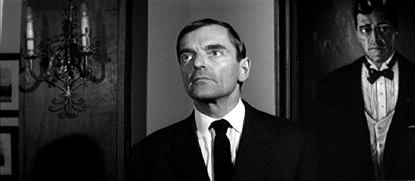
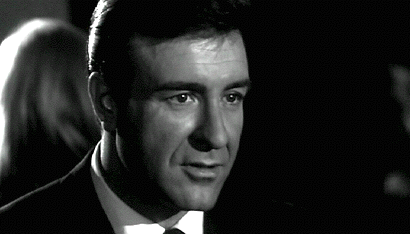
Franco has his original Dr. Orlof, Howard Vernon, return to star as the current day Baron Max Von Klaus. This time around, Vernon’s character is introduced as suspicious rather than immediately revealed as the villain to the audience. Although, being a dead ringer for the murderous ancestor depicted in a painting prominently displayed in the Von Klaus ancestral home certainly reminds everyone that he may have inherited the Von Klaus evil.

Another suspect Von Klaus family member is Max’s nephew Ludwig. He only seems relaxed when playing his piano. Otherwise, he is tormented by the potential of an evil influence from his notorious ancestors. Hugo Blanco plays Ludwig and would appear as the title character in Franco’s next horror film Dr. Orloff’s Monster (1964).
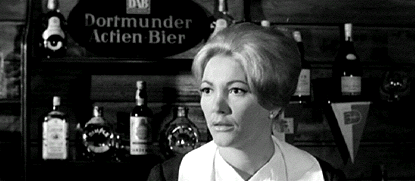
Ana Castor plays Lida, the proprietor of the local inn. She is featured in the prolonged stalking sequence that makes this film seem like a proto-giallo. Her voluptuous, blonde beauty would be featured again in Franco’s fourth, final, and finest black-and-white horror film, The Diabolical Dr. Z (1966). In that latter film, she was Franco’s first choice to play the main villain Irma Zimmer, but she declined that role due to some burn makeup needed for the character. She ended up flaunting her fine figure in the uncredited role of a sexy hitchhiker.

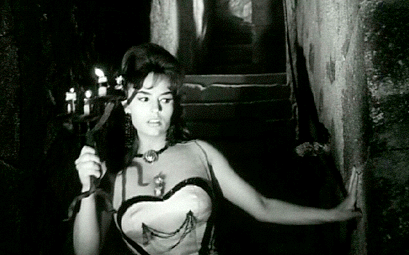
The wonderfully named Gogó Rojo (billed as Gogo Robins) has an even more sexually charged role as the curvy, brunette barmaid Margaret. She appears in a scene that was pretty transgressive for the time and portends the perversity Franco’s films would continue to explore.

Aside from a bit of levity provided by the banter between the crime reporter Karl Steiner (Fernando Delgado) and the frustrated Inspector Borowski (Georges Rollin), there seems to be an oppressive gloom throughout this film that is not alleviated by the conclusion. The true responsibility for the evil acts being perpetrated remains ambiguous; we are never quite sure where to place all of the blame for the recent crimes.

The prolific Jesús Franco’s second exercise in gothic horror has been almost forgotten among his vast body of offbeat films. This Spanish-French production should be considered a possible influence on what would soon become Italy’s giallo film genre. It certainly anticipates many of that genre’s aspects. It also blatantly presents kinky eroticism that would become a more common horror film element in the years to come, especially in Franco’s own work. This film is part of that early period in Franco’s filmography when technical and narrative discipline were still employed to explore some of his interests as he told his strange stories. Despite its slow pace and thin characterizations, The Sadistic Baron Von Klaus builds to a finale that leaves us with a lingering sense of haunting tragedy.

Sunday, August 29, 2021

THE DIABOLICAL DR. Z (1966), aka MISS MUERTE

Director: Jesús Franco

Writers: Jesús Franco (as David Kuhne), Jean-Claude Carrièrre

Producers: Michel Safra, Serge Siberman

Cast: Mabel Karr, Estella Blain, Fernando Montes, Howard Vernon, Guy Mairesse, Marcelo Arroita-Jáuregui, Cris Huerta, Alberto Bourbón, (and remaining uncredited cast members follow) Ana Castor, Mer Casas, Antonio Jiménez Escribano, Lucía Prado, Jesús Franco, Daniel White, Francisco Camoiras, Rafael Hernández, José María Prada, Javier de Rivera, Vicente Roca, Ángela Tamayo 

When elderly Dr. Zimmer (Antonio Jiménez Escribano) and his daughter Irma (Mabel Karr) attend a neurological science convention, he announces his desire to experiment on convicted criminals using surgical techniques to reform them. This provokes outrage and ridicule from other doctors at the assembly. Dr. Zimmer is so upset by their reaction that he has a fatal stroke. Irma plans to avenge her father’s death by killing his three most severe critics. Using her father’s techniques, she turns the beautiful dancer Nadia (Estella Blain), whose stage name is Miss Death, into her slave. Then Irma sends Nadia out to lure each of her father’s enemies to their doom. 

The Flashback Fanatic movie review

In yet another offshoot of his The Awful Dr. Orlof (1962), Jesús Franco presents another tale of mad medical science and uneasy sexuality. The Diabolical Dr. Z is another return to the tropes and obsessions that recur in many of Franco’s films: the elder Dr. Zimmer references theories of Dr. Orlof inspiring his own experiments; the experiments of Dr. Zimmer and his daughter Irma create not only a brutal and obedient henchman, but two beautiful and obedient henchwomen; a cabaret scene features the erotic and macabre Miss Death dance routine; and the police inspector played by director Franco is also named Tanner like the inspector in The Awful Dr. Orlof.


Mabel Karr, as Irma Zimmer, provides the impetus for the entire film. Her character is even more diabolical than her father. Karr’s performance is always controlled, yet seething with an obsessive intensity. She was not Franco’s first choice to play the role, but she is just right for it. In a rather strange detour in the plotline, Irma’s face gets severely burned. This seems of almost no consequence, as she has already set her plans of vengeance into motion and her disfigurement does not alter her character or MO one iota. In fact, she conducts facial surgery on herself immediately after the injury that almost completely removes the damage from her face. I have always puzzled over why this was included in the story. 

Fernando Montes is the handsome hero Philippe who has his way with the bereaved Irma Zimmer just before she begins her series of murders. Soon after, he becomes the live-in boyfriend of Nadia, aka Miss Death. His character has one of those incredible movie intuitions about the missing Nadia and how she might be involved in the murders of his fellow doctors. I guess Philippe’s ego just couldn’t handle the idea of the lady ditching him for a couple months to pursue a career opportunity. In another Orlof connection, Montes played the inspector’s right hand man in The Awful Dr. Orlof. 

The awful Dr. Orlof himself, Howard Vernon, is featured here as Dr. Vicas, one of the targets of Irma Zimmer’s revenge. 


Estella Blain is almost otherworldly as Miss Death/Nadia. Her supple and curvaceous body is always shown to great and often nearly nude advantage. She has eyes that are almost luminous and is equipped with a set of outrageously long fingernails that are used as weapons. This is probably Blain’s most famous role. She had a very troubled life that ended much too soon with suicide in 1982, just as Franco was considering casting her in another film. 

The black-and-white cinematography makes this the finest looking Franco film I have ever seen. The lighting and framing of shots make almost every frame demand attention. For those who gripe about Franco’s later haphazard use of the zoom, they will note here that the zooms are always used to great effect. Much of the visual credit must go to the cinematographer Alejandro Ulloa. Unfortunately, this was the only time he worked on a Franco film. Ulloa was the cinematographer on another of my all-time favorite Spanish fright flicks Horror Express (1972). 

The Diabolical Dr. Z concludes Jesús Franco’s early black-and-white period of horror films in fine fashion. It has Franco’s recurring fixations, another avant-garde music score, and an ending that leaves the viewer a bit uncertain about the fates of its surviving leads. These offbeat elements contrast with the bizarre but coherent plot to make perhaps the finest film in Franco’s vast, increasingly weird, and often frustrating filmography.

Saturday, August 14, 2021

THE AWFUL DR. ORLOF (1962)

Director: Jesús Franco

Writer: Jesús Franco (as David Khune)

Producers: Leo Max, Marius Lesoeur, Sergio Newman

Cast: Howard Vernon, Ricardo Valle, Conrado San Martin, Diana Lorys, Fernando C. Montes, Perla Cristal, Maria Silva, Mara Laso, Venancio Muro, Félix Dafauce, Fuastino Cornejo, Manuel Våzquez, Elena Maria Tejiero, Juan Antonio Riquelme, Javier de Rivera, Carmen Porcel, Rafael Hernández, Marisa Paredes, Juan Garcia Tiendra, Pilar Gómez Ferrer, Tito Garcia, Jesús Franco 

In 1912 France women are disappearing. They are being abducted by the blind, mute, and disfigured Morpho (Ricardo Valle). He is being controlled by Dr. Orlof (Howard Vernon), a retired prison doctor that managed to falsify convicted murderer Morpho's death. Orlof has surgically altered Morpho to make him his obedient henchman. The women Orlof has abducted are for use in his experiments to restore the beauty of his scarred and catatonic daughter Melissa (Diana Lorys). 

The Flashback Fanatic movie review 

The Awful Dr. Orlof is a seminal film. It is the first Spanish horror film and the first of many horror films made by the man who would become probably the most prolific filmmaker in the world, Jesús Franco.

Prior to this film, most Spanish films were kept in a pretty staid mold. They had to avoid the lurid and sensational, as Spanish censorship was quite stern under the Francisco Franco regime, and traditional Spanish values and culture always had to be positively represented. Jesús Franco got around that by having his horror film set outside of Spain. That was the tactic that he and other Spanish filmmakers would usually have to use when they made horror films. His films were often heavily censored in Spain, but Franco’s films would be shown in some other countries with nudity that was daring in its day. The Awful Dr. Orlof is one of the earliest forebears of the increasingly brazen mixture of eroticism and horror in films. 

Jesús Franco (aka Jess Franco, Jess Frank) brought a mishmash of interests and influences to his films. In his earliest works, this lent them an offbeat vibe at the same time that they dealt with familiar tropes. He seemed to be riffing on characters and situations from earlier genre films while adding his own recurring obsessions. 

The most direct influence would be the Bela Lugosi starring thriller The Dark Eyes of London, aka The Human Monster (1939). The Lugosi character was named Dr.Orloff and had a creepy, blind, huge henchman carry out his murders. Many more Franco films would feature a character named Dr. Orlof or refer to him. 

Of course, the recent French film Eyes Without a Face (1960) had to be a direct antecedent of this film’s plot. It also deals with a doctor abducting women for experiments to restore the damaged face of his daughter. 

Another direct influence was the recent The Brides of Dracula (1960) from Britain’s Hammer Films. Franco has stated that seeing this movie provided the impetus for making a horror film. Since the Hammer films were having great international success and were usually set in a past era, this might have prompted Franco to make his film a period piece rather than a modern day story. 

In this first of Franco’s fright flicks, we have some of his ongoing film fixations make their appearance. As well as the first use of a Dr. Orlof character, he would also have other mad doctors in later films create creepy, mute henchmen to handle the rough stuff. Franco has much of his story take place in a cabaret where we see sexy women perform. This would be a recurrent feature in more of his horror films where beautiful women sing, dance, or strip in drinking establishments. That makes me feel right at home and I save the cover charge. 

Franco uses a very avant-garde score by Jose Págán and Antonio Ramírez Ángel that never seems to establish a melody, but sounds unhinged to create an unhealthy atmosphere. The music in more of his horror films would have a strange combination of prickly and ethereal themes alongside some jazz passages.

I had longed to see this film for many years, being teased by stills of the Morpho character. This wretch looked like one of the creepiest and most depraved fiends in movie history. When I finally had a chance to see this film, Ricardo Valle as Morpho did not disappoint. Those bulging, sightless eyes in that scarred and pale face make for an unforgettable villain. His odd body language and facial tics along with his kill technique of biting people on the neck make for one sick and deadly dude. It is also somehow more disturbing that before Dr. Orlof experimented on him, Morpho looked normal, but he was just as twisted. I still wonder how a blind henchman would be very practical for a mad doctor to use as an assassin, but I must admit this strange touch adds to the eerie vibe in this film. Morpho does have very acute hearing that allows him to zero in on at least one of his victims. Perhaps while Orlof's surgical techniques blinded Morpho they gave him other special senses to help compensate. Yes, I am trying to fill in the logic blanks because I think Morpho is damned cool; creepy, but cool. 

The rest of the cast has some Euro-horror notables. Howard Vernon stars as Dr. Orlof and would go on to star in many more Jesús Franco films. Beautiful Diana Lorys, as ballerina Wanda Bronsky, takes the initiative to track down Dr. Orlof for her fiancé Police Inspector Tanner (Conrado San Martin). She also plays the scarred lookalike daughter of Dr. Orlof. Fernando C. Montes plays Inspector Tanner’s right-hand man Malou. He would go on to be the hero in what may be Franco’s best film, The Diabolical Dr. Z, aka Miss Muerte (1966). Howard Vernon also appears in that latter film. 

Jesús Franco’s The Awful Dr. Orlof is much more accomplished and disciplined in its story and execution than many of his later films. Many feel that Franco was a hack with no talent because they probably saw some of his later works that he had almost no time or money to make. He was also probably someone more interested in the process of making a film than in the coherence of the final product. 

As he continued to churn out film after film with often impossibly small budgets, Franco became more improvisational. His style of filmmaking was perhaps the cinematic equivalent of his beloved jazz music. Franco was grabbing shots in what seems to be an undisciplined artistic abandon or a short schedule-dictated flurry. We are left to ponder whether the director was lazy, hurried, self-indulgent, or inept. I think that the quality of the images and the coherent plot in The Awful Dr. Orlof, and some of his other black-and-white horror films from the '60s, proves he could make uniquely stylized and accomplished films. They are bizarre to be sure and logic may be as strained as the sanity of the villains, but the best of Franco’s films are hardly inept.

STANLEY (1972)

Director: William Grefé Writers: Gary Crutcher, William Grefé Producer: William Grefé Cast: Chris Robinson, Alex Rocco, Steve Alaimo, Ma...