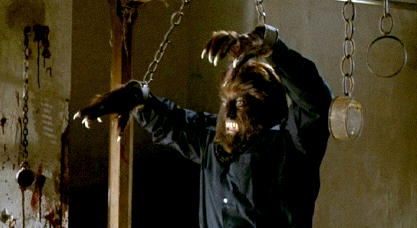
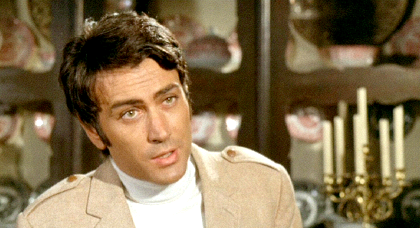
Showing posts with label Paul Naschy. Show all posts

Sunday, January 25, 2026

A DRAGONFLY FOR EACH CORPSE (1973/released 1975)

Director: León Klimovsky

Writer: Jacinto Molina (Paul Naschy), Ricardo Muñoz Suay

Producers: Jose A. Perez Giner, Ricardo Sanz

Cast: Paul Naschy, Erika Blanc, Maria Kosti, Ãngel Aranda, Susana Mayo, Ricardo Merino, Eduardo Calvo, Ramón Centenero, Mariano Vidal Molina, Anne Marie, José Canalejas, Beni Deus, Cesar De Barona, Maria Vidal, Ingrid Rabel, Frances O’Flynn, Javier de Rivera, Juan Madrigal, Rafael Albaicin, Luis Alonso, Antonio Mayans, Ernesto Vañes, Juan Cazalilla

In Milan, Italy, a serial killer is murdering people that the killer considers unclean and sinful. A plastic dragonfly is left on each of the killer’s victims. Police Inspector Paolo Scaporella (Paul Naschy) is on the case, which becomes personal as the killer taunts Scaporella with notes and as some of the detective’s friends also become victims.

The Flashback Fanatic movie review

Spain’s genre film Renaissance man and horror film champion, Paul Naschy, wrote and starred in this film with the perfect giallo-styled title of A Dragonfly for Each Corpse. He teamed with his frequent horror film director León Klimovsky to make a movie almost as offbeat as Naschy’s earlier giallo-inspired effort, The Blue Eyes of the Broken Doll (1974). I suppose the fact that this movie is a Spanish-Italian co-production and that it is set in Italy ought to qualify it as a giallo. However, the purists would argue that to be a true giallo the movie must be a purely Italian production. I think the real reason that A Dragonfly for Each Corpse is hard to classify as a true giallo is that it doesn’t show even a single bottle of J&B Scotch.

Besides a great animal-themed title (à la Italian director Dario Argento’s first three gialli), this film has many giallo trademarks. These include the mystery being set in Italy, a black-gloved killer, flashy fashions, successful and decadent professionals with secrets, infidelity, sexual perversity, and a high body count.

Although this movie has a very high body count, the kills are often pretty perfunctory. They are occasionally bloody, but usually not teased out to more suspenseful lengths like a lot of giallo movie murders. The plot is not too convoluted and plays fair with the audience, but there are a couple of illogical instances of characters not communicating what they know in the most direct fashion. Of course, that only serves to prolong the mystery.

One great asset this movie has is the main couple of Naschy, as Inspector Paolo Scaporella, and the radiant redhead Erika Blanc, as his wife Silvana. They are seemingly mismatched but compliment each other perfectly. Paolo is blunt and intense, while Silvana is a bright beauty that can soften some of his hard edges. It is refreshing to see a happily married couple as the protagonists in a giallo or near-giallo.

The other greatest asset that this or any other film could hope for is the magnificent presence of Anne Marie. She gives new meaning to the term showstopper as a stripper that gets pimped out to perform private perversions after hours. No other coffin ever had it so good (except Erika Blanc’s in 1971’s The Night Evelyn Came out of the Grave, but that is another kink from another film for another review by this obsessive reprobate).

A major difference here from most giallo films is that the police are neither incompetent nor inconsequential to the story and its outcome. The hero here is a police inspector. This story may also be influenced by poliziotteschi, the Italian police thriller film genre that was also very popular at this time. Yet, like many gialli, it is a creative or artistic person who intuits the killer’s identity.

As in many giallo films, there are sexual norms crossed by several characters, which attracts the puritanical wrath of the killer. Here we also have the mucho macho Inspector Scaporella accompanied on some inquiries by his gay, fashion designer friend, Vittorio (Ramón Centenaro). There is never a single remark, snide or otherwise, concerning Vittorio’s homosexuality. This seems like a very progressive bit of nonchalance for a film of this time.

A Dragonfly for Each Corpse is a pleasant surprise for longtime Paul Naschy film fans. There are many differences for Naschy’s character in this film from what he usually wrote for himself. He often treats himself to couplings with more than one woman in his films, yet here he is faithful to his devoted wife. Considering that the enchanting Erika Blanc portrays this wife, it is a wise choice, though the blonde prostitute Ornella (played by a dazzling and unknown actress) who offers her services to him would probably be indulged in by Naschy’s character in any other film. It is just one more reason we still respect this violence-prone, cigar-chewing cop who wears very loud ties. Naschy’s Inspector Scaporella is so honest and genuine that he does not even wear a toupee.

A Dragonfly for Each Corpse is a Paul Naschy film with a change-of-pace characterization for him, great theme music, a mystery killer that tallies up a high body count, and three of the most magnificent Euro-film beauties ever. That’s all that this sleazy sleuth craves in his Euro-horror film investigations. I just wish I could solve the mystery of who played Ornella.

Sunday, June 1, 2025

THE BLUE EYES OF THE BROKEN DOLL (1974), aka HOUSE OF PSYCHOTIC WOMEN

Director: Carlos Aured

Writers: Jacinto Molina (Paul Naschy), Carlos Aured

Producer: José Antonio Pérez Giner

Cast: Paul Naschy, Diana Lorys, Maria Perschy, Eva León, Eduardo Calvo, Antonio Pica, Inés Morales, Pilar Bardem, Luis Ciges, Sandra Mozarowski

Gilles (Paul Naschy) is a drifter hitchhiking in rural France when he is picked up by Claude (Diana Lorys). She is a bitter woman with a disfigured right hand covered in a prosthetic glove. She offers Gilles handyman work and lodging at her remote country villa. Claude’s two sisters also live there with her, the wheelchair-bound Ivette (Maria Perschy) and nymphomaniac Nicole (Eva León). Gilles performs his chores while having a dalliance with Nicole and imposing upon Claude’s cold and remote demeanor. Despite his confident manner, Gilles is haunted by visions of him strangling a mocking woman. Meanwhile in the nearby village, a black-gloved killer is murdering blonde women and removing their blue eyes.

The Flashback Fanatic movie review

Multitalented Spanish horror film player Paul Naschy toyed with the giallo genre when he wrote and starred in The Blue Eyes of the Broken Doll. Movie fan Naschy always paid homage to a lot of the genre films he loved by incorporating many tropes from them into his scripts. When adding his own attitudes and fixations, Naschy could create lively and often loopy storylines for his films. Naschy showed a bit of restraint here, yet he still provided a twisted, tricky plot with plenty of odd characters that should satisfy the expectations of giallo fans. That uniquely Italian genre seemed to suit Naschy well for this Spanish production.


We are introduced to Naschy’s character of Gilles in an interesting way. The film opens with Gilles amid the sprawling countryside as he walks along a road trying to thumb a ride. This places us on his side, if for no other reason than we can empathize with the plight of someone alone in the middle of nowhere needing a lift. We also can’t help but wonder why he is in this destitute situation and where he is headed. But our comfort with this character is soon disturbed; as he stops for a bite to eat, we see Gilles being eyed with suspicion by the village café patrons, including local police Inspector Pierre (Antonio Pica). Gilles quickly moves on.

As night falls our hitchhiking protagonist is picked up by Claude, an austere, beautiful woman who is self-conscious of her maimed right hand. Gilles seems unperturbed by Claude’s affliction and perhaps appreciates that this makes her feel as much of an outcast as he himself appears to be. Claude is played by Diana Lorys, who had appeared in many genre films. Lorys is perhaps best known for starring in the first Spanish horror film, Jesús Franco’s The Awful Dr. Orlof (1962).

Rather oddly for a giallo film, the kills do not begin until nearly halfway through the running time. Until that point, it is the strange characters of the three afflicted sisters in their remote country villa interacting with the mysterious drifter now staying with them that intrigues us. However, we are teased with some possible violence in Gilles’ past as he has recurring dreams or memories of strangling a beautiful woman laughing at him.


True heroes may be hard to come by in giallo flicks, but you can’t fault Gilles’ work ethic. He is certainly diligent in his chores of chopping wood, raking, milking cows, and laying plenty of pipe. After all, this is a Paul Naschy-written role.


Fortunately, sexy women are always plentiful in the giallo genre, which helps maintain interest until the bloodshed begins. Therefore, our lucky loner and live-in handyman Gilles is testing the boundaries of Claude, the apparent head of the household, appreciating the beauty of the paralyzed Ivette (Maria Perschy), and wallowing in the carnal comfort of nymphomaniacal Nicole (Eva León).


Once a black-clad killer starts murdering women in the nearby village, we are playing the whodunit guessing game. Naturally, Gilles is under audience suspicion due to his violent flashbacks and shady past. The three afflicted women he is living with all have their issues. Ivette’s new nurse named Michelle (Inés Morales) arrives instead of another nurse who was murdered, and she is making secretive phone calls. Jean, the previously fired handyman, attacks Gilles with a knife. René (Luis Siges), the odd character hanging out at the village café, ogles young girls and eavesdrops on discussions of the murders between Inspector Pierre and the local physician treating Ivette, Dr. Phillipe (Eduardo Calvo).


Paul Naschy’s script gives us climaxes that are red herrings just as much as many of the characters themselves. The film ends with a very morbid scene full of sick pathos. This conclusion is supposed to be loosely inspired by an actual 1865 case in Madrid, Spain. While Naschy’s scripts borrowed elements from many previous genre films, his main intent here seems to be emulating the giallo films as popularized in the 1970s by Italian director Dario Argento. Yet this film’s final scene reminds me a lot of Argento’s much later Trauma (1993).

Carlos Aured directed only four of Paul Naschy’s films and this ranks as one of Naschy’s best. Along with cinematographer Francisco Sánchez and editor Javier Moran, Aured has made this a visually nimble and occasionally striking looking film. There is cutting on action to new camera angles during often simple actions of characters, some lighting that ratchets up the mood and suspense, and shots that take advantage of interesting locations and scenery.

Giallo films are often graced with weird and catchy music scores. The Blue Eyes of the Broken Doll does not disappoint with some nice themes by Juan Carlos Calderón. Others have commented on the musical misstep that an almost jaunty theme used to introduce us to Naschy’s Gilles is also used during his final scene, which is totally inappropriate for the mood there. Composer Calderón is probably not to blame for the repeat of that piece of music. Perhaps someone thought that the music used to introduce the character of Gilles would be ironic for his last scene. It was Naschy who had the inspired idea to use the traditional French folk tune “Frère Jacques” as the leitmotif used for the killer. That song had always creeped out Naschy as a child.

The Blue Eyes of the Broken Doll is one of my favorite Paul Naschy films. As a giallo fan, I can appreciate that Naschy is giving us a fine example of the genre that is hardly typical. It has the giallo ingredients of sex, violence, and a mystery killer, while distinguished by its rural setting and damaged characters.

Friday, September 22, 2023

THE WEREWOLF VS. THE VAMPIRE WOMAN (1971), aka WALPURGIS NIGHT, WEREWOLF SHADOW

Director: León Klimovsky

Writer: Jacinto Molina (Paul Naschy)

Producer: Salvadore Romero

Cast: Paul Naschy, Gaby Fuchs, Barbara Capell, Patty Shepard (as Paty Shepard), Andrés Resino, Yelena Samarina, José Marco, Barta Barri, Julio Peña, Betsabé Ruiz, Luis Gaspar, María Luisa Tovar, Ruperto Ares, Eduardo Chappa (uncredited), Carlos Aured (uncredited) 

Elvira (Gaby Fuchs) and Genevieve (Barbara Capell) are two college students traveling in Northern France doing research for their thesis. They are looking for the tomb of Countess Wandesa Dárvula de Nadasdy (Patty Shepard), a notorious 11th-century Hungarian rumored to be a witch and a vampire that drank the blood of the virgins she killed. The two students happen to meet reclusive writer Waldemar Daninsky (Paul Naschy). He agrees to help them find Countess Wandesa’s tomb while they stay at his country house. Daninsky is suffering from a werewolf curse and believes that finding the tomb can help him end his affliction. When the remains of Wandesa are discovered, the vampire countess is accidentally revived just before Walpurgis Night when her master Satan’s power will be at its peak. 

The Flashback Fanatic movie review 

Paul Naschy’s werewolf character, Waldemar Daninsky, had already appeared in four previous films. After the character’s successful debut in Frankenstein’s Bloody Terror (1968), aka The Mark of the Wolfman, the next three films suffered many production difficulties and muddled results. In fact, the second Daninsky movie, Nights of the Wolfman (1968), was supposedly never completed and is considered a lost film. 

The Daninsky-Werewolf films were not a series in the normal sense. Many of the films often introduced the character with a new origin for his lycanthropy affliction and the stories could take place in different settings and eras. Many consider Walpurgis Night a sequel to The Fury of the Wolfman (1970/released 1972?). However, that previously made film was released at least a year later and only shares a couple details with Walpurgis Night, which was released in the US as The Werewolf vs. the Vampire Woman. As in other Waldemar Daninsky films, there is no specific movie series continuity adhered to in this story. We are introduced to the Daninsky character as a corpse lying in a morgue with two silver bullets in his chest. Although Daninsky had been killed in earlier films, this story is not necessarily an actual sequel to any of them. 

The pentagrams finally all seemed to be in alignment for Walpurgis Night. It was the box-office hit that finally made horror hot in Spanish cinema. It would be the most successful film in actor/screenwriter (and later director) Paul Naschy’s vast filmography.

Here Naschy works for the first time with the reliable and versatile director León Klimovsky. Following the suggestions in Naschy’s script, Klimovsky shot slow motion sequences for the vampires that add a dreamy, mystical atmosphere to the film. It has been suggested that this may very well have influenced director Amando de Ossorio’s similar technique for the blood-drinking specters in his famous Tombs of the Blind Dead (1972) and its sequels. The Blind Dead series’ creatures also look quite similar to the zombie monk seen in Walpurgis Night. 

What is always of interest to this Paul Naschy fan is the recurrence of Naschy’s particular tropes in his stories. Naschy’s scripts often have the character he plays getting it on with at least one beauty he meets in the story. That’s always a nice perk for a screenwriter starring in his own films. As is also usually the case, here the attraction is almost immediate and declarations of love and sex soon follow. 


This film also includes the Naschy trope of the violent rural dweller (Luis Gaspar) accosting Naschy’s hero. It seems practically every time one of Naschy’s characters gets away from the hustle and bustle of the city, he ends up being assailed by at least one dangerous country ruffian that just happens to drop in for no good reason. I wonder if that reflects some deep-seated resentment of what Naschy may have considered a rustic Spanish mindset that might have impeded the acceptance of the horror films that Naschy wanted to make. At that time Spain’s Francisco Franco regime decreed that Spanish films should be devoted to portraying traditional Spanish culture and values in a positive light. This stifled a lot of genre films, especially horror, from being made in Spain, unless the stories were set in other countries. 

In a nod to the monster mash inspirations from the Universal Pictures of his youth, Naschy provides that favorite trope of multiple menaces in his horror films. Here in Walpurgis Night, we not only have a werewolf and a vampire to deal with; we also get that vampire’s ancient monk ally (Eduardo Chappa) rising from the dead, a victim of the vampire becoming another vampire, a dangerously unhinged handyman (José Marco), a vengeful, knife-wielding, country widower, and Waldemar Daninsky’s deranged, breast-fixated sister Elizabeth (Yelena Samarina) attacking his nubile guests. 

All of these offbeat characters enliven a simple story with one-dimensional characters. That simplicity enhances the often-dreamlike feel of the film, but there are no characters of much dramatic interest here. This film is chiefly an exercise in supernatural situations and atmosphere. 

Of course, Naschy once again effectively vents his werewolf animosity. That is in great contrast to the subdued and controlled manner of his human side. It is only in close ups of Naschy that we see subtle flickers of emotion register on his stoic features. As Waldemar Daninsky, he conveys certain resignation to his plight as one who is cursed and seeking the release of a permanent death. 

Gaby Fuchs is stuck with the film’s second-most thankless role. As Elvira, her character never displays much personality or motivation. She is supposed to be the plot’s major protagonist as a researcher looking for the grave of the vampire Countess Wandesa. She is also the lady that falls for the tragic Waldemar. However, this doomed love angle is never as poignant as it should be due to the thin characterizations of both Elvira and Waldemar. Although it is often difficult to judge the effectiveness of an actor in a dubbed performance, despite being the lead character along with Naschy’s Waldemar, Fuch’s role of Elvira seems to be little more than a plot device. 

Elvira’s classmate and friend, Genevieve (Barbara Capell), is a character of no greater depth, but she has a bit of vivacious charm and humor. She also has the interest advantage by indulging in vampire shenanigans after the Countess puts the bite on her. 

Patty Shepard had appeared as a different character in an earlier Daninsky film Assignment Terror (1970), aka The Monsters of Terror. In Walpurgis Night her Countess Wandesa would be another of those proponents for lesbian vampirism becoming all the rage in 1970s horror films. According to Paul Naschy, Shepard regretted taking the part, but it is probably the one she is most remembered for. Patty Shepard really looks great in her very limited role. With her enigmatic, pale beauty draped in wispy, black veils, her character has a great spectral presence. Her vertical rise from her tomb late in the story is probably my favorite shot in the entire film. There is something about that simple feat that seems truly supernatural. 


If you are still wondering who has this film’s most thankless role, you are to be congratulated for hanging on my every word. Of course, since Elvira is the second-most thankless role here, it stands to reason that Andrés Resino, as her boyfriend, Inspector Marcel, would take top prize for the most thankless role in Walpurgis Night. He is not only ineffectual, he also gets passed over by his girlfriend for a werewolf with a death wish who lets his loony sister run about unsupervised to grope her. In fact, Marcel is the plot device that enables Elvira’s character (who is barely more than a plot device herself) to have someone to relay the exposition to regarding the Countess Wandessa history for the benefit of the audience. Resino looks like he is actually delivering his lines with some conviction; despite the sometimes-awkward English dialogue dubbing he receives. 

Regardless of any nits to pick, Euro-horror buffs and Paul Naschy fans will find Walpurgis Night to be essential viewing. Paul Naschy himself was initially underwhelmed with his first viewing of the film, as he considered director Klimovsky more of a craftsman than an artist. But Naschy did appreciate the film’s most effective sequences and later took pride in Walpurgis Night energizing Spanish horror film production in the 1970s. 

I have to believe that part of this film’s record-setting box office performance in Spain was due to some happy accident of timing. Spanish filmmakers had been dabbling in horror for most of the 1960s, yet those productions seemed to find greater success in other countries. In 1971 it seemed that many Spanish moviegoers were finally ready to succumb to the lurid allure of homegrown horror. Paul Naschy was just the right guy to feed their fright flick fever.

Sunday, July 10, 2022

PANIC BEATS (1983)

Director: Jacinto Molina (Paul Naschy)

Writer: Jacinto Molina

Producers: Augusto Boue, Julia Saly

Cast: Paul Naschy, Julia Saly, Frances Ondiviela, Lola Gaos, Silvia Miró, Manuel Zarzo, José Vivó, José Sacristán, Salvador Sáinz, Charly Bravo

Paris architect Paul Marnac (Paul Naschy) relocates with his wealthy wife Genevieve (Julia Saly) at his childhood home in the French countryside. Clean air and tranquility are prescribed to help cope with Genevieve’s heart condition. However, the Marnac family home was built upon the grounds where once stood the castle of Paul’s notorious ancestor Alaric de Marnac. Legend has it that the 16th century nobleman killed his unfaithful wife and returns every 100 years to claim the life of another wife of the Marnacs. 

The Flashback Fanatic movie review

Ten years after introducing perhaps his most evil character of Alaric de Marnac in Horror Rises from the Tomb (1973), triple threat Spanish filmmaker Paul Naschy revives him in a very different sequel. Naschy writes, directs, and stars in Panic Beats. As in many of Naschy’s scripts, this has strong influences from other films while laced with even more pessimism than most of his stories. It also has a circular and ironic narrative making it unique and completely different from the previous Marnac film.

Panic Beats opens on a surreal and violent note in the 16th century with the evil Alaric de Marnac (Paul Naschy in a dual role) in full knight’s armor on horseback pursuing his unfaithful, naked wife (Carole Kirkham) through a weirdly lit forest. This stylized flashback has a nightmarish feel that is appropriate to the subsequent unpleasantness that occurs in the modern day. These contemporary events are often meant to make us question the reality of the situations presented. We wonder if they are actual or imagined on the part of the characters involved. Almost anything seems possible if you accept that the evil of Alaric de Marnac may still be infesting the Marnac homestead.

One of the advantages of someone writing scripts that he will star in is that the writer’s character gets to get it on with beautiful women. Naschy’s architect Paul Marnac is erecting more than buildings at more than one site in Panic Beats. That should give you some idea of the slippery morality that mires many characters in this film. The ripples of deceit and evil just keep spreading and the surprises keep coming until that last horrible and fitting denouement.

As Paul Marnac, Naschy seems more relaxed than in many of his other roles. Of course, almost any character would be less tormented than his signature role of werewolf Waldemar Daninsky. While Paul Marnac has his share of concerns, he seems to be one pretty cool customer. That’s probably perfectly appropriate for him once you figure out just where this strange tale is heading.


Naschy’s frequent co-star and this film’s co-producer Julia Saly should have all of our sympathies as Paul’s ailing wife Gevevieve. We don’t find out a whole lot about her background and their relationship except for what Paul relates about her to other characters. This makes us wonder with whom we should be empathizing throughout the course of this story. 

As soon as Paul gets an eyeful of Julie (Frances Ondiviela), the sexy and restless niece of his country home housekeeper Mabile (Lola Gaos), we know that infidelity may become a recurring complication in the Marnac line. Julie has a troubled and disreputable past and speaks her mind without much sentiment or tact. We are never sure how much of a disruption she may cause in this new, seemingly idyllic setting for the Marnac couple. 

As Mireille, Sylvia Miró fills out her leopard print loungewear with awesome aplomb. She also has some lines and stuff like that but I was panting too hard to hear most of them. She really is there to provide another sexy complication. This naked sleeping beauty is the most magnificent comforter to ever cover a bed. 


Once seasoned fright flick fans get most of the way through Panic Beats, they may think that they have seen it all before. Then they are in store for something that may seem out of left field and inappropriate. A lot of Euro-horrors seem to veer off down delirious detours just for effect. However, in this film the weird climax has been justified as Panic Beats closes in a vicious circle resulting in an ironic finish.

STANLEY (1972)

Director: William Grefé Writers: Gary Crutcher, William Grefé Producer: William Grefé Cast: Chris Robinson, Alex Rocco, Steve Alaimo, Ma...