Sunday, August 27, 2023

A SHRIEK IN THE NIGHT (1933)

Director: Albert Ray

Writers: Kurt Kempler, Frances Hyland

Producer: M.H. Hoffman

Cast: Ginger Rogers, Lyle Talbot, Purnell Pratt, Harvey Clark, Lillian Harmer, Arthur Hoyt, Louise Beavers (as Louise Beaver), Clarence Wilson, (and uncredited cast members) Maurice Black, Jim Farley, Cyril Ring, Tiny Sandford, Philip Sleeman, Dick Rush 

In the middle of the night at the towering Harker Apartments Building in New York City, the millionaire owner Adam Harker falls screaming from his penthouse to his death. Newspaper reporter Pat Morgan (Ginger Rogers) has been posing as Harker’s live-in secretary to investigate his rumored ties to organized crime. Ted Rand (Lyle Talbot) is another reporter from a rival newspaper also trying to get a scoop on this case as he tries to woo Pat. Despite their competition, Pat and Ted cooperate trying to find the reason for Harker’s death as more bodies turn up in the Harker Apartments. 

The Flashback Fanatic movie review 

A Shriek in the Night is another of those little B-film thrillers from the 1930s that has plenty of humor, a tricky murder gimmick, and fine performances from the main players. It also has an atypical approach to its characters. The lead protagonists that are the most appealing and who get the most screen time are not as instrumental in solving the mystery as other seemingly minor characters. These developments are more of a surprise than the reveal of the villain. 

This film certainly begins with a bang, or actually with a shriek and a thud to be more precise. The brief opening credits have barely had time to finish before the first death via high dive off of the Harker Apartments Building occurs. This grim event is immediately dealt a bit of irreverence as one happily boozed-up bystander assumes that the fresh corpse of Harker is drunk. This is just the first hint of how this film will confound a lot of our expectations about crime thriller conventions. 

A tipsy crime scene gawker is only the first of many indications that the prohibition era was running out of steam. Booze was on the brain of a restless public anticipating the legalization of intoxicants. This is another early ’30s film in synch with that sentiment. Characters frequently indulge in drink and reference going to speakeasies. One shady character’s last name is Martini (Maurice Black). Even Police Inspector Russell (Purnell Pratt) savors the scent from a bottle of booze at a crime scene. This irreverence for the legal restrictions about alcohol seems to carry over into the narrative’s disregard for genre expectations and creates an overall sense of mischief. This flick even gives us more than one way for characters to get “gassed.” 

Ginger Rogers had already starred just the previous year in another Albert Ray-directed mystery thriller, The Thirteenth Guest (1932). Being just on the verge of superstardom in 1933, Rogers stars here as newspaper reporter Pat Morgan. All it takes is her beauty and relaxed charm to make us pay attention to her simple character in this odd, little yarn. Later that year, Rogers’ movie immortality really took off by appearing for the first time with Fred Astaire in Flying Down to Rio (1933).

Lyle Talbot had also co-starred with Ginger Rogers in that earlier Albert Ray film. At this time Talbot was in the midst of his six-year Warner Brothers contract and probably at the height of his fame. He was often cast in villain roles and, as Talbot wished to play good guys, he must have relished the opportunities getting loaned out to appear as the heroic lead in a couple of Albert Ray’s B-flicks. In later years he would have a long career as a character actor on film and television. Superhero fans know him best for being the first film actor to play Commissioner Gordon in the serial Batman and Robin (1949) and Superman’s archenemy Luthor in the serial Atom Man vs. Superman (1950). Cult film fans will remember Talbot’s appearances in three of famed bad movie director Ed Wood’s films: Glen or Glenda (1953), Jail Bait (1954), and Plan 9 from Outer Space (1957).

In A Shriek in the Night, Rogers and Talbot as our leads are the attractive couple we think are going to hook up, despite their playful antagonism. Since they are both newspaper reporters, we also expect them to solve the mystery. This film devotes plenty of attention to them, but there are other characters that actually prove to be just as instrumental in getting to the solution of this case. It can even be argued that the Rogers and Talbot characters of Pat Morgan and Ted Rand are not really solving the mystery but just spicing up the plot with some humor and romance. 
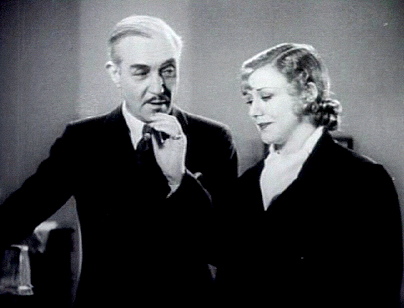
Another character that is a change of pace is Police Inspector Russell. Unlike many other such figures in crime thrillers featuring amateur sleuths, this official representative of law enforcement seems quite capable and likable. Russell doesn’t want reporters interfering with his investigation, but he is quite civil and intelligent. He even seems to take a genuine liking to Ginger Rogers’ Pat Morgan; the guy has great taste. Yet in spite of the respect this character is portrayed with, he is not picking up all of the crime-solving slack left by our romantic leads. 


Many horror and mystery films of this era had comic relief characters. There are several here, as well, such as the panicky maid Augusta (Lillian Harmer) and Inspector Russell's meek secretary Wilfred (Arthur Hoyt). However, some of them are absolutely vital in dealing with this film’s mystery and menace. That is another quirk in this offbeat, little thriller that does not always meet expectations. It seems to suit the sense of mischief running throughout the story. 

Despite all of this disregard for typical genre character responsibilities, there are a few macabre touches that help to maintain the intrigue. Exactly how the victims are being killed is as puzzling as the killer’s identity. The murderer also indulges in a bit of mental sadism by sending a peculiar warning card to the intended victims. 

Director Albert Ray does not get too fanciful in his direction. He does not need to do much in a film with a short running time and the humor of the Rogers and Talbot performances to keep things moving. Ray does use the interesting trick a few times of having scenes become very dark as we lose sight of characters to keep us disoriented and in suspense. This has a nice payoff as A Shriek in the Night reaches its climax in the film’s most irreverent touch.

Tuesday, August 22, 2023

A BOY AND HIS DOG (1975)

Director: L.Q. Jones

Writers: L.Q. Jones, Wayne Cruseturner (uncredited), adapting Harlan Ellison’s novella

Producers: L.Q. Jones, Alvy Moore

Cast: Don Johnson, Tiger (uncredited as the dog Blood), Tim McIntire (Blood’s voice), Jason Robards, Susanne Benton, Alvy Moore, Helene Winston, Hal Baylor, Charles McGraw, Hal Baylor, Ron Feinberg, Michael Rupert, Don Carter, Michael Hershman, (and uncredited cast members) Dickie Jones, L.Q. Jones, Maggie Smith

The world has been devastated by nuclear war. Humanity has devolved into barbarism. Teenager Vic (Don Johnson) and his dog Blood (Tiger, voiced by Tim McIntire) are partners in a nomadic existence of stealth and violence taking the food and supplies that they can scavenge from the remains of civilization. Blood is no ordinary pet. The dog has developed human-level intelligence and a telepathic bond with Vic. These two make a formidable and deadly team when encountering opposing scavengers that they must compete with to survive. Vic is under surveillance by an underground society that thinks the virile young man can be of use to them. 

The Flashback Fanatic movie review 

A Boy and His Dog is certainly a cult movie. It has an eccentric blend of science fiction and humor that never dispels the dread about the aftermath of nuclear war. It manages to be exciting, funny, thought-provoking, and, ultimately, very grim. This precarious mix of reactions to the story results in a unique experience that may reward some viewers and frustrate others. It is not that there is anything difficult to follow in the story. The uneasy feeling the film leaves one with is that nuclear war is not only awful, but surviving it is not a worthwhile option. 


This is another great example of the interesting science fiction films that were appearing in the 1970s before George Lucas’ Star Wars (1977) defined the genre for the mainstream as nothing more than effects-driven fantasies about action instead of speculative concepts about consequences.
 

A Boy and His Dog is also a film that its director L.Q. Jones suggests began the post-apocalyptic movie genre. This probably influenced director George Miller to use the collapse of civilization to set the stage for barbaric conflict and high-speed vehicle action in Mad Max (1979) and its sequels. Like George Lucas, Miller stressed action over ideas. 

Amidst the very unpleasant environment of A Boy and His Dog, we are dealing with the amoral survivalist mentality of the two main protagonists and partners in the story, Vic and Blood. They are the characters that make this a great science fiction film. They are interesting and engage our emotions while never comforting our civilized sensibilities. They demonstrate how the survivors are conditioned by the complete destruction of civilization wrought by nuclear war. Science fiction only matters when it explores an imagined phenomenon’s effect on people. 

In this early film role, Don Johnson is very good as Vic, the daring, young man that steals and kills to survive. He is reckless, ruthless, and believable as a teenager hardened by the cruel times he endures, but he still has a young man’s drives and volatility. 

Fortunately, Vic’s partner Blood is a dog that has somehow acquired more learning and intelligence than the savage humans of this post-apocalyptic world. Blood also has a telepathic ability to share thoughts with Vic. Just how the dog developed such abilities is never explained, but we could assume that he is the result of some sort of mutation. In sci-fi flicks, radiation can play all sorts of tricks. 

The character of Blood is the most memorable thing about the film. This is a remarkable performance by the canine actor Tiger and Tim McIntire providing the voice for Blood’s telepathic thoughts. It is very funny to see that while Blood possesses superior intelligence and often belittles his human companion, he still engages in typical canine behavior trying to beg popcorn from a patron at a ramshackle approximation of a movie theater. 


While Vic and Blood are pragmatic about everything that they need to do to survive in a world without laws and dwindling resources, they also have a bond of loyalty to each other. They need each other to survive. However, this does not mean that they don’t frequently bicker about conflicts of interest. These exchanges are often very funny, as Blood’s telepathic bark is often worse than his bite. As the brains of the partnership, Blood tries to teach Vic history, proper grammar, and insults him for his impulsive and risky behavior. Their main point of contention is due to Vic’s libido. Blood is very good at sensing the presence of women for his horny partner to use, but that is likely to prompt Vic into taking dangerous chances.


When Blood spots Quilla June Holmes (Susanne Benton) for Vic, the bond between the boy and his dog is threatened. She is a different kind of girl than Vic has ever known. She is from a society “down under” and she does not resist Vic. The repetitive consensual sex she has with the randy, young man has him hooked. When Quilla June escapes Vic, he follows her into the underground facility that is her home called Topeka. 


This subterranean alternative to the dirt and devastation above is a grotesque and stifling caricature of “traditional” American small town culture. The director of the town’s committee, Lou Craddock, is played with a listless wit by Jason Robards. He is in charge of a culture so regimented in its rules and etiquette that any deviation from complete conformity is viewed as a threat to this isolated settlement’s social structure. This is an important aspect to the story. It supposes that as man strives to survive nuclear holocaust, there can be dystopias created that are unpleasant in different ways than the total lack of law and order.

According to director Jones, A Boy and His Dog was offensive to feminist sensibilities of the 1970s. Then, as the movie continued to be distributed and shown at various theaters into the 1980s, the reception by women became much more positive. The famed fantasy author of the original novella, Harlan Ellison, actually approved of the film, but he hated the last line of the picture. It is certainly a memorable line, yet I also see how it may not only be seen as misogynistic, but damages the respect we may have for characters we have invested our feelings in. However, I think it is still consistent with those characters’ behavior throughout the story. Something to bear in mind is that it helps to stress just how unsentimental the survivalist mentality of a post-apocalyptic world could become. Dog or no dog, it won’t be warm and fuzzy.

Saturday, August 12, 2023

BLUE SUNSHINE (1978)

Director: Jeff Lieberman

Writer: Jeff Lieberman

Producer: George Manasse

Cast: Zalman King, Deborah Winters, Mark Goddard, Ray Young, Robert Walden, Ann Cooper, Charles Siebert, Richard Crystal, Barbara Quinn, Alice Ghostley, Stefan Gierasch, Bill Adler, Adriana Shaw, Bill Sorrells, Jeffrey Druce, Brion James, Meegan King, Argentina Brunetti, Laura Booker, David Schwartz, Steve Tannes, Jim Storm, Sandy Robertson, Mary Moon, De Etta Adams, Bill Cameron, Marcy Hanson, Brandy Carson, Phyllis Glick, Rock Riddle, Richmond Johnson, James Carroll, Jeff Lieberman (uncredited as the macaw’s voice) 

People are losing their hair and becoming homicidal maniacs. Frannie Scott (Richard Crystal), becomes so afflicted and attacks his friend Jerry Zipkin (Zalman King). Frannie is accidentally killed in the struggle leaving Jerry on the run to avoid arrest. Jerry conducts his own investigation to find out what is responsible for the outbreaks of spontaneous murder. 

The Flashback Fanatic movie review 

These days, shaving one’s head is a convenient fashion statement. Any macho, movie hunk will go for that skinhead extreme when they start losing their hair. Back in the hair-conscious 1970s, hair loss was much more traumatic. But the absolute worst-case scenario for baldies was not just a blow to one’s vanity. In Blue Sunshine, when someone loses their hair, they also lose their mind. Then those around them lose their lives. 


Writer-director Jeff Lieberman’s film has a witty and subversive bite to it. The irony of the story is that the college crowd of the 1960s winds up being just as conventional as those squares they had for parents. But their youthful rebellion and indulgence in the drug culture comes back a decade later to ruin their conformist, thirty-something lives. These new establishment types are either freaking out on murder sprees as a decade-long delayed reaction to “Blue Sunshine” LSD, or they were dealing the drug in their college days. This plot is a nasty way to tweak the anti-establishment idealists of the '60s who ultimately sold-out to become the status-conscious consumers of the '70s. 

When Lieberman’s production budget was reduced, he had to simplify his script and eliminate some flashbacks to the 1960s scenes of characters’ involvement with the Blue Sunshine drug. I think this plays much better. We are dealing with the mysterious consequences from past choices and behavior of people that seem contrary to their current lifestyles. It drives home the point that the past may seem remote, but it can still have set things in motion that much later will have an unexpected impact. 

Zalman King plays this film’s odd protagonist. In what little background we get about Jerry Zipkin, he is very leftist and probably not trusting of any establishment institutions like the police. That gives Zipkin some motivation to keep dodging the law until he can figure out why his friend Frannie went crazy, which would justify Zipkin accidentally killing Frannie in self-defense. 

As Zalman King’s character Jerry Zipkin conducts his investigation, he reacts in ways that are manic or uncomfortable. As a result, some people feel that this is a bad performance on King’s part. Others, like myself, feel this adds to the unsettling vibe of this film. King’s offbeat manner also increases our paranoia about the Blue Sunshine danger. We wonder if King’s Jerry Zipkin was popping that acid back in his college days, too. 

Deborah Winters’ performance as Zipkin’s girlfriend Alicia Sweeney is almost as quirky as King’s. She is a steadfast ally to her unstable, on-the-run boyfriend Zipkin while being quite testy with everyone, including Zipkin at times. It’s no wonder she needs to take the edge off by getting party-plastered at the start of this flick, popping open a beer as soon as she gets out of the shower at home, or knocking back those vodka martinis at the discotheque as things start to really get out of control. She will definitely need some of that liquid courage. 

Robert Walden is quite funny as Zipkin’s friend, Dr. David Blume. Like many other characters of a certain age in this film, he makes us a bit uncomfortable wondering about his behavior and if he has any connection to the Blue Sunshine problem. 

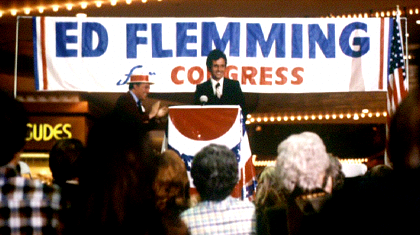
Big Ray Young has the unforgettable role of campaign manager/bodyguard Wayne Mulligan for politician Ed Flemming. It would be easy to have his character step way over the line into thug territory, but writer-director Lieberman does not give us any obvious bad guys to condemn. Young’s most outrageous scene unintentionally became something of a death-to-disco/pro-punk statement. 


Of course, Mark Goddard is best known as Major Don West from the CBS television series Lost in Space (1965-68). Goddard is really good here as aspiring congressman Ed Flemming. Goddard does not play an outright jerk. There is actually no behavior we see on his part that seems unreasonable. It is only his character’s past, like that of many others in this story, which is questionable. 

This is a movie about a menace resulting from a cultural trend. Back in 1978, Blue Sunshine based its horror on the long-term results of past recreational drug use. In retrospect, the real horror of this yarn is that nowadays politician Ed Flemming’s potential scandal would probably be excused or denied by all the media, politicians, and voters on his side of the political fence, regardless of the proof. We don’t need drugs anymore to alter our perceptions of reality, just the addiction to overpaid talking heads pandering to a market.

Monday, August 7, 2023

THE ROGUES' TAVERN (1936)


Director: Robert F. Hill (as Bob Hill)

Writer: Al Martin

Producer: Sam Katzman

Cast: Wallace Ford, Barbara Pepper, Joan Woodbury, Clara Kimball Young, John Elliot, Jack Mulhall, Ed Cassidy, John Cowell, Arthur Loft, Earl Dwire, Ivo Henderson, Silver Wolf (the dog) 

Jimmy Kelly (Wallace Ford) and Marjorie Burns (Barbara Pepper) are an eager-to-marry traveling couple. They head just over the US border into Canada to meet up with the nearest justice of the peace at the Red Rock Tavern. The remote country inn is full up with an assortment of recently arrived guests. Those guests are soon being killed one by one and found with animal bites on their throats. Since Jimmy is a police detective and his fiancée Marjorie used to be a department store detective, they take it upon themselves to try solving this weird case. 

The Flashback Fanatic movie review 

The Rogues’ Tavern is a lighthearted example of an old stage and movie staple: the old-dark-house thriller. Many horror films of the 1920s and 1930s relied on the atmospheric setting of an isolated mansion full of family and guests stranded there during foul weather. That usually meant that bridges and roads would be washed out and telephone lines would be down. Often, it was villainous hands intentionally disabling those phone lines. That kept a killer’s potential victims close at hand and unable to summon help. Over the years, many more films followed this deadly logic. 1980’s Friday the 13th actually swapped out the old, dark house for its remote campground setting. 

Director Robert F. Hill knew his way around these creepy contrivances. He had assisted in the script adaptation of the stage play The Cat and the Canary for the 1927 Universal Pictures silent film that was a classic template for movies of this sort. Here, as in most thrillers of this type, the gloom and danger mingle with eccentric characters and snappy banter. 

Wallace Ford was a vaudeville performer and Broadway actor during the 1920s. He embarked on a long and prolific film-acting career in 1931. He usually displayed a common man’s streetwise brashness and humor. Horror fans remember him in such productions as Freaks (1932), One Frightened Night (1935), The Mummy’s Hand (1940), The Mummy’s Tomb (1943), and The Ape Man (1943). As detective Jimmy Kelly, Ford cracks wise throughout The Rogues’ Tavern. 

Most of Ford’s quips are directed at his super-cute co-star Barbara Pepper as his fiancée Marjorie Burns. It is the kidding and exasperation between these two that enlivens the tavern-bound proceedings. Pepper is best known for her late-career role as Doris Ziffel from 1965 to 1968 on the Green Acres CBS television series (1965-71). 


Gorgeous Joan Woodbury is a sultry and hysterical presence as Gloria Robloff. At first, she seems like a mystic sage with her cards portending doom for another Red Rock Tavern guest. The camera moves in to her close-up as she stares back at us with seemingly unflappable, sinister wisdom. Before long, however, her demeanor does a complete 180, as if her fatalism has reached the saturation point, and she is drenched in a cold sweat of morbid panic throughout the rest of the picture. Instability be damned. In that provocative dress, Joan Woodbury can get away with murder, as far as I’m concerned. 


The rest of the Red Rock Tavern guests are a pretty colorless bunch. They all seem to be somehow acquainted with each other, despite all arriving from different cities in the United States. We soon learn that they have all been summoned to the inn for an unknown purpose. Once their well-gnawed bodies start turning up, that purpose becomes clear. 

Clara Kimball Young and John Elliot play the middle-aged Jamison couple who own the Red Rock Tavern. These two characters probably set the world record for the most furtive and wary sidelong glances in a film. Of course, since Mr. Jamison is an invalid, that makes him immediately suspect. In the murder mystery genre, the handicapped character seemingly the least able to commit murder is often the most scrutinized as a possible faker. Then again, that makes him too obvious a suspect as the one who should not be guilty, so he couldn’t be the killer, right? But what if the filmmakers are trying to outsmart our cynicism by making the obvious red herring actually be the killer? Geez, it’s enough to drive this armchair detective to drink. Actually, what I find to be the most impenetrable mystery at the Red Rock Tavern is that there isn’t a drop of booze to be found in the joint. Maybe Mrs. Jamison spikes the coffee. 

Apart from the Ford-Pepper banter and Joan Woodbury’s pulchritude, what distinguishes The Rogues’ Tavern is the weird menace angle. Chewed up throats is a strange and nasty way to off people. Of course, the part-wolf dog (Silver Wolf) hanging around the Red Rock Tavern is an obvious suspect. Dog lover that I am, I’d have to see the pooch mangling victims with my own two Woodbury-oglers before I could accuse man’s best friend. 

The Rogues’ Tavern is a fun example of the short, low-budget thrillers that were churned out in the 1930s and are largely forgotten today. Their attitude is quite unlike what anyone bothers to attempt anymore when making movies. Most of these quickies were just meant to be a light entertainment mixing humor, horror, mystery, and romance. Sometimes they are the perfect change of pace from today’s overblown and cynical mainstream product.

Sunday, July 30, 2023

THE MAJORETTES (1985/released 1987), aka ONE BY ONE

Director: Bill Hinzman

Writer: John Russo adapting his novel

Producer: John Russo

Cast: Kevin Kindlin, Terrie Godfrey, Sueanne Seamens, Denise Huot, Tom E. Desrocher, Carl Hetrick, Mark V. Jevicky, Mary Jo Limpert, Harold K. Keller, Zachary Mott, Tom Madden, M. Therian, Jacqueline Bowman, Colin Martin, Russ Streiner, Tammy Petruska, Dana Maiello, Gina Cotton, Angela Eckerd, Angela Canalungo, Teresa Almendarez, Edna Kleitz, Joy Deco, George Brennan, Joe Blakely, Earl Brandstadter, John Russo, Bill Hinzman, Amy Mathesiuf, Wilbur Roncone, Daryl Darak, Robert Lintner, Abby Roach, Jay Ross, Dave Gordon 

High school majorettes are being stalked and killed. Part of the killer’s deadly ritual involves immersion of his victims’ bodies in water. The murders set off ripples throughout the small town that disrupt the lives of the victims’ classmates and some very unsavory characters. 

The Flashback Fanatic movie review 

When Night of the Living Dead (1968) alumni John Russo, Bill Hinzman, and Russ Streiner held a reunion to make The Majorettes, they played the slasher game pretty late in that horror subgenre’s season. Being filmed several years past the slasher film’s peak of popularity and not released for two more years, some may attribute its modest reputation to slasher film burnout at the box office, though home video was probably intended as its main outlet. Others still devoted to that style of horror were probably frustrated that The Majorettes was not just more of the same. 

As it is based on John Russo’s 1979 novel that was published before the slasher film had established a formula, The Majorettes has a more complex narrative and a wider range of character concerns than the typical slasher flick. It is not just a series of nasty kills, but about an assortment of characters that conflict with one another and react in surprising ways. The murderer of the majorettes is the catalyst for those confrontations. That may seem like a film lacking focus, but I see it as a welcome variation for the slasher film. This movie has intrigue beyond waiting for the reveal of the killer’s identity. 

One thing that I appreciate about John Russo’s writing, in both his novels and his films, is that his characters are not idealized. They usually come from mundane circumstances, and many of his characters are both petty and principled. No one is grandstanding as heroic or sympathetic. They are just living their lives as horror intrudes. 

A good example of the messy morality of Russo’s characters is the majorette Nicole (Jacqueline Bowman) that comes on to the nerdy photographer Tommy (Colin Martin). She is doing this out of fear and confusion resulting from a recent, unwanted pregnancy. Nicole thinks that, if she has sex with Tommy, she will have a more responsible person to blame the pregnancy on instead of the local drug pusher Mace Jackson (Tom E. Desrocher). Yet Nicole’s conscience does not allow her to follow through on her seduction. 

Kevin Kindlin plays the closest thing to a hero in The Majorettes. His character is the star high school quarterback Jeff Halloway. He is bickering with his majorette girlfriend Judy Marino (Sueanne Seamens) about their future together if Jeff goes off to college out of town. Both have legitimate motivations for their friction. These disputes are not integral to the plot, but they ground us in the reality of the life and times of these two characters. That is something that many more “focused” films don’t bother to do. When everything seems too deliberate, a film can seem contrived instead of relatable. 

Later, The Majorettes again loses its focus as a pure slasher film when Jeff is repeatedly traumatized by a succession of brutal events and retaliates. At that point the film veers into “Rambo” territory, yet it all plays out in a much less sensational fashion that seems all too likely these days. Jeff is never glorified in that action hero mode. He is just a high school kid that snaps. 

That is not to say that all of writer John Russo’s characters are sympathetic. He is never remiss to include scumbags, perverts, and sociopaths in his stories. There is no shortage of them in The Majorettes. They figure into some subplots that create a bit of complexity I can appreciate as a variation on typical slasher films. However, they also contribute to that loss of focus whined about by slasher purists. 

Even this film’s original title seems contrary to the genre. It does not follow the holiday-titled tradition that provided an almost perverse contrast to the horror in many previous slasher films. Its title is also not designating its bloody intent. While The Majorettes makes its youth-centric concerns apparent, it also sounds like a likely title for a teen-sex comedy. I find it morbidly appropriate to title the film with the innocent triggers and targets of the madman’s atrocities. 


And what of our majorette-mauling madman? He is the catalyst for all sorts of suspicions and repercussions among the cast of characters. Like many horror films, the menace is of interest because his transgressive behavior disrupts society. He is an element of chaos that not only threatens public safety, but also causes complications for other nefarious locals. It is an uneasy reminder of just how flawed and fragile civilization really is. This is reinforced by the killer’s so-called values that many would believe help maintain social stability. 

We are also not comforted by the agents of social order in this film. Few of the adults seem to have meaningful interaction with the teens. The parents are rarely present. Members of the faculty, clergy, and law enforcement are portrayed as suspicious or ineffectual. While there are some well-meaning people around doing their jobs, they can’t always be counted on to save the day. 

For those who have read the original novel, this fairly faithful adaptation still has a different resolution, so all is not spoiled when they watch the film. The Majorettes ends with a lingering sense of dread that is not unusual for horror in the last half century. That should come as no surprise from some talents involved in the classic Night of the Living Dead that helped set that uneasy standard in horror movies.

DETOUR (1945)

Director: Edgar G. Ulmer Writer: Martin Goldsmith (and uncredited Martin Mooney) adapting Martin Goldsmith’s 1939 novel Detour: An Extraor...