Wednesday, May 7, 2025

THE SIX MILLION DOLLAR MAN (1973)

Director: Richard Irving

Writers: Henri Simoun (Howard Rodman) adapting Martin Caidin’s novel Cyborg

Producer: Richard Irving  

Cast: Lee Majors, Martin Balsam, Darren McGavin, Barbara Anderson, Ivor Barry, Charles Knox Robinson, Anne Whitfield, Maurice Sherbanee, Robert Cornthwaite, Olan Soulé, Dorothy Greene, Norma Storch, George Wallace, John Mark Robinson

Former astronaut Steve Austin (Lee Majors) crashes during his test flight of an experimental aircraft for NASA. His injuries include the loss of his left eye, right arm, and both legs. Austin’s friend and attending physician, Dr. Rudy Wells (Martin Balsam), is approached by Oliver Spencer (Darren McGavin), the director of a government agency called the Office of Strategic Operations. Spencer is aware of Dr. Wells’ theories regarding the replacement of human limbs with functioning, lifelike, mechanical substitutes. He supplies Dr. Wells the millions of dollars needed to reconstruct Steve Austin into a cyborg (part man and part machine). After the surgery and recuperation, Spencer wants to employ Austin’s cyborg abilities on special missions for the OSO. However, Steve Austin is despondent about his strange, new condition and is reluctant to have any more to do with the government.

The Flashback Fanatic movie review

The Six Million Dollar Man has always been a favorite movie of mine. When this boob tube brat saw its first broadcast on the ABC network, I just knew that it had to become a series. At that time, I had no idea that television films were ever made in the hope that high ratings would justify the development of an ongoing series; I was just so buzzed about it that I thought fate somehow had to intervene to make me happy by providing a weekly dose of this as a new video vice. Aside from its status as the pilot for the iconic 1970s television series (which inspired a succession of other superhero programs), The Six Million Dollar Man is terrific as a stand-alone science fiction film and was nominated for a 1974 Hugo Award.

This TV-movie is a streamlined adaptation of Martin Caidin’s 1972 novel Cyborg. He would write three sequel novels about his part-man and part-machine hero, Steve Austin. Caidin had an aviation and aeronautics background and wrote novels about World War II and space travel. His science fiction included current technological innovations and their future development and application. Caidin’s earlier 1964 novel Marooned (about the attempt to rescue NASA astronauts orbiting the Earth) had been made into the 1969 movie. Caidin first used the word “bionics” in his 1968 science fiction novel The God Machine, but he did not actually invent that term. (Don’t feel bad; I only just discovered that on my smart phone a minute ago.) Of course, it is The Six Million Dollar Man television series that made bionics a household word. Although Caidin’s novel refers to the technology implanted into his hero’s body as bionics, that term is never used in this pilot film.

The opening scene of the movie is the desert-based airstrip where NASA and the U.S. military are about to conduct an experimental test flight. This is the setup for the tragedy that puts the plot in motion and establishes the plight for our hero, former astronaut and test pilot Steve Austin. He makes a distinctive entrance that establishes his personality and foreshadows his fate. We first see Steve Austin as a lone figure approaching from a distance on a morning stroll returning from the barren desert onto the airstrip. This visually suggests Austin’s independence and his imminent isolation as a technological prototype which will eventually lead him to another even more lonely and dangerous desert-bound mission. We see Austin’s camaraderie while he makes small talk with the other NASA personnel as he returns, and we enjoy his nonchalance that irks the uptight general at the airstrip. Austin is immediately established as down-to-earth, confident, and likable. This is efficient storytelling and character building that puts us squarely on Austin’s side within the film’s first few minutes.


Steve Austin’s tragic test flight is very well realized with plenty of NASA stock footage intercut with Austin at the aircraft’s controls and radio chatter between him, escort planes, and the ground crew. The final footage of the ill-fated test flight is of an actual 1967 crash of the M2-F2 lifting body aircraft. That real accident’s NASA test pilot was Bruce Peterson. He was badly injured but recovered. Unfortunately, Peterson lost the sight in one eye due to an infection in the hospital.

Lee Majors was perfect casting for Steve Austin. He has the rugged good looks and athleticism that suit an action hero. Most importantly, Majors has a likability that has us rooting for him while he maintains some emotional reserve that makes us believe he has the discipline and stability to be capable of heroism. Before his acting career, Majors suffered a serious back injury playing college football that left him paralyzed from the waist down for two weeks. One must wonder if the memory of that trauma and the awful suspense of recuperation informed Lee Majors’ performance as the maimed and hospitalized Steve Austin. By 1973 Majors had already starred in three television series and would go on to star in several more. It is with this pilot film of The Six Million Dollar Man that Lee Majors begins his most famous role.


Martin Balsam’s movie immortality was already established as the private detective Milton Arbogast in Alfred Hitchcock’s classic Psycho (1960). He provides great support as Austin’s friend and physician, Dr. Rudy Wells. It is his character’s medical genius that restores our damaged hero to a full-bodied, superhuman state. Balsam’s narration as Wells immediately creates a sense of foreboding as the story begins and later explains the pioneering technology used to rebuild Steve Austin. Balsam’s Dr. Wells is both brilliant and compassionate. In the subsequent series, the role of Wells would be played by Alan Oppenheimer and Martin E. Brooks.

The great Darren McGavin appears in the crucial role of Oliver Spencer, the callous, government bureaucrat that has been planning to fund a cyborg project to create technologically enhanced humans for espionage and military operations. Spencer decides that Steve Austin’s catastrophe presents the perfect subject for a cyborg prototype. Spencer practically steamrolls over Dr. Wells when he presents him the proposition to turn the comatose Steve Austin into a cyborg. McGavin’s performance as the heartlessly pragmatic Spencer is a joy to watch. This role was just one year after McGavin had first portrayed the more admirable character of newspaper reporter Carl Kolchak in the record-setting TV-ratings blockbuster The Night Stalker (1972). That fine film would lead to a sequel, The Night Strangler (1973), and then the weekly series, Kolchak: The Night Stalker (1974-75).

During Steve Austin’s recuperation and reconstruction, Jean Manners is his personal nurse. Her affection for her patient makes the physically rebuilt, emotionally damaged Austin confront his new self-image as a once ideal specimen of manhood that is now partly artificial. Jean Manners is played by incandescent-eyed Barbara Anderson. She had guest-starred on many television series and won the Primetime Emmy Award for her ongoing supporting role of Police Officer Eve Whitfield in the series Ironside (1967-71).


One of my favorite scenes of any sci-fi film occurs after Dr. Wells and his team have performed the surgery attaching Steve Austin’s artificial limbs. Austin regains consciousness and weakly quips to Wells, “Dr. Frankenstein, I presume?” The rest of the scene plays without dialogue as we see Austin lying in his hospital bed coping with the strange sensations of his new cyborg body and his mental struggle to make his mechanical attachments respond. As his new arm rises into his field of vision, Austin’s expression passes from strain to horror to hope. Majors, Balsam, and Anderson give very moving silent performances underscored by the awe generated with Gil Mellé’s idiosyncratic and powerful music.

Some departures from the source novel concern Steve Austin’s cyborg modifications. I am guessing that Austin in the movie has his right arm rather than the left arm replaced because actor Lee Majors was probably right-handed. In the novel, Austin’s artificial eye could not see, but it could take photographs with an enclosed miniature camera. Similarly, his bionics limbs had compartments concealing devices, such as an underwater breathing apparatus in his leg and retractable swimming flippers in his feet. The middle finger of his bionics hand could shoot poisoned darts. While Austin’s bionics limbs of the novel were tireless and formidable weapons, they were made much more powerful in the film. Lee Majors’ character can run sixty miles per hour and tear off car doors. His artificial eye can not only replicate human vision, but in the later episodes it can see in the dark and has zoom in capability over long distances or for up-close detail.

There are also interesting and effective character alterations from the Cyborg source novel. The ruthless Oliver Spencer originates in the TV-movie and provides more immediate dramatic conflict with the characters of Steve Austin and Dr. Rudy Wells than any government official does in the novel. Spencer’s agenda as the OSO director to develop Austin as a weapon is not enthusiastically received by either Wells or Austin. The movie also modifies Steve Austin’s character; he is a civilian member of the space program instead of a military colonel. This establishes Austin as a man not accustomed to military protocol, which makes him apprehensive about what the government and Oliver Spencer have planned for him. These changes in a simplified movie plot dial up the drama to deal with a couple more character concerns than the novel. Conversely, the ongoing television series would replace OSO director Oliver Spencer with the novel’s less antagonistic Oscar Goldman (Richard Anderson) as director of the OSI (Office of Scientific Intelligence) and make Austin a USAF Colonel, after all.

While the film’s Steve Austin suffers the same accident and reconstruction as the novel’s character, he is made a bit more sympathetic. In the novel, Austin is chiefly concerned with his ability to gain mastery over the new technology that has been attached to him. He is also angered by his initial helplessness and fears that his manhood and virility are diminished by so much of his original body having been destroyed. The Austin of the film has those same emotions, but as he is not a member of the military, he is more suspect of the government and averse to killing. Despite the character’s trauma and frustrations, Lee Majors makes his Steve Austin more appealing than the somewhat surly and cold-blooded character of the novel.

It is Steve Austin’s ambivalence in the film that creates more tension for us during the mission Oliver Spencer assigns him. We wonder how capable and determined Austin will be when he is sent out into the desert of Saudi Arabia to rescue an important hostage held by terrorists.


The Six Million Dollar Man is another fine example of the compelling science fiction films that were being made in the early 1970s. I think science fiction should not just be a genre used to create fantasy worlds; it can speculate about the real-world consequences of scientific developments and their impact on individuals and society. Although this film depicts potential benefits of man merging with technology, it also stresses humanity and independence. As we become ever more dependent on technology, we must maintain and protect those vital human attributes.

Monday, April 28, 2025

BURIAL GROUND (1981), aka THE NIGHTS OF TERROR

Director: Anrdea Bianchi

Writer: Piero Regnoli

Producer: Gabriele Crisanti

Cast: Mariangela Giordano, Peter Bark, Karin Well, Cianluigi Chirizzi, Simone Mattioli, Antonella Antinori, Roberto Caporali, Claudio Zucchet, Anna Valente, Renato Barbieri

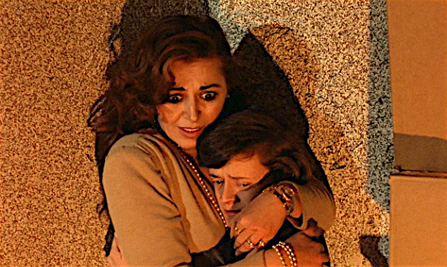
A professor (Renato Barbieri) is studying Etruscan magic at his friend’s Italian country estate. While exploring a nearby catacomb, he accidentally rouses a horde of dead monks back to life and is killed by them. George Conte (Roberto Caporali), the owner of the estate, returns with his lover Evelyn (Mariangela Giordano) and her young son Michael (Peter Bark) along with two other couples as his houseguests. They are soon besieged by the reanimated, rotting corpses that are hungry for their flesh.

The Flashback Fanatic movie review

In 1968, director George A. Romero, along with co-writer John Russo, introduced cannibal zombies to the world in Night of the Living Dead. In the ’70s there were several Spanish films, such as director Amando de Ossorio’s Blind Dead series and the Paul Naschy starring Horror Rises from the Tomb (1973), that may have been influenced by Romero’s seminal film. However, they were not without their own unique quirks and hardly just rip-offs. This slow and sporadic influence may have been because Night of the Living Dead was not an immediate blockbuster, but rather a film of limited releases and rereleases over the years that eventually made it into a cult film whose huge influence could not have been imagined.

It was the immediate success of Romero’s 1978 sequel, Dawn of the Dead, which really turned cannibal zombies into a worldwide horror trope and incited a horde of bloody imitators. In the ’70s and ’80s, the Italians always seemed ready to exploit the latest movie trends with their own takes on proven money-making subjects. Italian director Lucio Fulci’s Zombie (1979) was one of the first Euro-horrors to follow the Dawn of the Dead trend. Andrea Bianchi’s Burial Ground soon followed.

Burial Ground is a zombie movie about the things that typify the modern zombie film. This film does not really tell a story; it just depicts a situation. We are shown a group of people trapped and trying to fight off an ever-growing mob of reanimated corpses that are trying to eat them. Director Bianchi also manages to add some sex and perversity to the formula. If this is all you require for eighty-five minutes to be entertained, you should be satisfied, but that’s all you get.

With a setup this basic, it’s all about the execution and a few bizarre variations to make this film at all memorable. The characters are barely even one-dimensional, and most are never given last names (the professor is called Prof. Ayers only in the English dub). The three couples all seem to be of that well-to-do or professional status that typifies victims in the Italian giallo films. They all have the same idea as soon as they arrive at the isolated country estate: going to their separate rooms and having sex.


There are absolutely no character traits of any interest in these people except for the strange looking Michael. He is played by the small and slightly built adult actor Peter Bark as an odd boy of indeterminate age that has an incestuous fixation on his beautiful mother, Evelyn. It is Michael, and his increasingly uncomfortable scenes with his mother, that have made this film notable and a bit notorious. His final scene with her is one for the horror history books.

Regarding the zombies themselves, we are given no reason for their reanimation. The professor removes some sort of stone tablet from the catacomb that he is exploring and returns to the study at his friend’s estate to examine it. While comparing it to some documents, he arrives at one of those “Oh shit!” revelations. However, we are never privy to just what the professor has discovered. He returns to the catacomb that night and then becomes a midnight snack for the first zombie monks. At least, they appear to be monks as they are all wearing loose robes. It is mentioned later that the professor was studying Etruscan magic regarding the “survival of the dead.” That is all the explanation we get for this undead phenomenon.


The zombies are in various states of decay and no zombie resembles another. A few of them seem to be fairly recently deceased, yet rotten, while others are so decayed that they barely look human. Like their Romero movie inspirations, they need to have their heads destroyed to put them out of action, but they ooze brown liquid from their wounds and their skulls bust open like piñatas if struck hard enough. Although they are slow moving, these zombies can work in unison to use a log as a battering ram and wield gardening tools with deadly efficiency.


Most of the film’s main action takes place in a sumptuous mansion and its picturesque grounds. This interesting location is Villa Parisi, a grand 17th-century country estate. It has been featured in many other Italian productions such as Nightmare Castle (1965), Bay of Blood (1971), Blood for Dracula (1974), and Patrick Still Lives (1980). It seems a shame that these randy couples can’t take full advantage of this setting’s hospitality for an entire weekend of sex and sucking down that J&B Scotch instead of ending up on the menu for undead party crashers.

Elsio Mancuso and Burt Rexon provide an interesting score that alternates between some moody and intriguing synthesized music, horror stingers, and a lively cool jazz theme that plays under the opening credits while the main cast drives to the estate.

Director Andrea Bianchi strives to make Burial Ground a simple and derivative product that exploits the recent popularity of Romero’s Dead films with none of the social satire or commentary. It is only the addition of the Peter/Evelyn relationship that distinguishes this movie from other zombie horror films. Bianchi’s 1975 giallo, Strip Nude for Your Killer, was also rather generic, but still served generous dollops of sex and violence to satisfy the connoisseurs of that genre.

Burial Ground is the zombie film stripped down to its non-plot essentials. As such, it may seem too simplistic and monotonous to maintain interest in the seasoned horror fan, or it may still disturb with its utter nihilism. Its main claim to infamy is that it takes titillation in a surprising, new direction. Remember, ladies, it’s never a good idea to serve milkshakes to a zombie.

Sunday, April 20, 2025

ALL ABOUT EVE (1950)

Director: Joseph L. Mankiewicz

Writers: Joseph L. Mankiewicz adapting Mary Orr’s short story “The Wisdom of Eve”

Producer: Darryl F. Zanuck

Cast: Bette Davis, Anne Baxter, George Sanders, Gary Merrill, Celeste Holm, Hugh Marlowe, Thelma Ritter, Gregory Ratoff, Marilyn Monroe, Barbara Bates, Walter Hampden

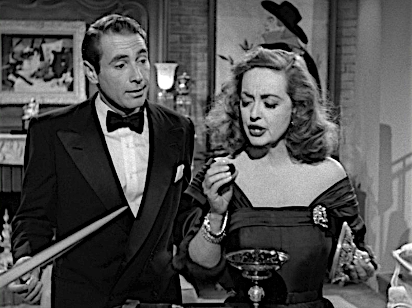
Broadway theatre star Margo Channing (Bette Davis) is troubled by her entry into middle age. Margo’s friend Karen Richards (Celeste Holm) introduces her to a young, lonely, and ardent fan named Eve Harrington (Anne Baxter). Eve ingratiates herself to Margo and her circle of friends and becomes Margo’s personal assistant. However, the pretty and ambitious young Eve exacerbates Margo’s insecurities.

The Flashback Fanatic movie review

Occasionally, my regular cinematic diet of vintage schlock and offbeat genre fare must be fortified with acknowledged mainstream classics. During such lapses of my bad taste, this immature film fan must sit up straight and eat everything on my plate because it’s good for me. My latest order for a well-balanced and nutritious movie meal was the justly revered All About Eve.

I had almost no preconceptions about this film or its subject matter. I knew that it starred Bette Davis in a great role and that it was considered a great film. Since Bette Davis is a classic movie legend, I thought it was high time that I found out what all the fuss was about. The only other thing I knew about this film was that it gave George Sanders the part that won him the Best Supporting Actor Oscar. I have appreciated the smooth and sardonic wit that Sanders can deliver better than anyone, which he demonstrated as hero Simon Templar in The Saint film series, so he was another factor drawing me to this film for the first time.


All About Eve could have tipped over into maudlin melodrama, yet it is much too nimble and cynical for that. That is not to say that it is just a snarkfest loaded with posturing by so-called characters meant to reassure us all that being presumptuous and conformist is some form of strength. All About Eve has some characters with decent sentiments and insecurities. They can be fallible or flawed, and even friends and lovers may have conflicts with each other that may be resolved by nothing more deliberate than just a cooling-off period. Most of the story’s cynicism is directed at the machinations and egos of some in the theatre and motion picture industry.

Margo Channing was the comeback role for Bette Davis that fit her like a glove. She was not the first choice for the role, but no one could have been more suited for it. As an aging film star herself, Davis may have had concerns that her best days career-wise were behind her. Davis certainly addresses such anxieties in her performance without losing our sympathy. This really surprised me, as I thought her Margo Channing would turn out to be the flamboyant diva that we would love to hate. Bette Davis’s irascible temperament provides the humorous grit the character needs, but her role is written and performed with enough sensitivity to make us engaged rather than judgmental. Nevertheless, that Bette Davis star power is burning brighter than ever when she utters that now-classic film quote, “Fasten your seatbelts. It’s going to be a bumpy night.”


As Eve Harrington, Anne Baxter plays the title character in All About Eve that, initially, seems to be the least interesting. She has some surprises in store for us and prompts theatre diva Margo Channing to confront some of her own fears and develop some perspective. Ironically, the character that Anne Baxter plays would steal some of the thunder from both Bette Davis’s character in the film and perhaps from Davis’s real-life accolades. Since both Davis and Baxter were nominated for the Best Actress Oscar Award for their roles in this film, it may have somehow given Judy Holliday the edge to win the Oscar for her role in Born Yesterday (1950). Bette Davis herself speculated that Gloria Swanson’s nomination (for the role of another aging actress in 1950’s Sunset Boulevard) may have helped to cancel out Davis’s Oscar chances. Did three great performances about actresses that year make each of them seem less Oscar-worthy?

George Sanders’ voice is so good that it could qualify as a special effect. As theatre critic Addison DeWitt, his sardonic narration sets the tone for this film perfectly. Of all the characters in this film, DeWitt ends up being the most surprising, yet this is not done as any sort of redemptive act. He is anything but heroic. He is simply someone that remains true to his character, yet, in doing so, enacts a strange form of justice. While DeWitt is too cynical and egotistical to be truly righteous, it is his moment of prideful indignation at this picture’s climax that must have won Sanders the Oscar.

I had only seen Gary Merrill in the episode “The Human Factor” of the science fiction television series The Outer Limits (1963-65). Here he plays Bill Sampson, the Broadway theatre director and lover of Bette Davis’s Margo Channing. Merrill’s Sampson delivers some very verbose repartee throughout the film. This is all very dramatic and amusing, yet it still rings true to me. After all, theatre folk are accustomed to the wielding of words on stage for emotionally pointed effect, so it stands to reason that such people would be able to express theirselves that way in an impromptu manner. In yet another case of life imitating art from All About Eve, Merrill and Davis, having met on this film, began a relationship that led to their marriage of ten years.

Celeste Holm has the role of the nicest person in the film as Margo’s best friend, Karen Richards. As the amusing observation of Addison DeWitt’s opening narration points out, Karen only became part of the theatre crowd when she married playwright Lloyd Richards. My cynicism was immediately roused at that point, and I assumed that she would be a conniving hanger-on, yet she manages to remain seemingly wholesome. Once again, this film does not dole out obvious character payoffs to the audience. Karen is the catalyst of the story when she introduces fawning fan Eve Harrington to her idol Margo Channing. As Karen seems to be a very decent person, we can empathize with some of the emotional stress she is put through by others exploiting her goodwill efforts.

As Karen’s husband and Margo Channing’s frequent playwright, Lloyd Richards, Hugh Marlowe gets into a great shouting match with his temperamental star. Marlowe usually seems like the earnest everyman character in his roles, but that certainly does not mean his roles lacked range. He is probably best known for playing the world’s biggest heel in the sci-fi classic The Day the Earth Stood Still (1951). Marlowe would heroically redeem himself by trying to save the world from another extraterrestrial threat in Earth vs. the Flying Saucers (1956).

Two small roles are performed by very noteworthy ladies. The reliably amusing and acerbic Thelma Ritter plays Birdie, Margo Channing’s maid. Ritter was just one of many highlights in that Alfred Hitchcock classic Rear Window (1954). All About Eve also features a young bit player by the name of Marilyn Monroe. (Perhaps you’ve heard of her.) In this early role, she appears as Claudia Casswell. We meet her as critic Addison DeWitt’s escort trying to charm her way into the entertainment industry by flirting and flaunting what she’s got.

With a great cast to embody writer-director Joseph L. Mankiewicz’s conflicted characters and deliver his smart dialogue, this picture may have seemed like a shoo-in for Best Picture, Best Screenplay, and Best Director honors at the Academy Awards. But even Mankiewicz himself has acknowledged that the 20th Century Fox producer he had so much contention with, Darryl F. Zanuck, also made contributions by honing and simplifying his films to make them more effective. It was also Zanuck who changed this film’s title from Best Performance to All About Eve.

According to Joseph L. Mankiewicz’s son, All About Eve expressed many of his filmmaker father’s misgivings about the entertainment industry. Mankiewicz seemed to have more respect for the theatre scene, but enjoyed the greater financial rewards of Hollywood filmmaking and the greater control he could exert over a film than a live stage performance. 

While he seemed disdainful of the Hollywood crowd, the married Mankiewicz didn’t mind cavorting with various Hollywood starlets. This obviously contributed to a very stressful homelife in the Mankiewicz household. The marital dysfunction with his ex-actress wife must have inspired much of the attitude the writer-director portrays in that great cocktail party scene at Margo Channing’s residence. A bumpy night indeed!

It is rather fitting that a filmmaker who had more respect for the world of Broadway stages than Hollywood film studios would win Academy Awards for a film about theatre talents that plays out like a stage drama. Mankiewicz thought that the writing and performances should carry the story. Aside from just a few establishing shots, nearly everything occurs in interior settings that would be ideal for a stage play. Yet All About Eve also uses close-ups to allow its players to share feelings with us through subtle facial expressions that punctuate great dialogue. That is the simple power that can make a film classic.


WARNING: COMMENTS CONTAIN SPOILERS!

Thursday, March 27, 2025

BERSERK (1967), aka BERSERK!

Director: Jim O’Connolly

Writers: Herman Cohen, Aben Kandel

Producer: Herman Cohen

Cast: Joan Crawford, Ty Hardin, Judy Geeson, Diana Dors, Michael Gough, Robert Hardy, Geoffrey Keen, George Claydon, Philip Madoc, Sydney Taffler, Ambrosine Philpotts, Thomas Cimarro, Milton Reid, Ted Lune, Golda Casimir, Peter Burton, Marianne Stone, Miki Iveria, Howard Goorney, Reginald Marsh, Bryan Pringle

During a performance at The Great Rivers Circus in England, tightrope walker Gaspar the Great (Thomas Cimarro) is killed in a gruesome accident. As a result, circus attendance soars. The steel-willed co-owner and ringmistress of the circus, Monica Rivers (Joan Crawford), appreciates the increase in revenue that the morbid publicity generates. But as more deaths to circus personnel occur, suspicion and fear spread among the circus performers.

The Flashback Fanatic movie review

Once again the team of producer Herman Cohen and his writing partner, Aben Kandel, provide more thrills and chills in 1967’s Berserk. During the 1960s, American filmmaker Cohen’s productions had settled in England, but they were still punching the audience’s panic buttons. The horror Cohen is pitching this time around has a circus setting. Many circus acts serve to pad out the film’s running time and add a lot of production value to make this B-film seem quite lavish. It is the Billy Smart Circus that provides many of the acts we see performed under the big top. Two other British-backed movies were also filmed in this famous venue: Circus of Horrors (1960) and Circus of Fear (1967).

Cohen’s Berserk provides even more spectacle with his chosen star: Joan Crawford. The Oscar-winning actress was entering the twilight of her career, but during the 1960s she had already appeared in a few successful shockers. In 1962’s What Ever Happened to Baby Jane?, Crawford co-starred with another aging Hollywood legend, Bette Davis. That hit film led to the “psycho-biddy” trend of thrillers starring older, established actresses usually playing against type. For horror-meister William Castle, Crawford starred in Straight-Jacket (1964) and I Saw What You Did (1965).

Supposedly, Joan Crawford’s clout prompted a title change for this film. Originally, it was called Circus of Blood, but Crawford suggested Berserk. That was certainly a memorable title that I’ll bet Crawford thought sounded a bit less exploitational. Her title would also keep this film from being confused with the previously made circus-based thrillers. What remains unknown is did Crawford suggest the title with or without an exclamation mark? The onscreen title has no punctuation, yet the posters for the film usually add an exclamation mark. Which is it?! It’s enough to drive this anal-retentive film fanatic berserk!

It seems that no matter what stage her career was at, or the intent of the material she was performing in, Joan Crawford always gave it her all. She did not think that headlining a lurid thriller made her any less of a star. In fact, Crawford quite rightly must have felt that her name was lending these productions a lot of prestige. She also thought that her fans must always perceive her as a star. Therefore, she had to give them a performance worthy of a star. In addition to her ballyhoo as the ringmistress announcing the acts and her take-charge demeanor with circus employees, Crawford deftly delivers a few saucy one-liners and subtle expressions that display her character’s worldly confidence.

Joan Crawford seems simpatico with her role in Berserk. Crawford was determined and relentless in achieving and maintaining her stardom. She channels that same resolve into her performance as the head of the circus that is the story’s setting. Her Monica Rivers is rather opportunistic about the bizarre death of her tightrope performer that has resulted in very profitable notoriety for her circus. Monica also demands that the show must go on, and it seems that her commanding presence is all that keeps the circus folk in line despite their paranoia. There are not a lot of shadings to her character or any others in this film, yet there is some ambiguity about them, which is appropriate in a mystery yarn.

For this horror fan, and a devotee of producer Herman Cohen’s flicks in particular, another name in this cast that gets my attention is Michael Gough. With Joan Crawford’s star power taking center stage, Gough is left with a supporting role instead of the villainous main attraction he had provided to distinguish Cohen’s previous Horrors of the Black Museum (1959), Konga (1961), and Black Zoo (1963). I find it quite interesting that Gough’s usual dominant and heartless role in a movie relationship is reversed in Berserk. Here his Albert Dorando is the subordinate and lovelorn business partner to Crawford’s Monica Rivers. Actor Gough performs an amusing about-face having the decency to criticize Crawford’s character for being cold-blooded about the tragedy that took the life of a circus performer. But fear not, Gough fans! The great Michael Gough’s vile villainy would be redeemed in the next Joan Crawford-starring Herman Cohen fright flick, Trog (1970).

Ty Hardin had starred as the hero on the ABC television network Western series Bronco (1959-62). Here Hardin plays hot-tempered Frank Hawkins, the handsome replacement for the deceased Gaspar the Great. Hawkins is suspect for not only conveniently showing up to replace the just-killed high-wire artist, he also is pretty deliberate about putting the moves on Monica Rivers. His proposition to become her business partner in the circus makes him appear up front about his ambitions, yet he still seems rather suspicious. While Hawkins acts frustrated with Monica’s reserve in their potential romance, we wonder if his urges are driven more by profit than passion.

The sexy standout in Berserk is Diana Dors. Once groomed to be the British alternative to Marilyn Monroe, Dors provides plenty of sparks to justify her blonde bombshell status. As Matilda, the assistant to the magician Lazlo (Philip Madoc), she is the circus sexpot and troublemaker. Whether she is trying to seduce the Magnificent Hawkins, badmouthing the magician she lives with, spreading malicious gossip, or getting into catfights, Matilda is probably my favorite character in Berserk. Any bodacious babe who drops by with notions of nookie in her noggin and brings her own booze is still a class act in my book.


Judy Geeson shows up as Angela Rivers, Monica’s just-booted-from-boarding school daughter. Angela’s reunion with her mother serves to soften the edges of the Monica Rivers character, making the hard-nosed circus owner a bit more sympathetic. This also seems to be following the Herman Cohen formula for having youthful characters prominent in his horror films.


Like many giallo films, or the slasher films that they would inspire, Berserk has us playing the whodunit guessing game. The oh so dapper Detective Supt. Brooks makes sure that we are mulling over the various suspects. As was often the case in Cohen’s films and horror movies in general, the officers of the law are diligent but largely ineffectual. Nevertheless, I enjoy Robert Hardy’s smooth assurance as Brooks. He convinces us that having him tag along with the Rivers Circus should reveal the killer. In the meantime, Brooks displays the smoothest fast draw I’ve ever seen when lighting Monica’s cigarettes. Although some may regard the police procedural antics as just padding, I appreciate that the authorities dealing with fright flick atrocities are often out of their depth. This lends a lasting sense of chaos and unease to the proceedings.


Ultimately, Berserk is simply a showcase for Joan Crawford that kills time with circus acts and squabbles between the murders. Fully enjoying the film requires one to appreciate being part of that circus lifestyle for an hour and a half. I am all too happy to settle for this vicarious video experience. Although my immaturity means that I am never too old to consider running away to join the circus, unless I could land a sideshow gig as the Great Couch Potato, I would probably end up pounding tent stakes and shoveling up elephant droppings.


TARANTULA (1955)

Director: Jack Arnold Writers: Robert M. Fresco, Martin Merkeley, Jack Arnold, adapting Robert M. Fresco’s “No Food for Thought” script us...